
New hope for stroke patients
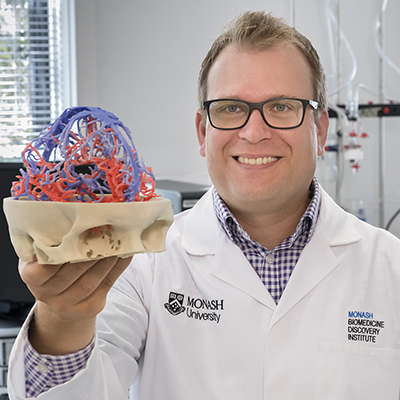
Stroke is one of Australia’s biggest killers and a leading cause of disability. Stroke is treatable, however treatments are time critical and currently only a limited number of Australians have access. Some of the most recent advancements in ischemic stroke treatment – strokes caused by a clot – must still be carried out within the first few hours of a stroke.*
A seven-year research project, co-led by Monash Biomedicine Discovery Institute’s Dr Brad Broughton, with researchers from La Trobe University, The Ritchie Centre, ARMI and Monash Health found that when human amnion epithelial cells – the cells lining the human amniotic sac during pregnancy and discarded after birth – were injected after stroke, impact was less severe and recovery was significantly improved.
The findings were published in the high impact journal, Stroke.
“When we intravenously administered human amnion epithelial cells 90 minutes after stroke, the cells migrated to the site of injury, and protected the brain from cell death as well as inflammation,” Dr Broughton said.
“But the most exciting finding from this research was that when the amniotic cells were injected as late as one or three days following stroke, there was increased healing within the brain and an improved rate of long term functional recovery,” he said.
Co-lead author, Professor Sobey, said why human amnion epithelial cells were particularly effective in cell therapy.
“These cells are abundant, they are discarded after birth and they don’t require any treatment before being used,” Professor Sobey said.
“They already contain natural immune-suppressants which means the patient’s body won’t reject them and they don’t form tumours – both issues with other forms of cell therapy,” he said.
A Monash Health team led by Director of Neurology at Monash Health and Associate Professor at Monash University, Dr Henry Ma, will soon commence a first-in-human trial in acute stroke patients to assess its feasibility and safety profile.
“The trial will be a great opportunity to translate this exciting research finding into clinical practice which may benefit stroke patients in the future,” Dr Ma said.
The research was part-funded by the Heart Foundation, CASS Foundation and National Health and Medical Research Council.
*Time critical stroke treatments
Thrombolysis – The 2017 Acute Stroke Audit found 36 per cent of patients reached hospital in a 4.5 hour time window from stroke onset for thrombolysis. 13 percent of appropriate patients received it.
Endovascular thrombectomy (mechanical removal of clot). Time frame is generally 6 hours. Endovascular thrombectomy services are delivered in 21 locations nationally – 12 of those are 24 hours, seven days a week.
Please contact Director of Neurology at Monash Health, Dr Henry Ma, about the in-human trial. Email henry.ma@monash.edu
Read the full paper in Stroke titled Acute or Delayed Systemic Administration of Human Amnion Epithelial Cells Improves Outcomes in Experimental Stroke