
Success at inaugural graduate student symposium
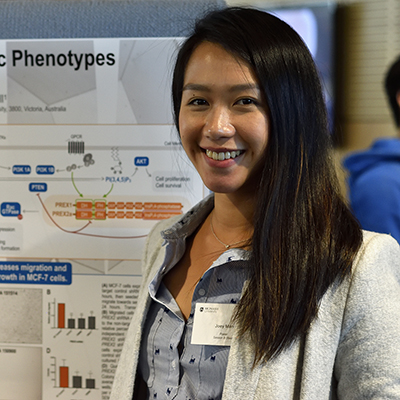
Photo credit: Steve Heaton.
The inaugural Monash Biomedicine Discovery Institute (BDI) Graduate Student Symposium offered our PhD students a chance to step back and see how they form part of the institute’s research engine – working towards making discoveries that will have a positive impact on people’s health. It also offered them the opportunity to learn more about each other’s research and be inspired by their colleagues’ work.
The Monash BDI Graduate Student Symposium was held over two days (12-13 June), and included a wide range of activities and presentations.
Dr Miranda Davies-Tuck, research fellow at the Hudson Institute of Medical Research, was keynote speaker at the Symposium. Dr Davies-Tuck spoke about her academic journey thus far, how she switched fields after six months of her PhD, the importance of good mentors, and how you can have a healthy work-life balance.
This year’s three minute thesis (3MT) competition was held during the symposium, drawing a large crowd to hear nine speakers from the five biomedical departments. The high quality of all of the 3MT talks made it difficult for the judges to declare the winners (listed below). The winners of the 3MT competition will go on to represent the Monash BDI at the Faculty 3MT competition.
Following the 3MT competition were the lightning and showcase presentations. These speakers had 10 and 15 minutes respectively to present their research, highlighting both the successes and the failures they have encountered along the way. The showcase presentations were the highlight of the entire Symposium. The 14 speakers all spoke clearly about their PhD research, communicating with their academically diverse audience and engaging them in their research. The insightful, probing questions that followed each of their talks proved how they caught the interest of their audience.
The Symposium also included a careers panel and poster presentations. Five volunteer judges adjudicated the posters, taking into account the content of the posters and the five-minute verbal explanations from each author.
Associate Professor Priscilla Johanesen, Director of the Monash BDI Graduate Program said that the symposium was a fantastic showcase of the research performed by graduate students across the institute. She commended the students on the successful running of the event.
“It really brought the student community together,” Associate Professor Johanesen said.
The Symposium was organised by the Monash BDI Graduate Student Committee. Blake Riley and Tess Malcolm, two of the event organisers, spoke on behalf of the committee about the success of the event.
“The inaugural Monash BDI Graduate Student Symposium was an outstanding success. We're incredibly proud of our fellow PhD students and their ability to clearly explain their research to such a diverse and skilled audience—it's a true credit to the calibre of the PhD students studying in the Institute,” Blake said.
“The Committee would like to extend a special thanks to the cast of volunteers who gave their time to this inaugural conference,” he said.
“The high calibre of student presentations reiterated the important role graduate students play within the institute, and the exceptional quality of research outputs generated by our peers. The breadth of research presented meant all attendees were exposed to new and exciting ideas and walked away learning something new," Tess said.
Monash BDI Director, Professor John Carroll congratulated all participants of the symposium.
"This is a great showcase of the research we do, and the critical contribution PhD students make to our research environment," Professor Carroll said.
Competition results
3MT competition
1st place – Ranga Siriwardhana, ‘The labour saviour: making the first cry a happy cry’
2nd place – Monica Goney, ‘Inhibin treatment to shield older women from bone and muscle loss’
People’s choice – Carina Dexter, ‘Acinetobacter baumanii: what’s your drinking personality?’
Student showcase presentation
Emily Gulliver, ‘The role of RNA chaperone ProQ in the Gram-negative bacterium Pasteurella multocida’
Lightning presentation
Tahnee Saunders, ‘Mitochondrial herniation and the release of DAMPs’
Poster presentation
- Gautham Balaji, ‘Recognition of host Clr-b by the inhibitory NKR-P1B receptor provides a basis for missing-self recognition’
- Katarzyna Gajewska, ‘Key role of the nuclear transporter Importin 13 in the oxidative stress response through relocalising cell survival regulators’
- Sayeeda Chowdhury, ‘Structural elucidation of chemokine-binding tick proteins’
- Rhys Colson, ‘Structural and functional analysis of the C. elegans TRIM protein NHL-2’