
Eyes on the stars, feet on the ground - An Interview with AI in Space 2023 Winner Rizka Purwanto
Eyes on the stars, feet on the ground - Dr Rizka Purwanto Wins Women in Artificial Intelligence (AI) Award 2023 in the AI in Space category
 Monash University, Indonesia’s Assistant Professor of Cybersecurity, Rizka Purwanto
Monash University, Indonesia’s Assistant Professor of Cybersecurity, Dr Rizka Purwanto, has recently emerged as a shining star in the field of artificial intelligence (AI) and space technology. Her dedication and work in space technology has captivated the attention of the academic and scientific communities and earned her the APAC Women in AI Award 2023. Dr Purwanto's research focuses on the application of artificial intelligence (AI) in space technology. After having conducted most of her research in Australia, Dr Purwanto remains an adjunct associate lecturer at UNSW Canberra Space. She has now returned to her home country, Indonesia, to contribute her expertise, inspire future generations, while maintaining her affiliation with UNSW Canberra Space.
In this interview, we delve into her work and explore the correlation between her expertise in space and her research interest in phishing, shedding light on her journey and inspiring words for aspiring young minds.
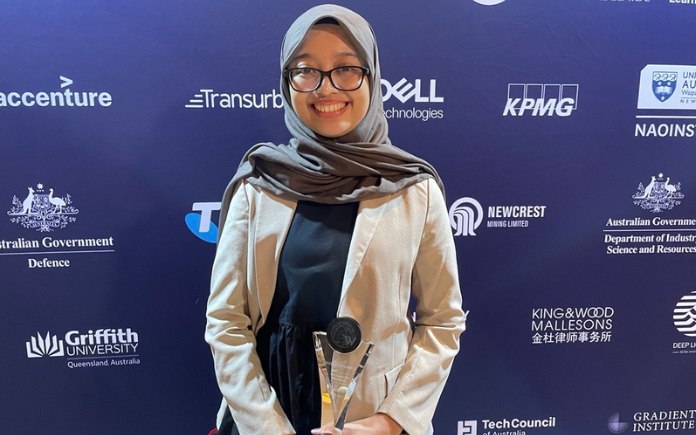
Dr Rizka Purwanto at the Awards Ceremony in Sydney on 16 June 2023.
Your recent work in AI specifically orbited around satellites. Now that you are working at Monash University, Indonesia, you have also shown research interest in phishing. Can you tell us more about your work in layperson's terms?
Nowadays, we have satellites the size of a bread loaf with sufficient resources to perform AI. I’m currently working on two projects in the area of AI in space. First, we are using AI on satellite constellations, where multiple satellites collaborate, communicate, and perform tasks more accurately and efficiently. This collaboration enables us to analyse satellite data and detect objects on Earth, aiding in the prevention and mitigation of disasters. For instance, we can pinpoint the locations of bushfires.
The second project involves utilising light curve data of satellites that are captured from telescopes. By extracting the light intensity patterns, we can employ AI algorithms to analyse and classify different types of space objects, such as lower Earth orbit (LEO) satellites or geostationary satellites. This application has implications for enhancing space situational awareness and contributing to space traffic management. Furthermore, my work in space can be extended to explore the cybersecurity aspect of the system, which aligns with my research interest in cybersecurity in general.
Actually, cybersecurity plays a pivotal role in space technology, especially nowadays as we increasingly rely on space systems in our daily lives. Thanks to space technology, we can connect to the Internet, have mobile phone signals, enjoy GPS systems to navigate us to places we have never been before, and make use of space systems for weather forecasting, earth observation, disaster management, and many other uses. Due to the importance of space systems, cyberattacks may cause various damaging consequences, from theft or manipulation of sensitive data, loss of control over spacecraft and satellites, disruption in global communications and navigation systems, to impacts on national security. For this reason, strong cybersecurity measures are essential to prevent these potential outcomes and ensure that space technologies can operate reliably. I’m currently teaching several courses in Monash University Indonesia, including Information and Computer Security, and Software Security which are essential and useful not only for space technologies, but also IT systems in general.
Tell us about yourself as a teen. What were your ambitions then?
I just knew that I liked maths and I loved physics. But I just didn’t really know what I wanted to do.
Friends would come to me and ask for help with their homework. I was happy when I could explain something until they understood and could apply it on their own homework. So, I thought I might be a teacher.
I have always been interested in space since I was little. I loved it - But the career options didn’t seem to be that wide in astronomy in Indonesia. I was just thinking pragmatically when I was younger. So I was in the computer science/ electrical engineering area.
And when I was just in my final year of my PhD I was looking for job opportunities and there was this one job that seemed so exciting which combined AI and Space. I didn’t really think I would get it, because I don’t really have that background. I was really lucky, I would say, because it turned out to be one of the best groups of people that I had ever worked with.
Fast forward to the first year of your PhD, during your first year working on your doctorate, what did you think the feature was holding for you?
I thought if I was sticking with computer science and electrical engineering, I would be working as an academic. Alternatively I was thinking I would love to go back to the industry as well, probably working as a machine learning engineer or data scientist - something like that.
But I think, you know, I don’t really know what the future holds. Sometimes we make plans and sometimes you get surprised in life.
There aren’t that many people in Indonesia that are working in the Space related field. Would you have some pointers for those interested to work in Space?
To be honest, I have been out of the country for quite a while. I don’t really know about Indonesian bodies that support this field of study. For now I can just recommend to keep looking, who knows, things can change very quickly. Otherwise, look abroad for opportunities.
But there is a lot of use for space technologies in Indonesia, as we are an archipelago and face many disasters. It would be very useful for Indonesia to make use of space technologies for that purpose.
I would of course love to work with NASA, if I can.
On a personal note, what is something you wish you had heard more as a young scientist starting out that resonates with you until today?
Sometimes it is really daunting to take chances. I didn’t think this would be for me.
Many people don’t want to pursue something because they don’t think they are good enough. But you should try.
And there are many times you don’t get what you want and do the things you really want, which is all fine.
But if you can and have the chance: recognise when to be brave.
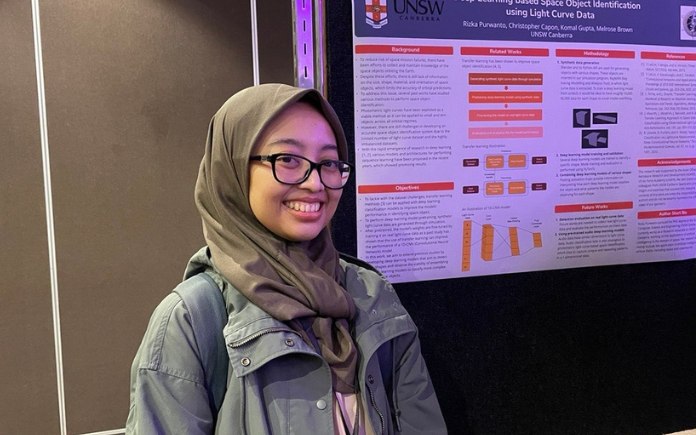 Dr Rizka Purwanto, lead author of the paper Deep Learning based Space Object Identification using Light Curve Data
MEDIA ENQUIRIES
Monash Media
E: media@monash.edu
T: +61 (0) 3 9903 4840