
Impactful Storytelling: The Blueprint for Social Change from Emmy® Winner Chris Schueler
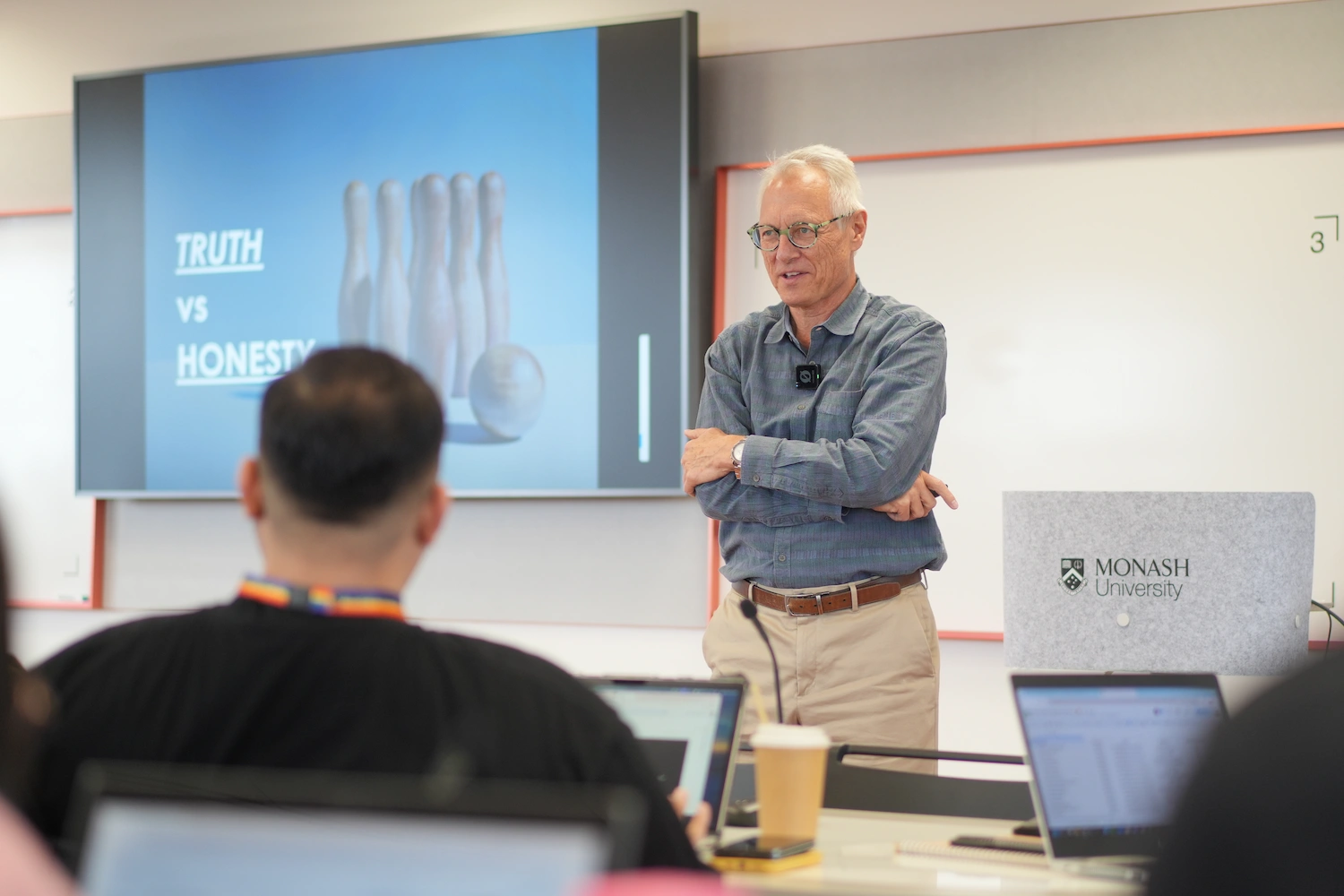 Chris Schueler delivering masterclass about impactful storytelling
BSD City, Tangerang – Emmy® Award-winning filmmaker Chris Schueler recently shared his strategic framework for creating media that drives social change during a masterclass at Monash University, Indonesia. Students from diverse master’s programs, including Global Business, Public Health, Public Policy and Management, and Marketing and Digital Communications, attended the session, which was organised by the Student Experience Operations Team. Schueler, whose decorated career spans over 100 projects focused on critical social issues like public health, youth empowerment, mental health, social justice, and environmental issues, holds 21 Emmy® Awards for Directing, Documentary, and Writing.
The masterclass offered a "powerful new toolkit" for future leaders, providing immediately applicable skills for initiatives ranging from public health policy to digital marketing campaigns.
The Core Thesis: Emotion is the Hook
Schueler’s foundational message challenged the traditional reliance on data alone, emphasising that "FACTS DO NOT WORK ALONE". While data is essential, "EMOTION is the Hook" that truly "CHANGES PERCEPTIONS". The ultimate objective for impactful storytelling is to "FIND AN IMPORTANT STORY THAT MAKES A DIFFERENCE IN PEOPLES LIVES".
Stories are effective because they provide examples that audiences can relate to, reinforcing the idea that example is the only thing necessary in influencing others. Media fundamentally shapes public opinion and drives behaviour change, with Mass Media creating knowledge and awareness, and Social Media (interpersonal media) forming and changing attitudes to motivate action.
The Change Pyramid: A Strategic Framework
At the heart of Schueler's methodology is the Change Pyramid, a comprehensive strategic framework designed to guide creators from the concept stage through to completion, ensuring every decision serves the ultimate purpose of creating change. This systematic structure demands strategic thinking before production begins.
The layers of the Change Pyramid build strategically:
- The Foundation (Purpose & Goal): Every project must start with "PROJECT RESEARCH BACKGROUND" and a clearly defined "PURPOSE / GOAL". Schueler stressed that this goal must be specific and represent "ONE THING".
- The 'Who' (Target Audience): Identifying the specific "Target Audience" is the next critical step, as this determination affects the entire approach.
- The 'What' (Call to Action): A project cannot succeed without a specific, "Do-able CALL TO ACTION". Effective CTAs must clearly answer three questions: "What do you want them to do?", "How do they do it?", and "Why should they do it?".
- The 'How' (Production & Distribution): Only after the strategy has been fully developed do "PRODUCTION" and "Distribution" come into play. Schueler emphasised that impact requires strategic distribution that meets target audiences where they spend time, and distribution format (e.g., phones versus cinema) must be considered from the project's inception.
Mastering the 'How': Key Techniques for Impact
Schueler provided practical techniques for turning complex social issues into compelling narratives.
1. The Trim Tab Principle
He introduced the concept of the "TRIM TAB", a small rudder on a large ship that provides the necessary leverage to turn the entire vessel. In storytelling, this means strategically identifying who or what represents the key to creating change. This requires identifying the right target audience and finding the simplest, most potent information that will motivate that specific audience to act. Rather than trying to reach everyone, effective change-makers identify primary and secondary target audiences based on their goal, often using the secondary audience as the pathway to influence the primary decision-makers.
2. Collapsing Time
For students focused on digital communication, a key takeaway was the concept of "COLLAPSING TIME". The filmmaker acts as a "distiller of information," condensing complex stories and extended timelines into digestible narratives. This is crucial in today's attention economy, where the average single-screen attention span has dramatically decreased.
Schueler highlighted three powerful techniques used to achieve this distillation:
- JUXTAPOSITION: Placing contrasting images, sounds, or ideas close together to create a "contrasting effect" and communicate complex ideas efficiently, such as showing wealth alongside poverty to illustrate inequality without lengthy explanation.
- Foreshadowing: Serving as a warning or indication of future events, this technique builds tension and keeps viewers engaged.
- Symbolism: Using marks, signs, or images that signify ideas or relationships beyond their literal meaning, allowing filmmakers to address layered meanings efficiently.
3. Visuals and Messengers
Television literally means "tell-a-vision," stressing the power of visuals to create mental images that shape understanding. Visual choices fundamentally alter how different audiences perceive the same information based on factors like age, gender, and location. Therefore, filmmakers must ask: who is the target audience for your visuals?.
Choosing credible experts and relatable protagonists is another crucial decision, requiring the filmmaker to consider why the target audience would believe these messengers. Effective documentary requires finding an important story, finding "amazing people to tell that story," and finding "visual assets that show that story".
Production basics also include meticulous attention to audio, as poor audio destroys credibility and viewer engagement. Schueler recommended using three systems simultaneously for audio safety: shotgun microphones, lavalier (lav) mics, and separate recorders, and checking all equipment twice.
Scripting for Social Change
Documentary scriptwriting combines three primary elements: 1) Interview or narration, (2) Aurals, including music and natural sounds, and (3) Visuals. The goal is to achieve gestalt, the concept that the organised whole is "perceived as more than the sum of its parts".
For social change projects, the log line—a single sentence defining the project—must include the protagonist, goal, barriers (antagonist), plus the target audience and call to action. An example provided was an anti-vaping campaign log line: "Health Professionals attempt to overcome misinformation to help teens and young adults stop vaping".
Empowering Future Leaders
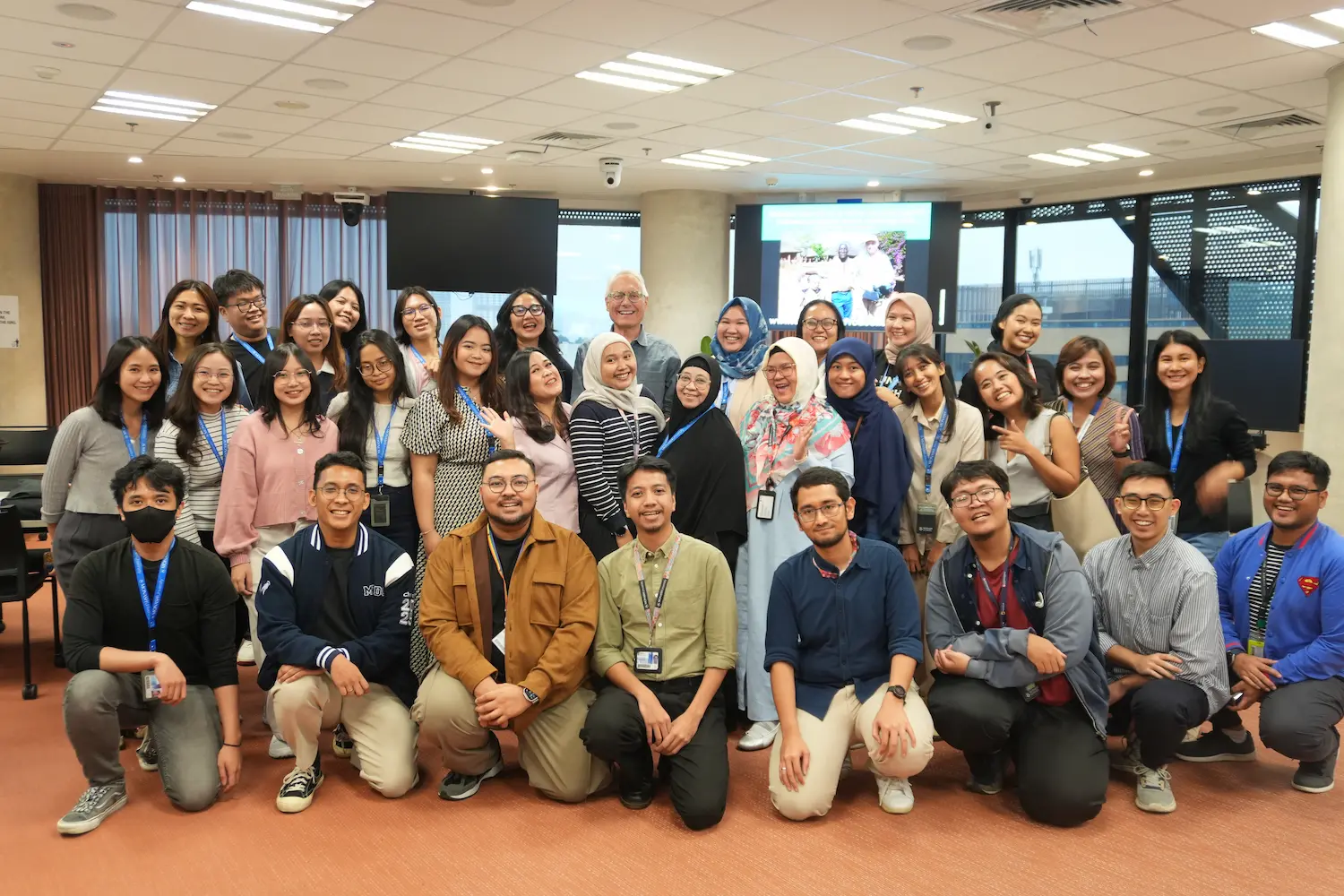 Students taking a group photo with Chris Schueler after the masterclass session
The masterclass provided Monash University, Indonesia students with practical frameworks and inspiration. Schueler concluded the session by sharing a quote from Johann Wolfgang von Goethe: "Whatever you can do or dream you can, begin it; Boldness has genius, power, and magic in it."
Reflecting on his experience at Monash, Schueler shared his admiration for the students and faculty:
"What amazing students, faculty, and facilities you have at Monash University, Indonesia. I was so impressed with your professionalism before I arrived, and the in-person experience was amazing. The energy and enthusiasm to learn and explore the issues were fantastic and, based on the questions after the presentation, your students are world-class. I can’t wait to see what your students do in the world and for the world in the coming years. Thank you so much for having me visit. It was truly an honor to be a guest at Monash."
Armed with Schueler's methodology and inspired by his message, Monash University, Indonesia students were equipped to transform from consumers into strategic storytellers, prepared to shape perceptions and drive measurable real-world impact across their respective fields.