
Master of Urban Design Students win outstanding design prize at Biodesign Sprint 2025: Ocean Futures
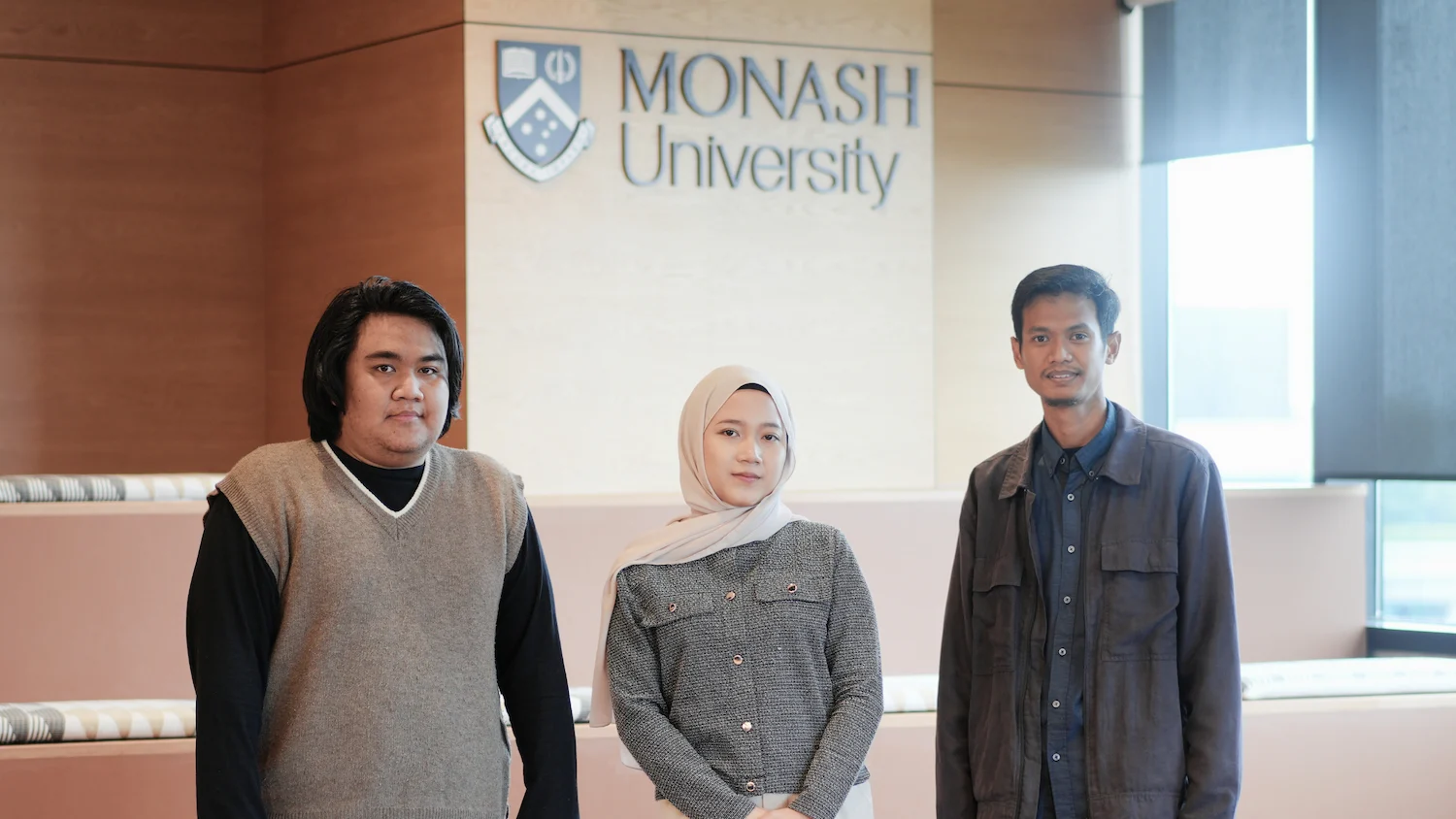 From left to right: Bimario Eka Bhaskara, Resinthia Rachmanda, and Haris Sunansyah
BSD City, Tangerang – Monash University, Indonesia proudly celebrates the Outstanding Design Prize awarded to the team behind SeaWall + Beyond Barriers, an innovative coastal resilience proposal responding to the urgent climate challenges of North Jakarta.
The winning team from Monash University, Indonesia—consisting of research assistants, alumni, and Master of Urban Design (MUD) students Gita Rama Mahardika, Haris Sunansyah, Bimario Eka Bhaskara, and Resinthia Rachmanda—was supervised by Adjunct Associate Professor Eka Permanasari. Together, they developed a nature-based modular system designed to protect vulnerable coastal communities while restoring ecosystems and supporting livelihoods.
Designing with nature, not against it
The project focuses on Muara Angke, one of North Jakarta’s most vulnerable coastal areas, facing severe flooding, land subsidence, and environmental degradation. Rather than proposing another large-scale concrete barrier, the team introduced EcoPOT — a tetra-shaped hybrid module that functions as:
- A wave breaker
- A mangrove planter
- A marine habitat
EcoPOT is designed to be implemented across different coastal zones:
- Along shorelines to dissipate wave energy
- Within nearshore areas as buffer systems
- Integrated with constructed wetlands to filter water
- Supporting mussel cultivation and fisheries
The result is not just a structure — but a living coastal system that balances physical protection with ecological regeneration and economic resilience.
A project grounded in real urban challenges
According to Dr. Eka Permanasari, the project supervisor, what makes SeaWall + Beyond Barriers academically meaningful is its grounding in real-world urban complexity.
"This work is meaningful because it is not speculative. It responds directly to the realities of Jakarta's coastal conditions," she explains.
Dr. Eka Permanasari's supervisory approach is informed by years of professional involvement in Jakarta, particularly in projects related to flooding, rising sea levels, and major coastal infrastructure such as the Giant Sea Wall. These experiences shaped how she guided the students to critically assess risk, scale, governance, and long-term urban consequences.
"Throughout the competition, I encouraged the team to treat climate adaptation and resilience as socio-spatial and governance challenges — not purely technical problems."
She emphasizes that this reflects the learning approach at Monash University, Indonesia, where supervision is an academic partnership. Students are challenged to test their ideas against empirical realities, policy frameworks, and lived urban conditions.
"When professional expertise is translated into teaching and supervision, student work becomes critical, context-sensitive, and implementable."
This integration of professional insight and academic rigor is what elevated the project into an award-winning design.
From classroom to coastal strategy
The project emerged from the City and Ecology class, where students explore nature-based solutions and learn to design with ecological systems rather than against them.
Initially, the team sought to align their proposal with the Muara Angke Urban Design Guidelines (UDGL). However, as research progressed, they realized that there is no one-size-fits-all solution to such complex and layered problems. Instead of proposing another monumental infrastructure intervention, they developed a multi-purpose grey modular system that allows for contextual, community-based adaptation — with potential replication along shorelines across Indonesia.
The strength of collaboration
The project's success was driven by diverse expertise within the team:
- Bimario Eka Bhaskara, team captain, contributed his background as an urban planner and personal experience growing up in a coastal community.
- Haris Sunansyah, a senior in the Master of Urban Design (MUD), strengthened the proposal with technical depth and prior UDGL assessment experience.
- Gita Rama Mahardika, a Research Assistant in MUD, ensured the approach remained rigorous and research-driven.
- Resinthia Rachmanda focused on refining and synthesizing the design to ensure contextual clarity and real-world applicability.
Each member brought a distinct strength — and together, they produced a comprehensive and meaningful design solution.
Shifting the coastal mindset
Beyond winning the Outstanding Design Prize, the team hopes the project contributes to a broader shift in how coastal protection is understood. Instead of relying solely on grey infrastructure, SeaWall + Beyond Barriers reframes coastal defense as a regenerative, socially inclusive system.
If implemented, EcoPOT could:
- Reduce flood risks
- Restore degraded ecosystems
- Improve water quality
- Support fishermen’s productivity
- Strengthen long-term community resilience
A transformative learning experience
For the students, this project fundamentally reshaped how they approach design. "It taught us to think systemically, to embrace complexity, and to see infrastructure not as isolated objects but as part of living, interconnected systems."
Their advice to future students, "Go beyond simply solving the problem — strive to deeply understand the context and its broader impacts. Iterate continuously, test your assumptions, and refine your ideas. Above all, design solutions that are adaptive, because true resilience is not about resisting change, but evolving with it."
Through SeaWall + Beyond Barriers, Monash University, Indonesia once again demonstrates how academic excellence, professional mentorship, and collaborative learning can generate solutions that are not only visionary — but grounded, implementable, and impactful for Indonesia's urban future.