Because we incorporate evidence-based knowledge and skills with research to provide comprehensive education in core healthcare in disaster concepts. The course is taught by experts in the field of emergency management in major hospitals. Lecturers all have postgraduate qualifications with many years of clinical practice, experience and research knowledge.
-
 What makes our Healthcare in disaster course different?
View
What makes our Healthcare in disaster course different?
View

These units are aimed at Health professionals in leadership roles, not just nurses or midwives.
No clinical placement is involved in this course but it does imbeds strategies that can be adopted within the clinical setting when faced with adversity.
This course provides knowledge on how to prepare, plan, execute and recover. You will also learn how to support and educate your staff during these abnormal events.
We offer:
Our course adopts a blended learning approach, which allows you to engage in your learning online and participate in tutorial and/or simulation classes. We offer a flexible approach to attendance for tutorial and/or simulation classes.
The Disaster in healthcare specialisation:
 What will I study?
View
What will I study?
View
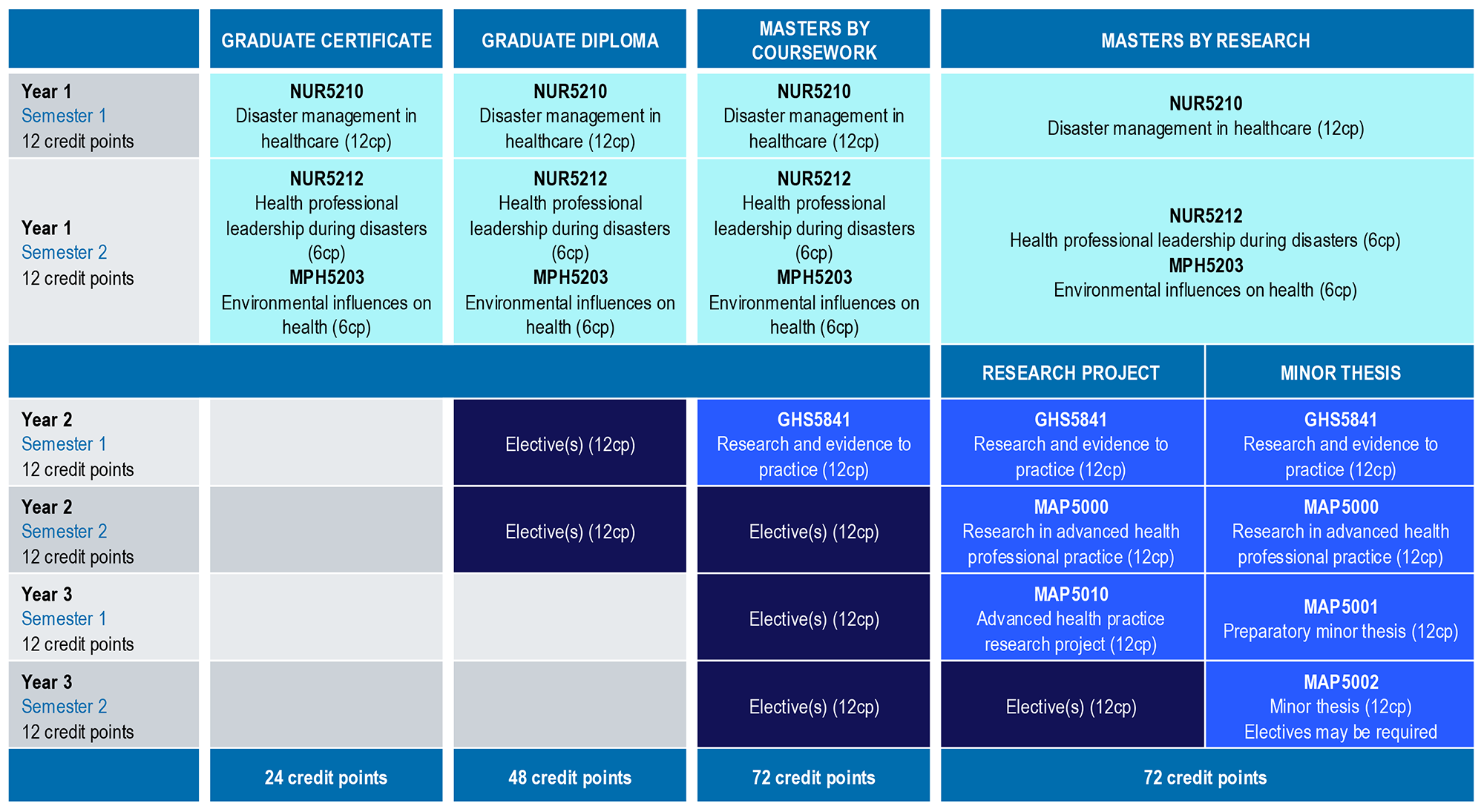
The disaster stream at Monash University Nursing and Midwifery involves two units. Both units are elective and come under the Masters of Advanced Nursing program. These units are:
This unit introduces you to disaster health management and the role of leadership within the multidisciplinary healthcare workforce during a disaster incident.
In this unit you will:
In addition, as a graduate student, you will immerse in learning opportunities designed to expand your skills in critical thinking, problem solving, evidence-based practice, and clinical decision making. You will also be exposed to core concepts associated with research including literature searching, critique of contemporary research, referencing and advanced academic writing skills.
This unit will introduce you, a health professional to the role you play in emergency preparedness and disaster management in local and international settings.
Areas of focus include:
These units involve flexible learning on campus at Peninsula as well as online delivered synchronically. Each unit involves four tutorials of three hours each throughout the semester. There is other work that students perform online incorporating pre-class and wrap up tutorial readings and activities. The difference in the credit points reflects the amount of work required, and the length of assessment tasks.
Topics include classifications and severity ratings of disaster events, and universal theoretical frameworks of impact mitigation concepts. Students will learn to assess the leadership skills needed when striving for disaster resilience, and understand the differences between roles of command, control and collaboration. Global Disaster Risk Reduction concepts, Safe Hospital Indexes, and international council of nurse core competencies in disaster nursing will be explored.
You will gain an understanding of the concepts of crisis management. This involves examining qualities of leadership skills required during risk adverse and high consequence impacts, how professionals communicate, prioritise, risks stratify and apply governmental policies and guidelines to healthcare settings. Most importantly you will learn to promote and educate future health professionals on how to change from everyday nursing to the next level of advanced practice during the need to respond to disaster events.
On successful completion, you will be eligible to graduate with a Graduate certificate of advanced nursing.
Should you wish to undertake further study and progress toward a higher qualification, pathways exist for you to continue your education in a Graduate Diploma or Master of Advanced Nursing. Further information is available in the course handbook.
 How long will the course take?
View
How long will the course take?
View
Both units are elective and come under the Masters of Advanced Nursing program. Students can elect to do one of the units or both units over twelve months.
Should you wish to proceed to further study beyond the Graduate certificate of advanced clinical nursing, further information to identify course duration is available in the course handbook.
 How many hours will I spend a week studying on average?
View
How many hours will I spend a week studying on average?
View
Tutorials will be a total of 12 hours per semester plus you will need to review pre-class materials, explore in-class content and cover post-class activities per tutorial.
The study pathway shown is an example of part-time enrolment for a domestic student in Disasters in healthcare specialisation.
The Master’s program offers flexibility to tailor your learning experience through elective units drawn from other specialisations. As individual study plans may differ, this pathway is provided as a guide only, and the order in which units are completed may vary.
Additional units or requirements may apply based on your individual needs.
-