
Hanmun Grammar Sketch
This grammatical sketch is based on the grammar model used in the upcoming Hanmun textbook “Practical Hanmun” (working title) by Felix Siegmund (Professor of Premodern Korean Philology, Ruhr Universität Bochum)
To use this sketch, it is recommended to first review the grammar explanations and then refer to the examples at the end. After spending some time with the examples, re-read the grammar explanations and then re-read the examples and their explanations. If anything is left unclear, please use a reference grammar (Pulleyblank, Dobson, Kim Wŏnjung, Yang Bojun etc.) for clarification.
Feedback on the usability of this grammar sketch is very welcome.
This grammar model is based on some core assumptions, namely:
- It is a grammar for educational purposes, assisting learners in making sense of Hanmun texts. It does not attempt to contribute to linguistic discussions of Literary Chinese.
- The grammatical model is designed to be applicable to Hanmun materials from virtually all stages of the development of that language, thus covering the timespan from roughly 500 CE to the early 20th century.
- We have attempted to make explanations as simple as possible to avoid overburdening students of the language while maintaining accuracy and informativeness.
- Grammatical terminology has been kept simple, and we have employed a minimum number of such terms.
- Examples and texts are taken from Korean sources.
Word Classes
We need the following word classes:
Nouns (N)
Verbs (V)
Auxiliary verbs (X)
Adverbs (A)
Markers (M)
Some of the above categories contain subclasses.
For verbs, we differentiate between transitive and intransitive verbs, depending on whether they can take objects. We also note that some verbs, which we may refer to as qualitative verbs and which are always intransitive, can also serve as attributes for nouns, thereby functioning in a manner similar to adjectives in English. An even better illustration may be qualitative verbs in Korean, which, like qualitative verbs in Hanmun, can either be verbal predicates of a sentence, or can modify a noun, if they are given a participle ending. For example, the character 生 could either be an intransitive verb “to be born, to live” (or “A is born, A lives”), or a transitive verb “to give birth to, to produce” (or “A gives birth to B, A produces B”). The verb 死 on the other hand is nearly always intransitive, meaning “to die” (or “A dies”).
Auxiliary verbs do not need sub-classes. They are verbs that modify other verbs, expressing possibility, necessity, permissibility, prohibition etc. of the action expressed by the verb. All auxiliary verbs can also appear as verbs. An example is 能 “to be possible”.
Adverbs do not need sub-classes, as they always function the same way: They describe the way that the action expressed by the verb happens. The only thing to note is that some adverbs can also appear in nominal sentences (that is: sentences without a verbal predicate), in which case they nearly always appear in the comment part of the sentence and modify what is expressed in it. An example is 亦 “also, too”.
Markers are the trickiest word class, since the only characteristic they have in common is that they do something grammatically. But for didactic purposes it is sufficient to remember that markers are used to mark grammatical relations (markers are used to mark “grammar”). It is helpful to think of markers as belonging to one of the following sub-classes:
Postpositional markers
These are placed after the noun that they modify, such as the comitative 與 (“and”, “together with”) and the attributive marker 之 (“that”).
Prepositional markers
These are placed after the noun that they modify, such as the locative marker 于.
Conjunctions
Conjunctions link two or more clauses in a sentence. 則 (“then”), 以 (“in order to”) and 雖 (“even though”) are examples of conjunctions.
Sentence end markers
These appear at the end of sentences and mark the end of the sentence, plus, in some cases, modality, mood etc. 也, 已 and 耳 are examples.
Markers of nominalization
These are placed with a verbal phrase to mark that it is nominalized: 者 and 所.
Modal markers (interjections)
Modal markers mark an emphasis. Interjections are also grouped with modal markers for simplicity. 乎 and 夫 would be typical examples.
Syntax
Syntax is the system of how the words form groups and how these words and word groups interact with each other.
Hanmun grammar functions on the following levels:
Words
A word is just that: A lexical unit of low complexity, usually one or two characters in length, as can be found in the dictionary.
Interlude: Predicates
Before we go on to phrases and sentences, it is necessary to mention predicates. We can try to illustrate what is meant by a “predicate verb” by explaining that it is a verb that says something about what is happening in the sentence (or its main phrase, if there is more than one). Accordingly, a verbal sentence can (and must) have exactly one verbal predicate. For example, in the sentence 虎食王 “the tiger eats the king”, 食 (“eats”) would be the predicate verb.
Phrase
Phrases come in two types: Verbal phrases and nominal phrases. The difference is that verbal phrases have a verb, while nominal phrases do not.
An example for a verbal phrase would be 虎食王 from above; 食 being the verb. An example for a nominal phrase would be 虎王也 “The tiger is a king”. Often, nominal phrases end with the sentence end marker 也, but this is not mandatory and the form 虎王 would also be possible.
Nominal phrases are very important to understanding Hanmun grammar, since they can appear at any position in the sentence where a noun could be placed. They often act as subjects or objects of verbs.
Verbal phrases are relevant much less often, since their usual function is to be turned into nominal phrases by nominalization. Verbal phrases that are not nominalized are nearly always clauses or sentences.
Another case are adverbial phrases, which are phrases that function like adverbs. In most cases they can be explained as either topics (if they appear at the start of the sentence) or as complex, lexicalized adverbs, consisting of multiple characters. But in some cases it seems better to explain them as adverbial phrases.
Interlude: Nominalization
One of the key concepts to understanding the syntax of Literary Chinese is that of nominalization. The markers 者 and 所 are very frequently used in Hanmun. Their function is to turn a verbal phrase into a nominal phrase. The marker 者 is placed after a verb or after the object, if the verb has one. It replaces the subject of that phrase. This form can be translated as “the one who V” or also simply as “to V” (as a noun). The marker 所 functions analogously, but is placed in front of the verb and replaces its object of that verb. It can be translated as “The one/the thing who/that is V” (in the passive voice).
Nominalization can also be unmarked and happens simply by putting a verb or a verbal phrase in a place where a noun is to be expected. This transforms the verbal phrase into a nominal phrase (which acts like a noun).
For example, in the sentence 虎食王, the verb 食 could be transformed into a nominal phrase by adding the marker 者 or 所. The phrase 食者 would then be “he who eats” while 所食 would be “that what is eaten” or “the one who is eaten”.
Thus we could form sentences like:
虎食王 “The tiger eats the king.”
食者虎也 “The one who eats is the tiger.”
所食王也 “The one who is eaten is the king.”
Clauses
Clauses are a category in-between phrases and sentences. Clauses are necessary as a category because there are cases in which a clause of multiple phrases forms an element in a sentence, for example in a conditional sentence. It can be useful to think of them as “incomplete sentences”. For example, in the sentence 虎食王則王死, there are two clauses 虎食王 “the tiger eats the king” and 王死 “the king dies”. The two clauses are connected by the conditional conjunction marker 則 (“if/when…, then…”), thus giving the sentence 虎食王則王死 “if the tiger eats the king, the king (then) dies”. In a conditional sentence, we can call the if-part of that sentence (here 虎食王) the “protasis” and the then-part of the sentence (here 王死) the “apodosis”.
Sentence
Sentences consist of one or more clauses. They are the highest level of our model of structural analysis. Again, we should differentiate between verbal and nominal sentences, depending on whether the sentence has a verbal predicate.
A verbal sentence always has a Subject-Verb-Object (SVO) structure. For example, in the sentence 虎食王, 虎 is the subject, 食 is the verb, and 王 is the object.
A nominal sentence always consists of an explicit comment. The topic can also be stated explicitly, but does not have to be; it can also be contextual. For example, in the sentence 虎王也 , 虎 is the topic and 王 is the comment. The sentence end marker 也 marks the end of the nominal sentence.
Text
The text may be the most complex layer of language, but for our purpose it is relatively easy to deal with. It is necessary to pay attention to context and to look for connections between sentences in the text. Such context is the most important reference in deciding the relative plausibility of multiple possible interpretations of a sentence. Other than that, the problem is mostly that of the need for some knowledge about text types, genres and writing conventions, which are outside the scope of this sketch.
Examples
Now that these rather abstract grammatical concepts have been explained, let us look at how this syntax model works in practice.
The symbol “|” is used in some places in the diagrams to help the differentiation of groups in the syntactical structure.
Let us begin with a very simple example:
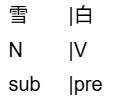
“The snow is white”
Here we have a sentence that consists of a verbal predicate 白 and its subject 雪. The predicate 白 is an intransitive verb, so the sentence does not – and cannot – have an object.
The second example is slightly more complex:
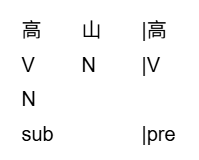
“The high mountain is high”
In this sentence, we have added the attribute 高 to the noun 山. Being a qualitative verb, 高 can be attributed to nouns, as is the case here. 高山 is the subject of the sentence. The predicate is the intransitive verb 高.
Next, we have a sentence with a transitive verb and an object:
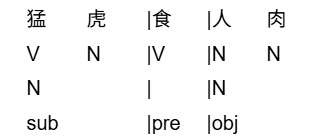
“The fierce tiger eats the flesh of men”
Here, subject 猛虎 consist of a noun with a verb attributed to it. The object 人肉 consists of two nouns, 人 being attributed to 肉. The verbal predicate is 食, which is a transitive verb, thus being able to take 人肉 as its object.
We can also negate verbs, by inserting a marker of negation:
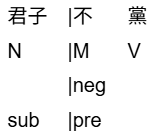
“The gentleman (君子) does not form factions”
The subject 君子 is a single lexical item, even though there would also be no harm in considering it to be an attributive construction (where the noun 君 would be an attribute to the noun 子). The verb 黨 is used here as an intransitive verb and it is negated by the standard marker of negation for verbs, which is 不.
Positions in a sentence can be occupied by more than one word or phrase:
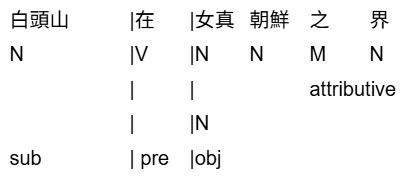
“Paektusan is at the border of the Jurchen and Chosôn”
Here, the object is a nominal phrase 女真朝鮮之界, which consists of the noun 界 and the two attributes 女真 and 朝鮮 which are explicitly attributed to the noun 界 using the attributive marker 之. It is also clear from context that they should be considered to be in a comitative relation, which could be marked with the marker 與, but is not.
The subject is easy to find; it is 白頭山. Likewise, the predicate verb must be 在.
Nominal sentences do not have a verbal predicate. Instead, they consist of a topic and a comment:
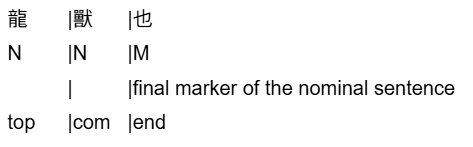
“The dragon is a land animal”
This sentence represents the simplest possible form that a nominal sentence can have. There is a topic consisting of one noun 龍 and a comment, consisting of another 獸. The sentence is marked by the sentence end marker of the nominal sentence 也. This marker could also be dropped, which would, arguably, make the sentence elliptical.
Nominal sentences do not have a verbal predicate, even though they can include words that clearly are verbs:
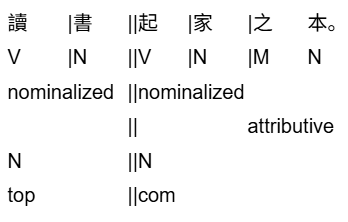
“To read books is the beginning of all enterprises”
Or, more literally: “To read books is the foundation of setting up a house/familiy”
Note: This is an unmarked nominal sentence (“unmarked” since it lacks the final marker of the nominal sentence 也).
The next example is slightly more complex:
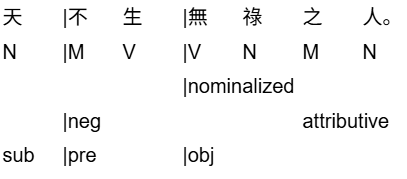
“Heaven does not give birth to people without a living (literally: “without a salary”)”.
the subject is very simple, consisting only of the noun 天. The predicate verb 生 is negated by the negation marker 不. The subject is a phrase 無祿之人. It consists of a verbal phrase 無祿, which itself could be a predicate verb 無 with an object 祿, if it was an independent sentence. Instead, it is attributed to the noun 人 by use of the attributive marker 之, which only connects nouns. This means that 無祿 must be understood to be nominalized, so that it can function as an attribute to the noun 人.
One special case is that of verbs with full sentences as objects:
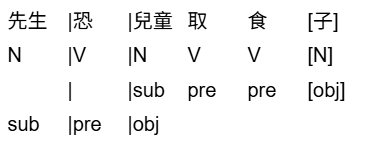
“The teacher feared that the children would pick up and eat [the nuts].”
While it would be logical to analyze the object here as a nominalized phrase, here it is not the case. It seems easier to just assume that some verbs, which semantically allow for this, can take full sentences as their objects.
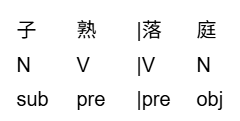
“When the nuts are ripe, they fall into the yard.”
This sentence consists of two clauses, both of which have 子 as their subject. The first clause simply consists of the explicit subject and a verb.
The second clause, which is coordinated with the first clause, presents an example of implicit grammar. In the second clause, the subject 子 is implicit, since it must be reconstructed from first clause. The predicate verb 落 is explicit and presents no further problems. The next word, however, 庭 stands in the object position without a locative marker. It can thus be understood to be the object of 落. Alternatively, we can assume that the locative marker in front of 庭 has been dropped and that we should analyze it as an implicit locative.
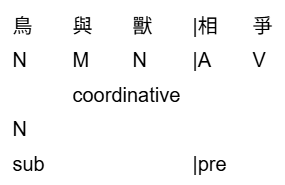
“Birds and beasts contested with each other”
Note: The subject in this sentence consists of two coordinated nouns (“N and N”). This could also be understood as nouns in a comitative relation (“N together with N”).
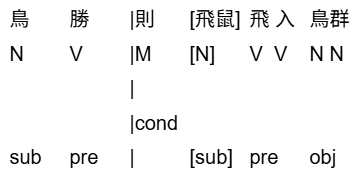
“If the birds won, [the flying squirrels] would fly into the group of the birds.”
Note that this is a conditional sentence. The protasis clause (the “if” clause) is 鳥勝. The apodosis clause (the “then” clause), marked by the conditional marker 則 is [飛鼠]飛入鳥群. The subject 飛鼠 is dropped in the original sentence and has been reconstructed for this explanation.
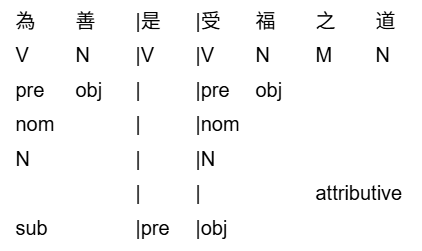
“To do good is the way towards receiving good fortune.”
Note: Here we have a verbal phrase 受福, which is implicitly nominalized and can be attributed, by using the attributive marker 之 to the noun 道. This complex nominal phrase (受福之道) is the object of the predicate 是. The subject 為善 is also a nominalized verbal phrase (consisting of a verb 為 and its object 善).
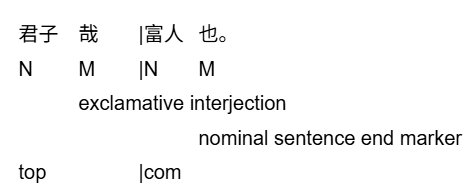
“As for you, Sir(君子), you are a wealthy man.”
Note: This is a nominal sentence. The topic is also marked with an exclamative marker, thus adding emphasis.
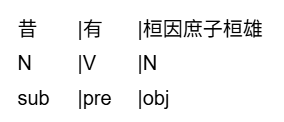
“In the past there was Hwanin, the secondary son of Hwan Ung.”
Note that the object is a complex nominal compound consisting of the three nouns 桓因, 庶子, and 桓雄. The core noun is 桓雄, which is attributed by 桓因庶子. The attribute 桓因庶子 does consist of 庶子 and its attribute 桓因.
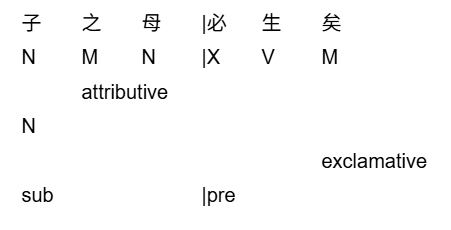
“Your mother will live!”
Note: The sentence end marker 矣 could also be analyzed as a marker of the perfect, since the fact described (子之母必生) is completed. Here, 子 is highly likely to be meant to refer to Sô Rûng as a form of address (“you, Sir”, thus: “Your mother”).
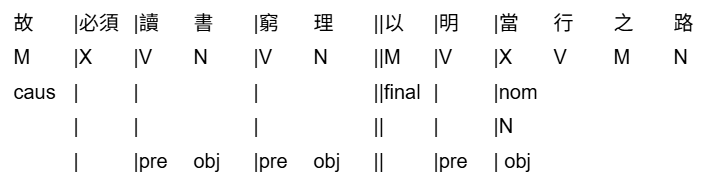
“Therefore one must read books and exhaust the principles (of Confucian philosophy) in order to elucidate the way that one should walk (in life).”
Note: Here we have two clauses (必須讀書窮理 and 明當行之路) that are connected by the final conjunction 以 (“so as to”). The auxiliary verb 必須 modifies both 讀 and 窮.
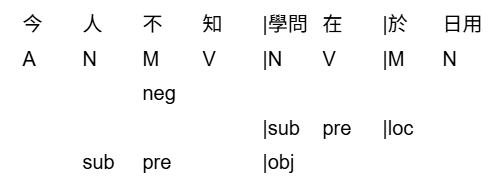
“Now, people do not know that learning lies in everyday activities (日用).”
Note: Here, 今 (“nowadays”, “now”) is an adverb, modifying the verb 知. It is equally possible that 今 is a noun, forming a compound noun with 人, thus resulting in 今人 (“people of today”). The meaning is more or less the same – as is often the case in situations where Hanmun sentences are grammatically ambiguous.
Reference
Dobson, W.A.C.H. [William Arthur Charles Harvey] (1974): A Dictionary of the Chinese Particles: with a prolegomenon in which the problems of the particles are considered and they are classified by their grammatical functions. Toronto: University of Toronto Press.
Kim Wŏnjung 金元中 (2003): Hŏja taesajŏn虛辭大辭典. Seoul: Hyŏnamsa.
Pulleyblank, Edwin (1995): Outline of Classical Chinese Grammar. Vancouver: UBC Press.
Yang Bojun 杨伯峻 (1981): Guhanyu xuci 古汉语虚词. Beijing: Zhonghua shuju.