
Podcast
The following information provides guidelines for Monash University-affiliated podcast cover images, as well as advice for using podcast directories and finding the right hosting platform.
The importance of the podcast cover image
Just as we’re drawn to well-designed book covers, podcast audiences are drawn to show covers that stand out and reflect the subject matter.
A Monash-branded template will soon be available in Canva.
Example of the Monash podcast template showing the 'M' and text placement options.
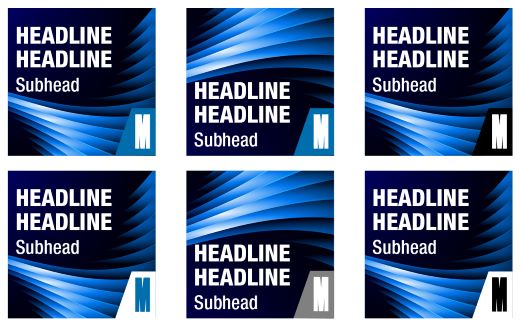
The Monash University logo is not used with this template and the branding is more subtle. This is due to:
- The restrictive amount of space within a podcast cover, especially when viewed at its smallest size on a mobile device
- Podcasts are content-driven, aligned with the Monash University brand, values and reputation
- This follows general podcast cover design trends
The podcast cover template uses the specially designed, for-purpose ‘podcast M’ element which:
- Ties the podcast back to Monash
- Provides more space for creative/flexibility
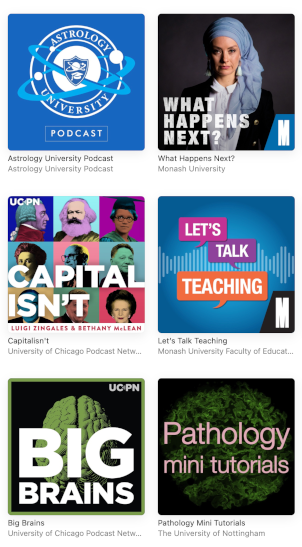
- Ensures your podcast cover is readable at 55 x 55 pixels
- Is available to use in Monash blue, black, grey or white
Colour options for the podcast M.

How the tile can look in the Apple podcasting app.
Best practices for podcast artwork
Here are a few tips to get your artwork working across multiple podcast directories:
- Use imagery that reflects the subject matter and stands out
- Use high-quality imagery that fits with the Monash brand. Brand imagery guidelines may be found here
- Design your podcast cover artwork to be a minimum of 1400 x 1400 pixels and a maximum of 3000 x 3000 pixels
- Ensure your podcast cover artwork still looks good when reduced to 55 x 55 pixels
- Limit the number of words used on your cover to three or four.
Contact Brand requests for artwork advice.
Hosting platforms
The easiest way to push your podcast’s RSS feed to multiple directories is through an online podcast hosting provider, which also stores your .mp3 files. Some platforms even offer additional services such as AI promotional tools and distribution to social media channels.
Advantages:
- Often generous hosting and bandwidth
- Optimisation of your audio file
- Helps you get listed in multiple podcast directories
- RSS feed is automatically generated and submitted to directories
- Website created for your podcasts
- Analytics on your podcast performance
- Migrate any existing podcasts across
Some popular podcast hosting providers:
- Spotify for Podcasters (free)
- Omny studio (monthly/annual fee, used by UMAC)
- Libsyn (annual fee)
- Podbean (annual fee)
We do not recommend using SoundCloud due to the instability of the platform.
Your hosting provider must comply with the University’s IT policies and procedures. Please contact eSolutions for more information.
Best practices for content
Podcast show description
A podcast show description is what people will read after the title of your show has caught their interest. The description is likely to 'make or break' things for listeners deciding whether they want to listen to your show.
A well-written podcast description answers:
- Is this show for me?
- What value will I get from it?
An example structure for your podcast description:
- First sentence – write a sentence that engages your user by striking an emotional chord or piquing their curiosity. Most potential audience members will only see the first 10 words of your description, so make them count
- Second sentence – Tell listeners more about the podcast, e.g. the host and guest/s, who has produced it and the frequency of the show
- Third sentence – Describe briefly what's in it for them and why they should listen
Other real examples
NASA’s curious universe
Our universe is a wild and wonderful place. Join NASA astronauts, scientists and engineers on a new adventure each week — all you need is your curiosity. Visit the Amazon rainforest, explore faraway galaxies and dive into our astronaut training pool. First-time space explorers welcome.
What Happens Next?
Fictional dystopias have never seemed so close to becoming reality. Is it too late to change our course? Monash University’s What Happens Next? explores the biggest challenges facing the world today. Join academic and commentator Dr Susan Carland to learn from experts, listen to the people making a difference and discover how you can help drive change.
Podcast episode intros
The start of each podcast episode should follow a consistent format:
- Introduce the name of the podcast and who it's by (Monash University… )
- Introduce the host/s.
- Mention who the podcast is for and briefly explain what the overall show or theme is about.
- Ensure guests also introduce themselves and, if applicable, mention they are from Monash
Example:
Hello and welcome to Monash University’s ___ podcast by ________. This is the show for ___, all about ___. Have you ever struggled with ___? I’m _____, your host, and that's exactly what we're going to help you with in today’s episode. We’ll be speaking to _____ from Monash’s Faculty of ____.
Help listeners find your podcasts
It's important to ensure you include the correct tags in your RSS feed and write a good show description using keywords to help listeners find your podcast in search engines and podcast directories such as Apple Podcasts and Spotify.
Most hosting platforms will provide tag fields for you to populate as part of the process of creating your podcast’s RSS feed.

Author name
The 'show author' most often refers to the parent company of a podcast.
- Set your podcast author name to 'Monash University'
For example:
<itunes:author>Monash University</itunes:author>
Or you can include the related area after ‘Monash University’:
<itunes:author>Monash University, SensiLab</itunes:author>
<itunes:author>Monash University, Engineering</itunes:author>
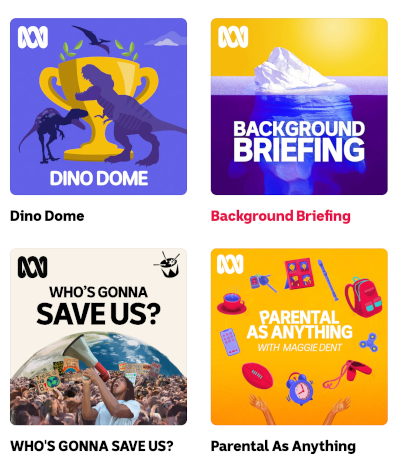
Author information is especially useful if a company or organisation publishes multiple podcasts. Providing this information will allow listeners to search and see all shows created by the same entity.
Example of ABC Radio podcasts, which displays consistent logo placement and a consistent author name:
Where to distribute your show
For the best reach for your podcast, you’ll want to make it available in as many podcast directories as possible. There are four major podcast directories to consider first:
Apple Podcasts has a wide reach and huge listener base. Apple’s approval process can take a bit longer than other platforms, so consider this when planning your show’s launch. If you only add your podcast to one directory, make it this one – many other apps pull data from Apple Podcasts.
Spotify is one of the best options for Android users who don’t use Apple Podcasts. Spotify’s popularity is growing among podcast listeners, and it collects a lot of data about its users that can tell you more about your listening audience.
Amazon Music has an app and a web service and is used by the company's smart speakers.
This service aims to simplify adding your podcast to many directories at once.
Next steps
Once your Monash branded podcast has been published and distributed, please let University Marketing, Admissions and Communications know.
Podcasting advice and help
Always check in with your faculty marketing team for advice as a starting point.
The School of Media, Film and Journalism (MFJ) provide a wealth of information and podcasting expertise, training and facilities to get you going. Get in touch for help with producing a high-quality, professional podcast.
Contact MFJ for podcast support
UMAC does not provide podcast production or editing services but can recommend external providers with the skillsets required for starting and maintaining a podcast.
For more information about podcasting at Monash University, please email podcasts@monash.edu. Appearing on a podcast or considering starting your own? Watch UMAC’s 10-minute “Podcasting for Thought Leaders” training online now.