
Joint Collaboration Development Forum with Penn State University
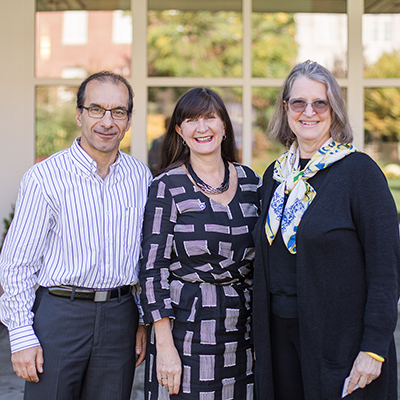
The Monash Biomedicine Discovery Institute’s (BDI) Dr Jane Bourke was one of fourteen Monash researchers who travelled to the US to take part in the 2019 Joint Collaboration Development Forum with Penn State University (PSU) in October.
Held as part of the strategic partnership between Monash and PSU, the forum was an opportunity for PSU and Monash researchers who received seed funding under the 2019-20 round of the Collaboration Development Fund to kick-start their projects and showcase their plans for cross-institutional work.
A key partnership in Monash University’s Networks of Excellence initiative, the partnership with PSU was established in 2018 to identify and facilitate collaborative research, education and service activities that neither institution is able achieve independently.
The focus of this latest Collaboration Development Fund round was Intersection of Health and the Environment, and provided seed grants of up to $50,000 to foster collaborative, sustainable and self-supporting research that demonstrates the potential to grow into a larger thematic program.
Dr Bourke and Dr Simon Royce are Monash partners for a collaboration with Professors Ali Borhan and Rebecca Bascom from PSU for a project, titled ‘An engineering-pulmonary-pathology collaboration for developing disease-specific, patient-specific models of inhaled toxicant susceptibility’. Their seed grant will be used to integrate innovative technologies at PSU and Monash to examine the pathways by which environmental toxicants lead to chronic respiratory diseases.
“It’s an exciting partnership,” said Dr Bourke.
“Our role at Monash will be to assess lung samples collected from predicted sites of injury based on sophisticated imaging and modelling of potential ‘hot spots’ in the lung. By showing specific changes in airway structure, we hope to develop strategies for early recognition and targeted treatments for lung diseases,” she said.
The visit also allowed the Monash delegation to explore further opportunities to combine complementary technologies and expertise, enabling the institutions to focus future investment in areas of strategic importance.
More than 50 academics attended the forum, which showcased joint research spanning the impact of farm management practices on antibiotic presence and antimicrobial resistance in waterways, to developing ethical, policy, and legal frameworks to address health effects of digital influence, assessing the air quality co-benefits of climate mitigation strategies in the US and China, and using mobile apps to explore the role of social networks in the recovery of substance-dependent individuals.
Delivering the welcome presentation to launch the event, Monash Provost and Senior Vice-President Professor Marc Parlange said the event demonstrated the importance of international collaboration to drive research impact.
“This partnership with Penn State leverages the unique strengths of both our institutions. In doing so, we hope it will make researchers from Penn State and Monash instrumental in addressing the most important challenges facing the world today,” Professor Parlange said.
The workshop was the second event to be held since the establishment of the joint research focus initiative with Penn State, and follows a visit by PSU researchers to Monash last year.
This article is based on an original, published in The Insider.
About the Monash Biomedicine Discovery Institute
Committed to making the discoveries that will relieve the future burden of disease, the newly established Monash Biomedicine Discovery Institute at Monash University brings together more than 120 internationally-renowned research teams. Our researchers are supported by world-class technology and infrastructure, and partner with industry, clinicians and researchers internationally to enhance lives through discovery.