
Groundbreaking study reveals vital roles of circular RNAs in biological processes
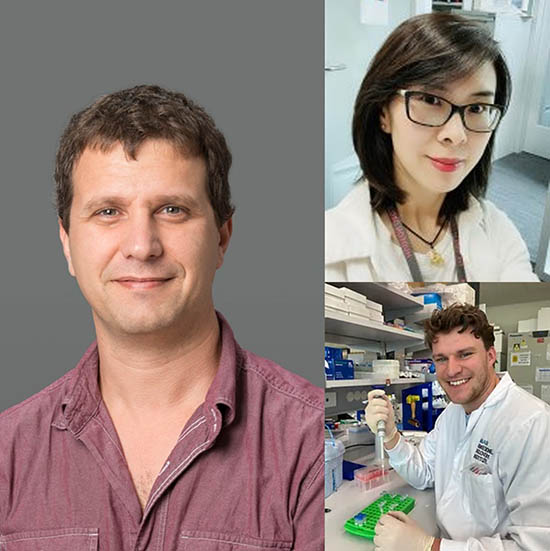
Lead author, Associate Professor Joseph (Sefi) Rosenbluh (L), and co-first authors Dr Ling Liu (top) and PhD student Matthew Neve (bottom).
A collaborative research team led by Monash University has made a significant breakthrough in understanding circular RNAs (circRNAs), a relatively new type of single-stranded RNA which forms a closed continuous loop.
Their study, published in Nature Cell Biology, provides compelling evidence that circRNAs play crucial roles in regulating key biological processes, challenging the notion that they are merely non-functional byproducts of gene expression.
CircRNAs are unique due to their circular structure, which differentiates them from traditional linear RNAs. circRNAs are covalently closed single stranded RNAs that are found in all known tissue types and across eukaryotic organisms, the biological significance of circRNAs has long been debated within the scientific community. Although the presence of circRNAs has been known, whether or not circRNAs play a role in regulating biological processes is an unanswered open question.
In this groundbreaking research led by Associate Professor Joseph (Sefi) Rosenbluh from the Monash Biomedicine Discovery Institute (BDI), the team developed comprehensive libraries that enable the suppression of every known circRNA. Using this library they screened a panel of 18 cancer cell lines and found circRNAs that are essential in a context specific or non-specific manner. This innovative approach allowed them to systematically investigate the phenotypic effects of circRNA knockdown across various biological contexts.

circRNAs are generated by mRNA backsplicing. This study used a systematic loss of function screen to identify biological functions associated with circRNAs.
“Our findings demonstrate for the first time that circRNAs are not just passive remnants of RNA processing; they actively regulate important signalling pathways and biological processes,” Associate Professor Rosenbluh said.
“This research establishes a vital resource - a database of functional circRNAs - that will facilitate future mechanistic and translational studies,” he said.
Collaborators Dr Gregory Goodall, from the Centre of Cancer Biology, Dr Simon Conn, Flinders University, Dr Jennifer Zenker, Australian Regenerative Medicine Institute and Dr Pablo Tamayo,the University of California San Diego, contributed to this pioneering work. Together, they explored the implications of circRNA function in processes such as cell growth, differentiation, and tumorigenesis.
“Understanding the roles of circRNAs in cancer biology could open new avenues for therapeutic intervention,” Associate Professor Rosenbluh said.
“Our team is eager to explore how these findings might lead to innovative strategies in cancer treatment.”
The study not only sheds light on the functional significance of circRNAs but also provides a foundational framework for future research. With this newly established database, scientists around the world can delve deeper into the regulatory roles of circRNAs, potentially identifying new biomarkers and therapeutic targets for various diseases.
Read the full paper published in Nature Cell Biology titled Systematic loss-of-function screens identify pathway-specific functional circular RNAs
DOI: 10.1038/s41556-024-01467-y
MEDIA ENQUIRIES
Tania Ewing, Monash University
Media and Communications Contractor
E: taniaewing@taniaewing.com
M: +61 (0) 408 378 422
GENERAL MEDIA ENQUIRIES
For more Monash media stories, visit our news and events site
Monash Media
E: media@monash.edu
T: +61 (0) 3 9903 4840
About the Monash Biomedicine Discovery Institute at Monash University
Committed to making discoveries that will relieve the future burden of disease, Monash Biomedicine Discovery Institute at Monash University brings together more than 120 internationally renowned research teams. Spanning seven discovery programs across Cancer, Cardiovascular Disease, Development and Stem Cells, Infection, Immunity, Metabolism, Diabetes and Obesity, and Neuroscience, Monash BDI is one of the largest biomedical research institutes in Australia. Our researchers are supported by world-class technology and infrastructure, and partner with industry, clinicians and researchers internationally to enhance lives through discovery.