
MACSYS Centre launch marks a new era in predictive biology
Key points:
- Backed by $35 million in ARC funding, the newly launched Centre of Excellence for the Mathematical Analysis of Cellular Systems (MACSYS) is pioneering whole-cell modelling to understand and forecast how living cells behave.
- In developing whole-cell mathematical models, MACSYS will provide in silico biology as a complement to in vivo and in vitro approaches to studying cells, with impacts in sustainable biotechnology and food, wine and other industries.
- MACSYS brings together 18 Chief Investigators across five Australian universities, together with international partners, and is a multi-disciplinary team spanning cell biology, mathematical modelling, statistics, computer science and AI. It works closely with ATSIMA to foster diversity and innovation.
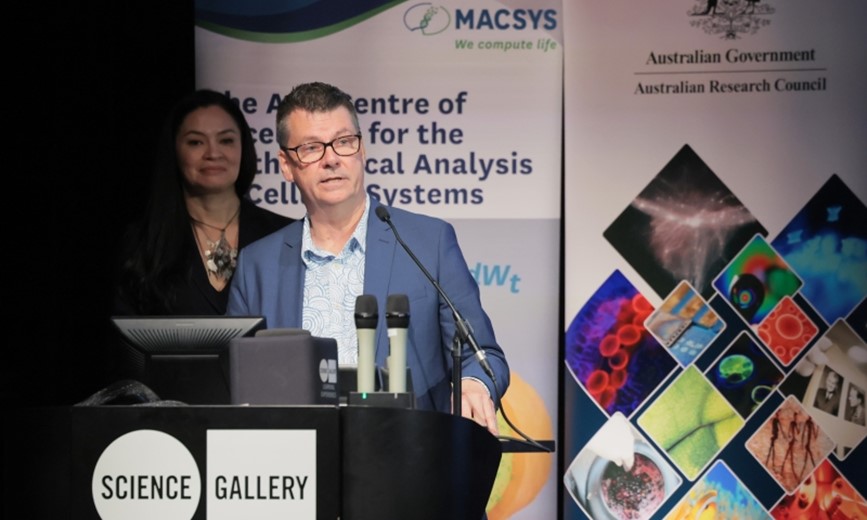
Director of MACSYS, Professor Trevor Lithgow, delivers opening remarks at the MACSYS Centre Launch at Science Gallery Melbourne.
Today marks the official launch of the Australian Research Council’s Centre of Excellence for the Mathematical Analysis of Cellular Systems – or MACSYS for short.
Although MACSYS began operations in 2024, this formal launch held at Science Gallery Melbourne, celebrates the Centre’s ambitious vision, groundbreaking research and the collaborative spirit that drives its mission.
Funded with $35 million through the Australian Research Council (ARC) Centres of Excellence program, MACSYS Director, Professor Trevor Lithgow said the Centre is poised to revolutionise biology by discovery and development of the new mathematical and computational technologies required to make biology predictive.
“We need to be able to predict what a cell is going to do in response to some intervention,” said Professor Lithgow, also head of the Bacterial Cell Biology Lab at Monash University’s Biomedicine Discovery Institute.
“If a stimulus is made, if a change in environmental conditions rips through, we must understand fully and comprehensively what the outcomes will be. That’s the power of whole cell modelling.”
The Centre is headquartered at the University of Melbourne and brings together 18 Chief Investigators across five node universities, including Monash University, the Australian National University, Queensland University of Technology , and the University of New South Wales.
It is a multidisciplinary team of researchers spanning cell biology, mathematical modelling, statistics, computer science and artificial intelligence.
Its research mission is to establish mathematical whole cell models for in silico biology (using computer models) as a powerful complement to traditional in vivo (inside living organisms) and in vitro (lab experiment) approaches. These models will tackle fundamental biological problems and create a world-leading research and biotechnology translation environment.
University of Melbourne Professor Jennifer Flegg is the Centre’s Deputy Director.
“If we can unlock the potential of a whole cell model, then there are vast biological, medical, and biotech applications that will advance greatly from our science,” Professor Flegg said.
MACSYS is proud to acknowledge its partner organisations, whose collaboration enriches its research and outreach. They include:
- ATSIMA, the Aboriginal and Torres Strait Islander Mathematics Alliance – working together to support ATSIMA’s mission for an education revolution in mathematics.
- AWRI, the Australian Wine Research Institute – collaborating on modelling yeast activity and capability in winemaking.
- JuliaHub – engaging closely to apply radical new computational approaches to biological data modelling.
ARC Executive Director for Humanities and Creative Arts, Professor Allison Ross, expressed her confidence in MACSYS’ future impact.
“The ARC looks forward to seeing MACSYS deliver the discoveries, insights, and innovations that will place Australia at the forefront of this transformative field,” Professor Ross said.
MACSYS also expresses deep gratitude to the ARC for its generous support. As Professor Lithgow noted:
“For 22 years, the ARC has supported a program of Centres of Excellence for some of Australia’s best researchers to collaborate and develop our international standing in research areas of national priority. In the 2023 round, the ARC invested into the mathematical analysis of cellular systems, and MACSYS is grateful for this huge support. The Centres of Excellence program is a means by which we will bring positive change to the scientific landscape in Australia and bring benefits beyond our scientific advances.”
Read the ARC media release: A bold leap into predictive biology
Learn more about MACSYS from their website
The MACSYS Mission (to Mars): more than two dozen MACSYS researchers talk about the mission of the Centre, its importance, its complexity and why it may even be a 'mars shot'.
______________________________________________________
GENERAL MEDIA ENQUIRIES
For more Monash media stories, visit our news and events site
Monash Media
E: media@monash.edu
T: +61 (0) 3 9903 4840
About the Monash Biomedicine Discovery Institute at Monash University
Committed to making discoveries that will relieve the future burden of disease, Monash Biomedicine Discovery Institute at Monash University brings together more than 120 internationally renowned research teams. Spanning seven discovery programs across Cancer, Cardiovascular Disease, Development and Stem Cells, Infection, Immunity, Metabolism, Diabetes and Obesity, and Neuroscience, Monash BDI is one of the largest biomedical research institutes in Australia. Our researchers are supported by world-class technology and infrastructure, and partner with industry, clinicians and researchers internationally to enhance lives through discovery.
About MACSYS
The ARC Centre for the Mathematical Analysis of Cellular Systems aims to deliver the mathematics required to compute life. The Centre will deliver innovation in computational and mathematical biology and establish in silico biology alongside in vivo and in vitro biology. These models will allow us to understand the complexity of life at the cellular level and enable new ways of combining diverse and heterogenous data. This will allow us to understand the mechanisms underlying cellular behaviour, and to apply rational design engineering methods in order to control the dynamics of biological systems.