
Peripheral Arterial Disease (PAD)

What is Peripheral Arterial Disease (PAD)?
 PAD is the reduced circulation of blood in the lower limbs due to narrowing of the arteries in the thighs, legs and feet.
Symptoms of PAD can include pain in the hip, thigh or calf muscles when walking, coldness in the lower leg or foot, numbness or weakness and skin ulceration.
Risk factors such as smoking, high blood pressure, obesity, diabetes and high cholesterol can all contribute to the development of atherosclerosis where fatty deposits build up in the walls of arteries and lead to the development of PAD. If left untreated PAD can result in the need for a major amputation.
The incidence of PAD globally is expected to rise dramatically due to increasing longevity and risk factor exposure in developing countries as well as type 2 diabetes and obesity pandemics in the developed world1,2.
The biomedical device Lumi-Solve, while still in the development and evaluation phase, presents a significant advance in endovascular therapy for PAD, dedicated to the provision of safer and more effective treatment than is currently available to patients.
How is PAD currently treated?
 First line treatment
First-line treatment focuses on a combination of lifestyle and pharmacological interventions including increasing exercise, improving diet and ceasing smoking, together with blood pressure and cholesterol management.
If these interventions are unable to stabilise the progression of PAD, endovascular or open surgical interventions are often required.
-
 Endovascular interventions
Endovascular interventions are minimally invasive procedures utilising devices such as angioplasty balloons and intra-arterial stents. While these are effective, between 40-70% of narrowed arteries treated with plain balloon angioplasty require repeat surgery after 12 months due to a condition called neointimal hyperplasia (NIH), an injury-triggered response in the artery at the initial site of balloon angioplasty which leads to renarrowing or restenosis of the artery3. Thus, these costly procedures often need to be repeated to maintain the unobstructed artery.
-
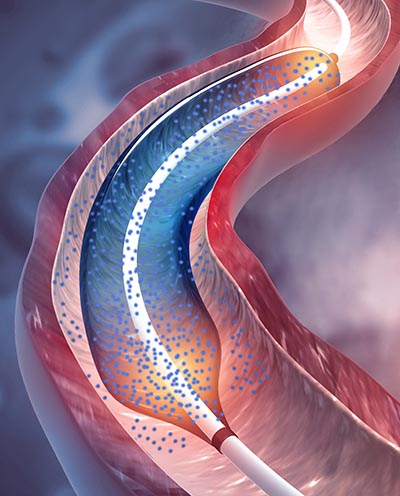 Drug-Eluting Balloons
Drug coated angioplasty balloons, also called Drug Eluting Balloons or DEB’s, have been developed to manage the significant problem of NIH-mediated blood vessel restenosis. Currently, DEB’s are coated with anti-proliferative drugs including paclitaxel (PTX) and more recently sirolimus. PTX coated DEB, have demonstrating improved rates of 1-year restenosis over plain balloon angioplasty4 while sirolimus coated DEB are yet to demonstrate comparable long-term efficacy in NIH restenosis management in PAD compared to PTX DEB.
Lumi-Solve is a paradigm shifting advance in DEB therapy precisely targeting a novel UV-activated epigenetic drug (c-Metacept-3) to the specific site of NIH-affected arterial narrowing utilising a Swiss fibre-optic-driven activation mechanism to optimize safety and efficacy during deployment of the device5.
-
References
- Sampson UK, Fowkes FG, McDermott MM, Criqui MH, Aboyans V, Norman PE, et al. Global and regional burden of death and disability from peripheral artery disease: 21 world regions, 1990 to 2010. Glob Heart. 2014;9(1):145-58.e21. View
- Song P, Rudan D, Zhu Y, Fowkes FJI, Rahimi K, Fowkes FGR, et al. Global, regional, and national prevalence and risk factors for peripheral artery disease in 2015: an updated systematic review and analysis. Lancet Glob health. 2019;7(8):e1020-e30. View
- Dormandy JA, Rutherford RB. Management of peripheral arterial disease (PAD). TASC Working Group. TransAtlantic Inter-Society Consensus (TASC). J Vasc Surg. 2000;31(1 Pt 2):S1. View
- Caradu C, Lakhlifi E, Colacchio EC, Midy D, Bérard X, Poirier M, et al. Systematic review and updated meta-analysis of the use of drug-coated balloon angioplasty versus plain old balloon angioplasty for femoropopliteal arterial disease. J Vasc Surg. 2019;70(3):981-95.e10. View
- Liu H, Sama GR, Robinson A, Mountford S, E Thompson P, Rodda A, et al. Design, Development, In Vitro and Preliminary In Vivo Evaluation of a Novel Photo-Angioplasty Device: Lumi-Solve. Cardiovasc Eng Technol. 2021. View