
Applications of integration
Integration is used in a wide variety of contexts. It can be used to determine areas of two-dimension regions. This can be expanded upon to find surface areas and volumes! Below are some such examples of how integration techniques can be used effectively.
Use this page to revise the following concepts within applications of integration:
Average value
The average value of a function is the average height above the \(x\) axis over the specified interval of \(x\).
Graphically, the average value of a function over the interval \(x \in \left[a,b\right]\) is the height of the rectangle over that interval that has the same area as the function over that interval.
Consider \(y = \dfrac{1}{2}x^{2}\), \(x \in [0,3]\)
- Area under the curve is 4.5
- Hence, the height of the rectangle with the same area is 1.5. This is also the average value of the function.

The average value of a function, \(f\left(x\right)\) over the interval \(x \in [a,b]\) is:
\[\text{Average} = \frac{1}{b -a}\int_{a}^{b}f\left(x\right)dx\]
Worked Example
The average value of \(f\left(x\right) = 3\cos\left(\frac{x}{2}\right)\) over \(x \in [0,\pi]\) is:
\[\begin{align}\text{Average} &= \frac{1}{\pi - 0}\int_{0}^{\pi}3\cos\left(\frac{x}{2}\right)dx \\ &=\frac{6}{\pi}\left[\sin\frac{x}{2}\right]_{0}^{\pi} \\ &=\frac{6}{\pi}\left(\sin\left(\frac{\pi}{2}\right) - \sin\left(0\right)\right) \\ &=\frac{6}{\pi}\end{align}\]
 Check your understanding
View
Check your understanding
View

Integration by recognition
Integration by recognition can sometime speed the finding of definite integrals. Consider, how is \(\int{e}^{5}\log_{e}\left(x\right)dx\) solved? This requires further integration techniques this to be done directly.
However, the function being integrated is the derivative of another function. Therefore, it can be solved indirectly by finding that original function.
Worked Example
Find \(\int_{1}^{5}{\log_e{(x)}dx}\) by first differentiating \(x\log_e{(x)}\).
- Find the derivative of the other provided function, \(x\log_e{(x)}\), first:
- Rewrite statement from derivative to integral:
- Rearrange the integral to find the required integral:
- Use this result to compute the required integral:
\[\begin{align}&\frac{d}{dx}\left(x\log_{e}\left(x\right)\right) \\ =&\log_{e}\left(x\right) + x \times \frac{1}{x} \\ =& \log_{e}\left(x\right) + 1\end{align}\]
Therefore \(\dfrac{d}{dx}\left(x\log_{e}\left(x\right)\right) = \log_{e}\left(x\right) + 1\)
\[\frac{d}{dx}\left(x\log_{e}\left(x\right)\right) = \log_{e}\left(x\right) +1 \longleftrightarrow \int\log_{e}\left(x\right) + 1dx = x\log_{e}\left(x\right)\]
\[\begin{align}\int\log_{e}\left(x\right) + 1dx &= x\log_{e}\left(x\right) \\ \int\log_{e}\left(x\right)dx + \int{1}dx& = x\log_{e}x \\ \int\log_{e}\left(x\right)dx + x &= x\log_{e}\left(x\right) \\ \int\log_{e}\left(x\right)dx &= x\log_{e}\left(x\right) - x\end{align}\]
\[\begin{align}\int_{1}^{5}\log_{e}\left(x\right)dx &= [x\log_{e}\left(x\right) - x]_{1}^{5} \\ &= \left(5\log_{e}\left(5\right) - 5\right) - \left(1\log_{e}\left(1\right) - 1\right) \\ &= 5\log_{e}5 - 4\end{align}\]
Check your understanding
View
General application of integration
Aside from being useful for determining areas, integration techniques are often used in rates of change problems. It is necessary to determine any boundary conditions associated with these problems in order to solve them, or develop an equation for the problem.
Worked Example
A spherical balloon is losing air. The rate of change of volume of the balloon is given by
\[\frac{dV}{dt} = -6t\ \text{mm}^{3}\text{/sec}\]
If the volume of the balloon is originally \(100\text{ mm}^3\) the rule for the volume at any time \(t\) can be found:
\[\begin{align}\frac{dV}{dt} &= -6t \\ V\left(t\right) &= \int-6t\ dt \\ V\left(t\right) &= -3t^{2} + c\end{align}\]
As \(V = 100\) when \(t = 0\)
\[\begin{align}100 &= -3\left(0\right)^{2} + c \\ c &= 100 \end{align}\]
Therefore \(V\left(t\right) = 100 - 3t^{2}\).
Check your understanding
View
Worked Example
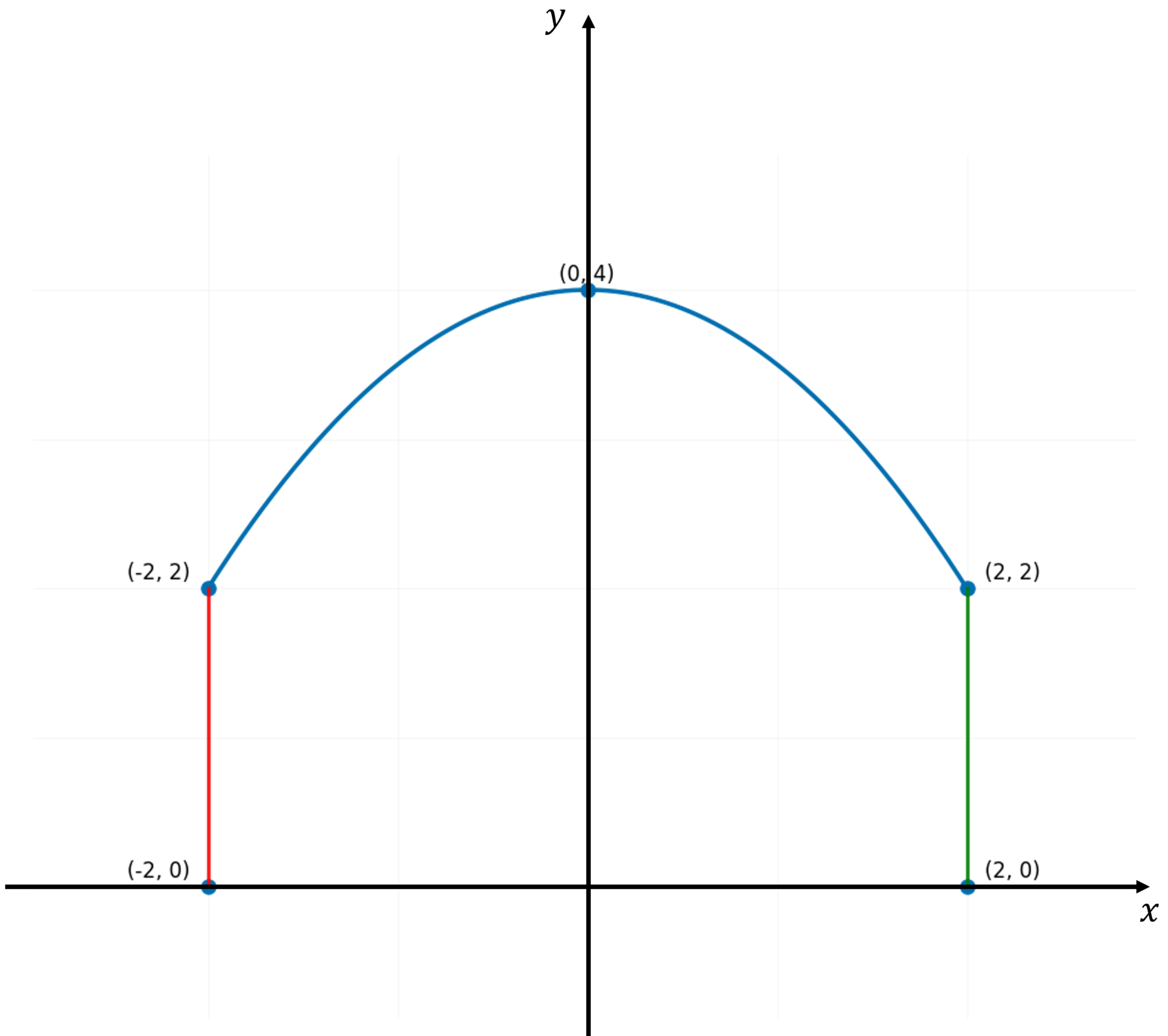
A proposed shed is to be built such that its cross section consists of two \(2\text{ m}\) walls that are \(4\text{ m}\) apart, with an inverted parabolic roof. The total height of the shed is \(4\text{ m}\). Determine the cross-sectional area of the shed:
- Sketch the situation
- Develop equations for the situation
- Create and solve an appropriate integral:

\[\begin{align}&\int_{-2}^{2}4 - \frac{1}{2}x^{2}dx \\ =&2\int_{0}^{2}4 - \frac{1}{2}x^{2}dx \\ =& \int_{0}^{2}8 - x^{2}dx \\ =&\left[8x - \frac{1}{3}x^{3}\right]_{0}^{2} \\ =&\left(16 - \frac{8}{3}\right) - \left(0 - 0\right) \\ =&\frac{40}{3}\ \text{m}^2\end{align}\]