
The unit circle
Structure of the Unit Circle
The unit circle is defined as a circle of radius 1, centred on the origin. The circumference around a circle is given by \(C = 2\pi{r}\). As the radius of the unit circle is 1, the circumference is \(C = 2\pi\) units.

We often need to discuss the direction and degree of rotation and angles around the unit circle. Moving in an anticlockwise direction, for example, moving from point \(A\) to point \(B\), is considered a positive rotation, while moving in a clockwise direction, from point \(A\) to point \(D\), is considered a negative rotation. We can also describe the angles formed between a radius line of the unit circle and the axes. These angles and rotations can be measured in degrees or radians.
 Check your understanding
View
Check your understanding
View

Degrees and Radians
The unit circle has a distance around the circumference of \(C =2\pi\) units.

The distance around the circumference from \(A\) to \(P\) is 1 unit. The angle that is formed at the origin of the circle that corresponds to this distance is called a radian. By this metric, we can also see the the angle from A all the way around and back to A is \(2\pi\) radians.
The unit of measurement for radian is \(\text{rad}\). Often, the unit is omitted; for example \(\frac{\pi}{4}\) is assumed to refer to \(\frac{\pi}{4}\) radians. Angles measured in degrees always include the unit symbol, for example 45°.
Common radian measurements can be taken from breaking up the unit circle.
Converting between degrees and radians
\(1 \text{ radian} = \dfrac{180^\circ}{\pi}\) and \(1^\circ = \dfrac{\pi}{180}\)
Therefore to convert from Degrees to Radians
\[x^{\circ} \times \frac{\pi}{180}\]
and to convert from Radians to Degrees
\[x \times \frac{180^{\circ}}{\pi}\]
Have a look at the worked example before trying some for yourself.
Worked Example
Convert 45° to radians
\[x^{\circ} \times \frac{\pi}{180}\]
\[\begin{align}&= 45^{\circ} \times \frac{\pi}{180} \\ &= \frac{45 \times \pi}{180} \\ &= \frac{\pi}{4}\end{align}\]
Worked Example
Convert \(5\pi\) to degrees
\[x \times \frac{180^{\circ}}{\pi}\]
\[\begin{align}&= 5\pi \times \frac{180^{\circ}}{\pi} \\ &= \frac{5\pi \times 180^{\circ}}{\pi} \\ &= 900^{\circ}\end{align}\]
Check your understanding
View
Defining Circular Functions: Sine, Cosine and Tangent
Circular functions can be defined using a point \(P\) on a unit circle.

Point \(P\) of the right-angled triangle \(\triangle AOP\) is located on the unit circle. We can describe the position of \(P\) using \((x,y)\) coordinates. The value of \(x\) and \(y\) will depend on the angle \(\theta\). We can measure \(\theta\) as the angle from the \(x-\)axis to the line \(\overline{OP}\).
Cosine and Sine
We can use trigonometry to determine the coordinates of \(P(x, y)\).
From the right-angled triangle \(\triangle OAP\) we can see that:
\(\overline{OA} = x \)
\(\overline{OP} = 1\); as for the unit circle \(r=1\)
And using the principles of trigonometry we can then define:
\(\begin{align}\cos\left(\theta\right) &= \dfrac{Adjacent}{Hypotenuse} \\ \cos\left(\theta\right) &=\dfrac{x}{1} \\ \cos\left(\theta\right) &= x\end{align}\)
Therefore, the \(x\)-coordinate of \(P\) is defined as \(x = \cos(\theta); \theta \in \mathbb{R}\).
Also, from the right-angled triangle \(\triangle OAP\):
\(\overline{AP} = y \)
\(\overline{OP} =1\); as it is the unit circle \(r=1\)
And from trigonometry:
\(\begin{align}\sin\left(\theta\right) &= \dfrac{Opposite}{Hypotenuse} \\ \sin\left(\theta\right) &= \dfrac{y}{1} \\ \sin\left(\theta\right) &= y\end{align}\)
Therefore, the \(y\)-coordinate of \(P\) is defined as \(y = \sin(\theta); \theta \in \mathbb{R}\).
Point \(P\) can then be defined in terms of \(\sin\) and \(\cos\):

The value of the \(x\)- and \(y\)-coordinates therefore varies only with the value of \(\theta\).
Importantly, we could also describe the same point \(P\), with the same coordinates \((\cos\theta, \sin\theta)\) using many other angles for \(\theta\), depending on how we measure \(\theta\).

We can measure the angle \(\theta_1\), directly from the \(x\)-axis to \(\overline{OP}\), or we can measure a full rotation around the origin from the the \(x\)-axis, and then to \(\overline{OP}\) as \(\theta_2\). Similarly, we could measure twice around the origin and then to \(\overline{OP}\) as \(\theta_3\), and could continue like this to infinity. The angle of a full rotation around a unit circle is \(2\pi\). Adding or subtracting integer multiples of \(2\pi\) still results in the same coordinates, \((\cos\theta, \sin\theta)\), meaning the relationship between \(P\) and \(\theta\) is many-to-one, and results in a periodicity that is fundamental to the behaviour of sine and cosine function.
Tangent
The last function to examine is \(\tan(\theta)\).
By drawing a tangent line at the point \(x = 1\) and extending the \(OP\) to intersect the tangent at \(C\), the coordinates of \(C\) are \((1,y)\) and two similar triangles have been created.

\(\triangle OAP\) and \(\triangle OBC\) are similar triangles. They have the same internal angle \(\theta\) and an equal ratio between their sides. That is
\(\overline{BC}:\overline{OB}=\overline{AP}:\overline{OA}\)
Taking the lengths of these lines from theunit circle, we can also write this as
\(y:1=\sin(\theta):\cos(\theta)\)
These equivalent ratios then imply
\(\begin{align} y &= \frac{\sin(\theta)}{\cos(\theta)} \\ y &= \tan(\theta)\end{align}\)
As \(\tan(\theta) = \frac{\sin(\theta)}{\cos(\theta)}\) then when \(\cos(\theta) = 0, \tan(\theta)\) is undefined as you can’t divide anything by 0. This means the domain of the function for \(\tan(\theta)\) is \(\theta \in \mathbb{R}\setminus \left\{\theta: \cos(\theta) = 0\right\}\)
This is read as the values at which \(\tan(\theta)\) exists include all possible values of \(\theta\) except for values where \(\cos(\theta) = 0\).
As \(\cos(\theta) = 0\) at odd multiples of \(\frac{\pi}{2}\), then \(\tan(\theta)\) is undefined when
\(\theta = \pm\frac{\pi}{2}, \pm\frac{3\pi}{2}, \pm\frac{5\pi}{2},\ \text{etc.}\)
Check your understanding
View
Symmetry Properties of the Unit Circle
The symmetry of the unit circle can be observed through dividing the circle into four quadrants. This symmetry will be valid for all possible values of \(\theta\).
We can use the symmetry of the unit circle to illustrate if \(\cos, \sin\) and \(\tan\) are positive or negative in the remaining quadrants. Click on the hotspots.
Check your understanding
View
Exact Values of Circular functions for Common Angles
While a calculator could provide all values of \(\sin(\theta)\), \(\cos(\theta)\) or \(\tan(\theta)\), some values within the unit circle can be easily calculated with exact values by understanding some special triangles.
Sin, Cos and Tan of 0 and \(\dfrac{\pi}{2}\left(90^{\circ}\right)\)
The unit circle shows that the coordinates of \((x,y)\) when \(\theta = 0\) is \((1,0)\), and \((0, 1)\) when \(\theta=\frac{\pi}{2}\).

We know that for any point, \((x,y)\), on the unit circle \(x=\cos(\theta)\) and \(y = \sin(\theta)\). Therefore, we can determine exact values when \(\theta=0\).
\(\begin{align}\ \cos(0) &= 1 \\ \sin(0) &=0\end{align}\)
As \(\tan(\theta) = \dfrac{sin(\theta)}{\cos(\theta)}\) then
\(\tan(0) = \dfrac{0}{1} = 0\)
When \(\theta = \frac{\pi}{2}, (x,y)\) is \(\left(0,1\right)\)
Therefore,
\(\begin{align} \cos\left(\frac{\pi}{2}\right) &= 0 \\ \sin\left(\frac{\pi}{2}\right) &= 1\end{align}\)
As \(\tan(\theta) = \frac{\sin(\theta)}{\cos(\theta)}\), then
\(\tan(\frac{\pi}{2}) = \frac{1}{0} =\text{undefined}\)
Sin, Cos and Tan of \(\frac{\pi}{6}\left(30^{\circ}\right)\) and \(\frac{\pi}{3}\left(60^{\circ}\right)\)
An equilateral triangle of side length 2 has equal angles of 60°. It can be shown that the a right angle triangle of side lengths \(1, \sqrt{3}\) and \(2\) will have angles 60° and 30°. Therefore, the exact values of sin, cos and tan for \(\dfrac{\pi}{6}\left(30^{\circ}\right)\) and \(\dfrac{\pi}{3}\left(60^{\circ}\right)\) can be determined from this triangle.

Sin, Cos and Tan of \(\frac{\pi}{4} \left(45^{\circ}\right)\)
A right angled isosceles triangle has two equal angles of 45°. By taking the two equal side lengths as 1, and by Pythagoras' theorem the hypotenuse is \(\sqrt{2}\). The exact values for sin, cos and tan of \(\frac{\pi}{4}\left(45^{\circ}\right)\) can be determined from this triangle.

From the special triangles, we can compile a useful table of exact values for \(\sin, \cos\) and \(\tan\) of common angles.
| \(\theta\) | \(\dfrac{\pi}{6}\quad(30^{\circ})\) | \(\dfrac{\pi}{3}\quad(60^{\circ})\) | \(\dfrac{\pi}{4}\quad(45^{\circ})\) |
|---|---|---|---|
| \(\cos(\theta)\) | \(\dfrac{\sqrt{3}}{2}\) | \(\dfrac{\sqrt{1}}{2}\) | \(\dfrac{1}{\sqrt{2}}=\dfrac{\sqrt{2}}{2}\) |
| \(\sin(\theta)\) | \(\dfrac{\sqrt{1}}{2}\) | \(\dfrac{\sqrt{3}}{2}\) | \(\dfrac{1}{\sqrt{2}}=\dfrac{\sqrt{2}}{2}\) |
| \(\tan(\theta)\) | \(\dfrac{\sqrt{3}}{2}\) | \(\sqrt{3}\) | \(1\) |
.
Worked Example
Use the special triangles tables to find the exact value of \(\sin\left(\frac{\pi}{6}\right), \cos\left(\frac{\pi}{6}\right), \tan\left(\frac{\pi}{6}\right)\)
- \(\dfrac{\pi}{6} = 30^{\circ}\)
- From the special triangles exact values table:
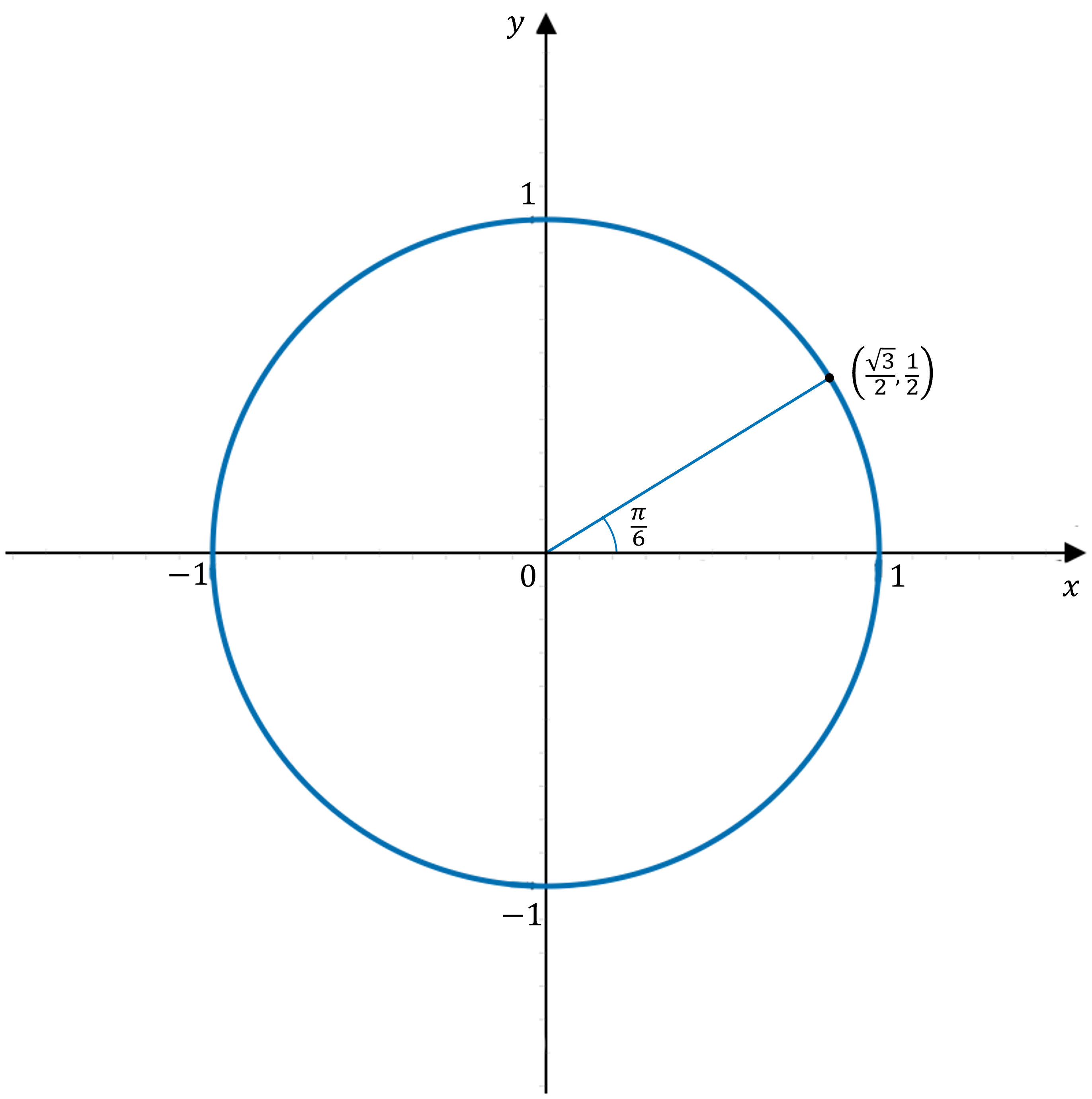
- From these values we can also plot a point on the unit circle that corresponds to a radius line at angle \(\frac{\pi}{6}\) from the horizontal
\[\begin{align} \sin\left(\frac{\pi}{6}\right) &= \frac{1}{2} \\ \cos\left(\frac{\pi}{6}\right) &= \frac{\sqrt{3}}{2} \\ \tan\left(\frac{\pi}{6}\right) &= \frac{\sqrt{3}}{3} \end{align}\]
Check your understanding
View
Worked Example
Using symmetry properties of the unit circle, calculate the following:
- \(\sin\left(\dfrac{5\pi}{6}\right)\)
- \(\cos\left(\frac{7\pi}{6}\right)\)
- \(\tan\left(\dfrac{11\pi}{6}\right)\)

By symmetry properties, \(\frac{5\pi}{6}\) is the same angle as \(\frac{\pi}{6}\), but measured clockwise from the horizontal \(\pi-\frac{\pi}{6}\).
We know the exact value of \(\sin\left(\frac{\pi}{6}\right)\) from the special triangles table above, and we know that solutions of \(\sin(\theta)\) are positive in the second quadrant.
Therefore,
\(\sin\left(\frac{5\pi}{6}\right) = \sin\left(\pi - \frac{\pi}{6}\right) = \sin\left(\frac{\pi}{6}\right) = \frac{1}{2}\)
By symmetry properties
\(\cos\left(\frac{7\pi}{6}\right) = \cos\left(\pi + \frac{\pi}{6}\right) = -\cos\left(\frac{\pi}{6}\right) = -\frac{\sqrt{3}}{2}\)

By symmetry properties
\(\tan\left(\frac{11\pi}{6}\right) = \tan\left(2\pi - \frac{\pi}{6}\right) = -\tan\left(\frac{\pi}{6}\right) = -\frac{\sqrt{3}}{3}\)

Check your understanding
View
The Pythagorean Identity
Trigonometric identities are a result of formulas that will be true for all values of \(\theta\) (or any variable used in its place). One of the most fundamental of these is the Pythagorean identity, which relates the squares of the sine and cosine of an angle to the value of one.
Pythagorean Identity
Consider a point \(P(\theta)\) in the first quadrant of the unit circle.

From the Pythagoras Theorem:
\[\left(\cos\left(\theta\right)\right)^{2} + \left(\sin\left(\theta\right)\right)^{2} = 1\]
Rewriting \(\left(\cos\left(\theta\right)\right)^{2}\text{ as }\cos^{2}\left(\theta\right)\text{ and }\left(\sin\left(\theta\right)\right)^{2} \text{ as }\sin^{2}\left(\theta\right)\)
The Pythagorean identity is defined as
\[\cos^{2}\left(\theta\right) + \sin^{2}\left(\theta\right) = 1\]
For all values of \(\theta\)