
Perimeter and area
Common geometric shapes include triangles, quadrilaterals and circles, and many everyday objects have faces that are made up of these shapes.
The perimeter of a shape refers to the length of its boundary. For a circle this is also referred to as its circumference. Formulas for perimeter will involve a sum of lengths and/or multiple of a length or lengths, depending on the shape being considered.The metric units for perimeter are length units, such as, centimetre, \(\text{cm}\), metre, \(\text{m}\) or kilometre, \(\text{km}\).
The area of a shape is the measure of the region its boundary encloses (its interior). Formulas for area will involve a product of two lengths or multiple of the square of a length, depending on the shape being considered. The metric units for area are square units such as square centimetre, \(\text{cm}^2\); square metre, \(\text{m}^2\); or square kilometre, \(\text{km}^2\).
Use this page to revise the concepts of perimeter and area of:
NoteThe diagrams of shapes and objects in this topic are illustrative and not necessarily drawn to scale. Answers to practical problems are specified to an accuracy suitable for the context, for example, a length may be calculated to the nearest centimetre, or 0.01 of a metre. |
Triangles
Triangles are polygons with three sides, and interior angles that sum to \(180^\circ\). The perimeter and area of a triangle can be calculated from known lengths. For some triangles, unknown lengths can be inferred from known lengths. For example, Pythagoras Theorem can be used to calculate the length of the third side given the lengths of the other two sides. This is revised in detail on the next page.
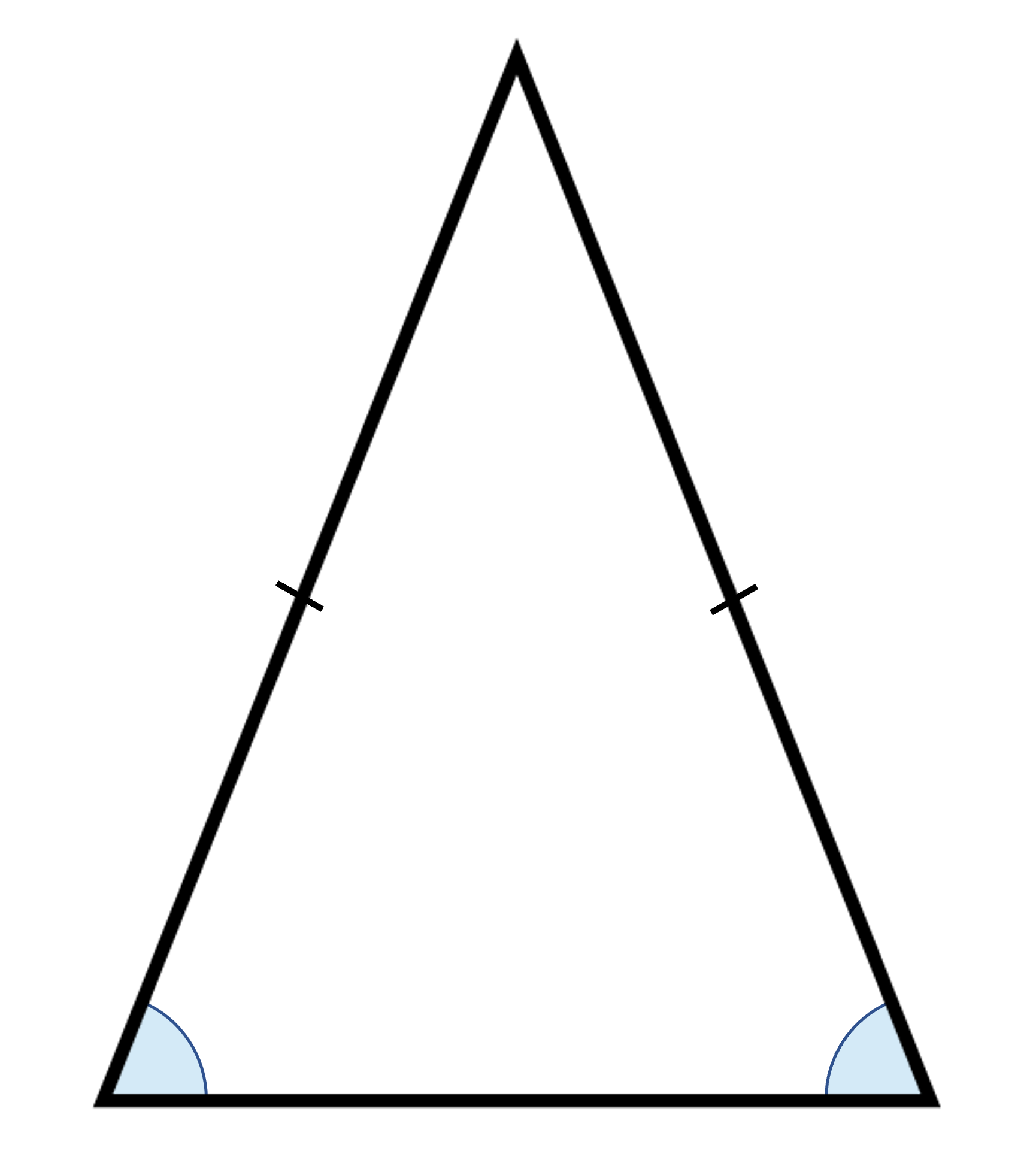
There are four types of triangles as shown in the table below:
| Type of Triangle | Example |
|---|---|
Equilateral – all sides are the same length and all angles are equal. | 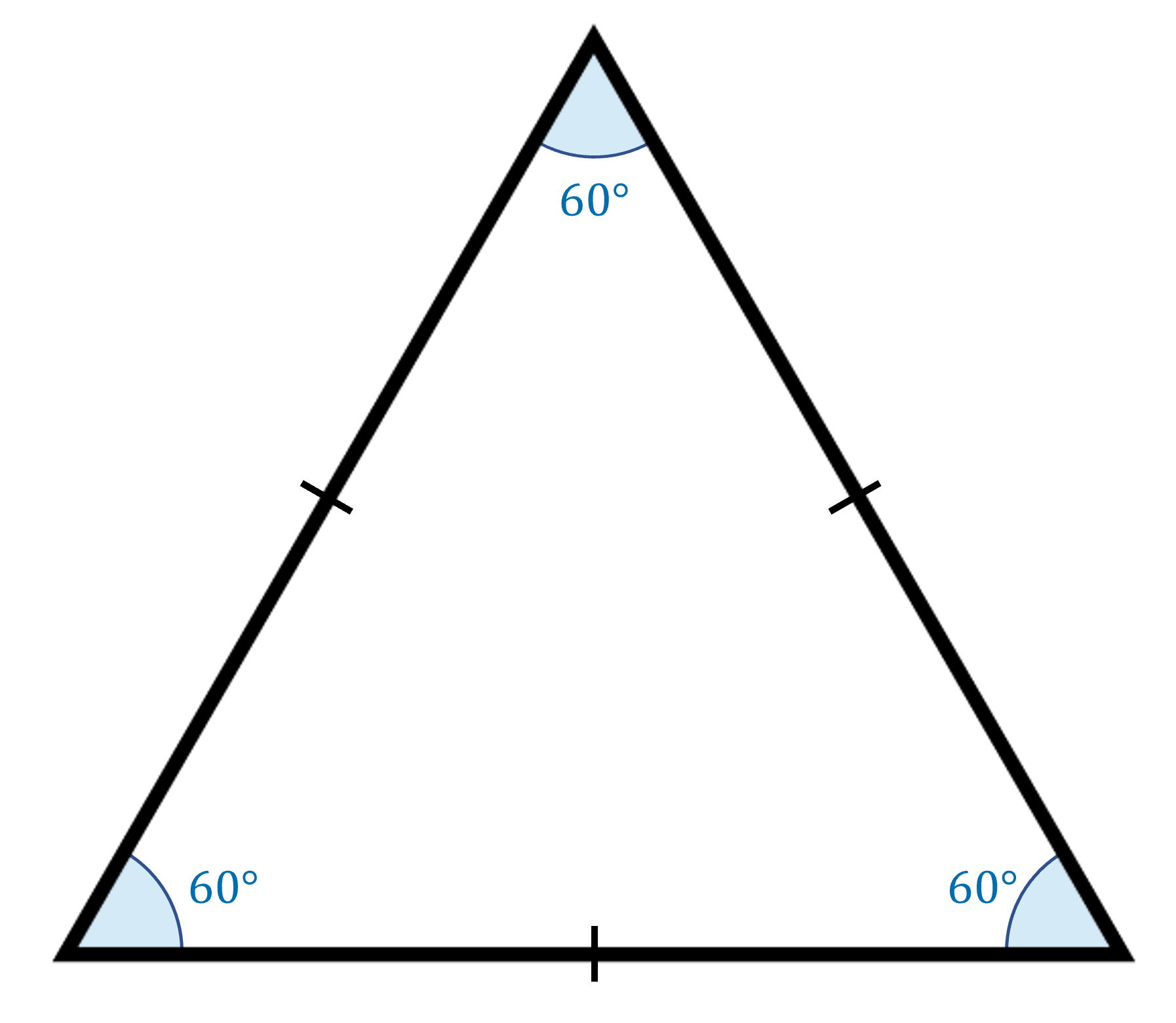
|
Isosceles – two sides are the same length and two angles are equal |
|
Scalene – all sides are of different length | 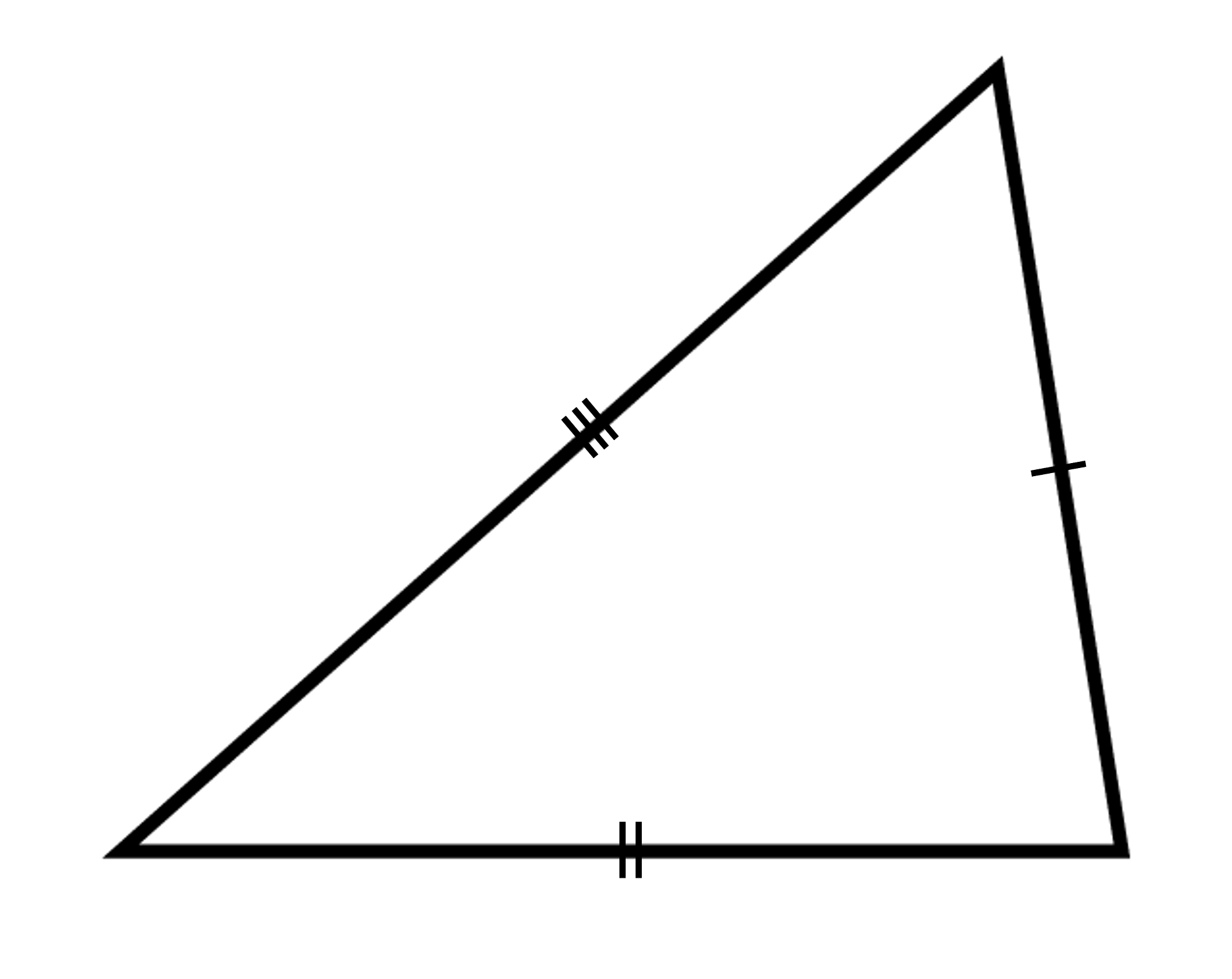
|
Right - contains a right-angle | 
|
Perimeter of a triangle
The perimeter of a triangle is sum of the lengths of its three sides. If the side lengths are \(a,b,c\) then:
\[\text{Perimeter} = a + b + c\]
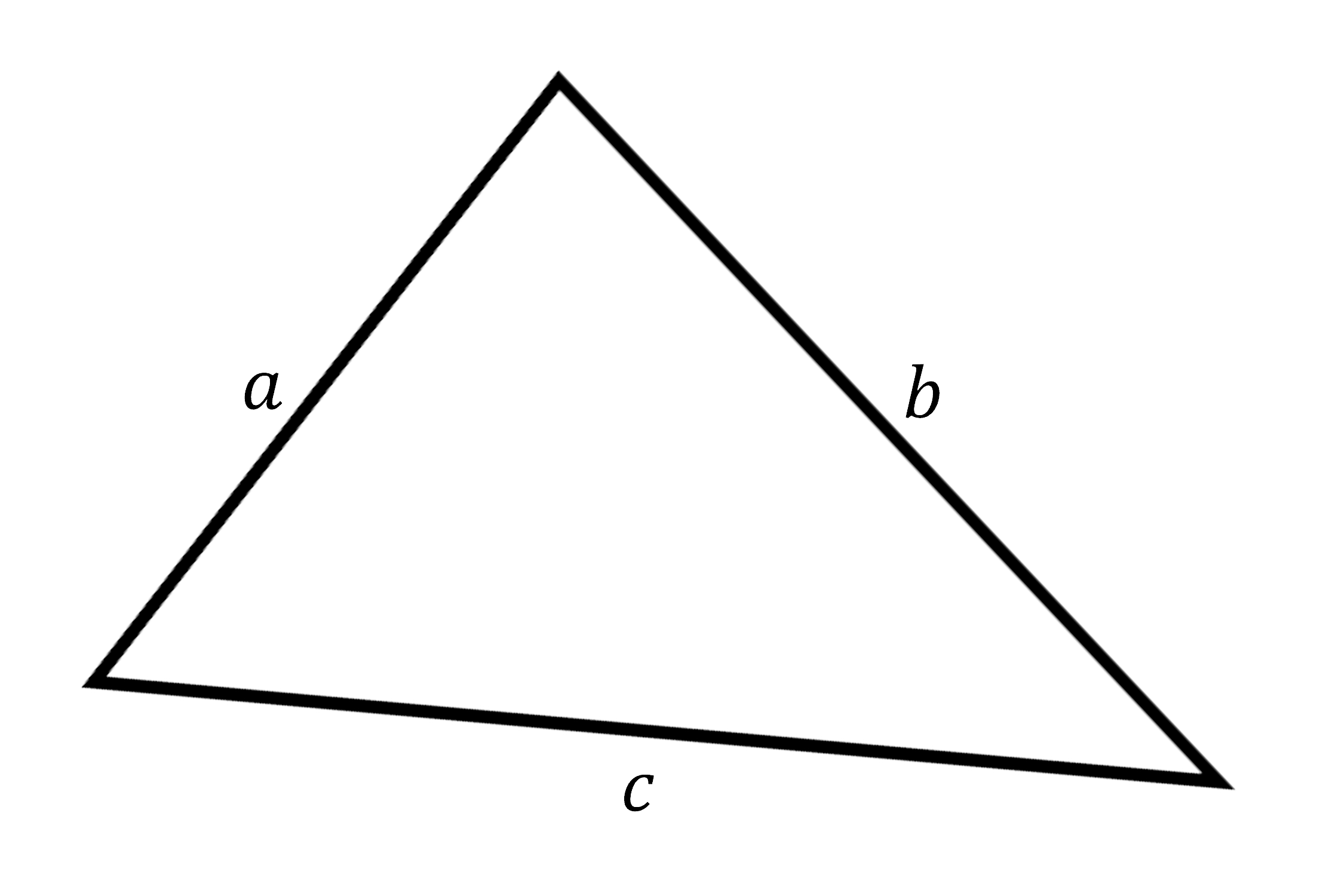
For an equilateral triangle with side length \(a\), the perimeter is equal to \(3a\).
Area of a triangle
If the base, \(b\), and the height, \(h\), of the triangle are known, then the area of the triangle is half of its base multiplied by its height, that is:
\[ \text{Area} = \frac{1}{2} \times \text{base} \times \text{height} = \frac{1}{2} bh \]
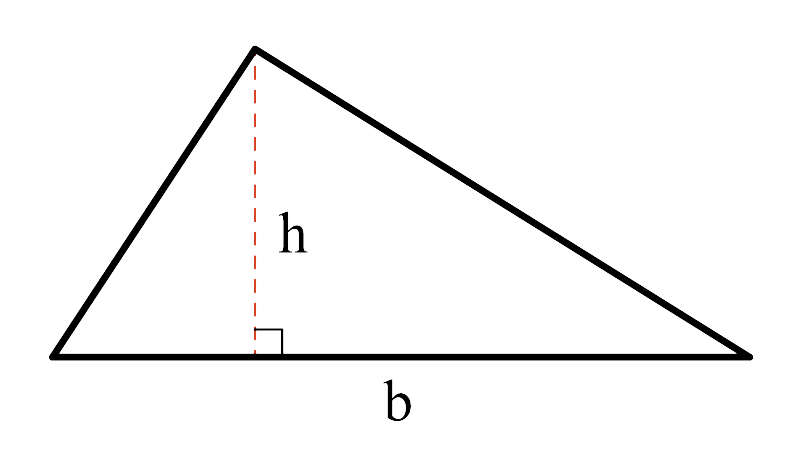
For an equilateral triangle with side length \(a\), this formula can be combined with an application of Pythagoras' Theorem to show that the area of an equilateral triangle is
\[ \text{Area(equilateral}\triangle) =\frac{\sqrt{3}}{4} a^2 \]
For a scalene triangle, with side lengths \(a, b, c\) where the height is not known, the area can be calculated using Heron’s formula
Worked Example 1
A right-angled triangle has side lengths 6, 8, and 10 metres.
For this triangle, find:
- the perimeter
- the area
|
The perimeter is \(6 + 8 +10 = 24\text{ m}\) The area is \(\begin{align} \text{Area} &= \frac{1}{2}bh\\ \text{Area}&= \frac{1}{2} \times 8 \times 6\\ &= 24\text{ m}^2 \end{align}\) | 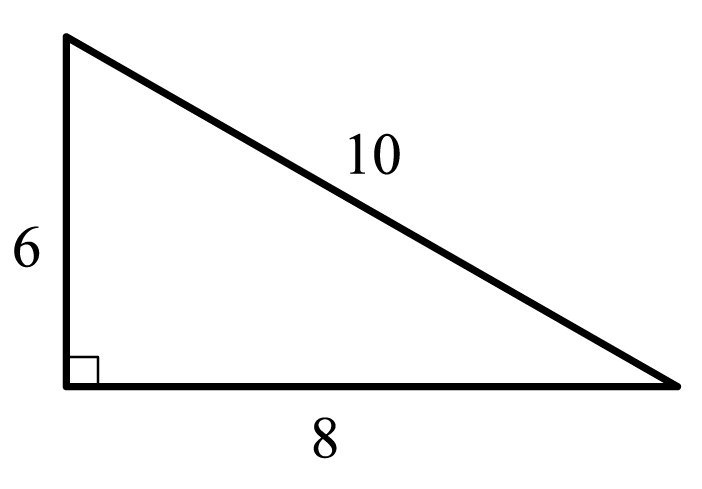
|
Worked Example 2
An equilateral triangle has side lengths of 12 cm. What is:
- Its perimeter
- Its area
The perimeter is \(3 \times 12 = 36\text{ cm}\). To calculate the area, the vertical height, \(h\), needs to be found. This can be determined by dividing the triangle in half as shown in the diagram and applying Pythagoras' Theorem: \[6^2 + h^2 = 12^2\] \[36 + h^2 = 144\] \[h^2 = 108\] \[h = \sqrt{108}\] \[ h \approx 10.39 \text{ cm} \] The area is \(6 \times \sqrt{108} \approx 62.35 \text{ cm}^2\). |
|

Worked Example 3
A scalene triangle has side lengths \(5\text{ m}, 8\text{ m}, 11\text{ m}\), what is:
- Its perimeter
- Its area
The perimeter is \(5 + 8 + 11 = 24\text{ m}\). To calculate the area, Heron’s formula is used. The semi-perimeter is \( s = \frac{24}{2} = 12\text{ m} \). Then, the area is \(\begin{align} \text{Area}&=\sqrt{12(12-11)(12-8)(12-5)}\\ &=\sqrt{12\times 1\times 4 \times 7} \\ &=\sqrt{336} = 18.3 \text{ m}^2 \end{align}\) |  |
 Check your understanding
View
Check your understanding
View

Quadrilaterals
A quadrilateral is any polygon with four sides, four vertices, and four angles that sum to \(360^\circ\). It can be regular, with equal sides and angles, or irregular. Common examples include squares, rectangles and trapeziums.
Perimeter and area of a rectangle
A rectangle is a quadrilateral with two pairs of parallel sides at right angles to each other. The key measures of a rectangle are length and width.
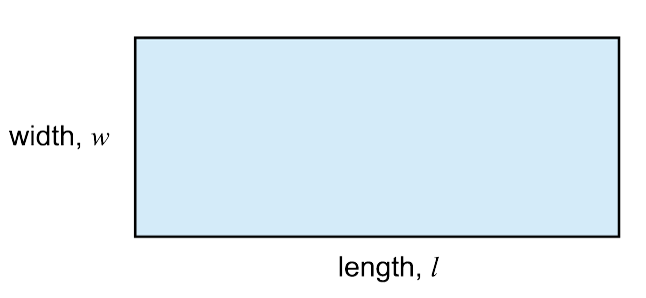
The area and perimeter of the rectangle can then be calculated by
\[\text{Perimeter}=2l+2w=2(l+w)\]
\[\text{Area}=l\times w\]
Where:
- \(l\) is the length of the rectangle
- \(w\) is the width of the rectangle
Perimeter and area of a trapezium
A trapezium is a a quadrilateral with a pair of parallel sides. The key measures of a trapezium are the side lengths, and the height.

The area and perimeter of the trapezium can then be calculated by
\[\text{Perimeter}=a+b+c+d\]
\[\text{Area}=\frac{h}{2}(a+b)\]
Where:
- \(a\) and \( b\) are the lengths of the parallel sides of the trapezium
- \(c\) and \(d\) are the lengths of the other sides
- \(h\) is the height of the trapezium
The formula for the area of the trapezium is derived from the sum of the areas of the rectangle and the areas of the triangles that make up the trapezium. We know the area of the triangles can be calculated as \(2 \times \frac{1}{2}\text{base}\times\text{height}\), and that the base of each triangle can be found by \(\frac{b-a}{2}\), and the width of the rectangle is \(w=h\). Therefore
\(\begin{align} \text{Area of the trapezium} &= 2\times \dfrac{1}{2}\left(\dfrac{b-a}{2} \times h\right)+a\times h \\ &=h\left(a+\dfrac{b-a}{2}\right) \\ &=h\left(\dfrac{2a+b-a}{2} \right) \\ &=\dfrac{h}{2}(a+b)\end{align}\)
Worked Example
An isosceles trapezium is formed by joining two right-triangles with side lengths of \(3, 4\) and \(5\text{ cm}\) at each end of a \(4\text{ cm}\) by \(10\text{cm}\) rectangle as shown in the diagram below:

Calculate the perimeter and area of the trapezium.
\(\begin{align} \text{Perimeter}&=a+b+c+d \\ &=10+(2\times 3+10)+2\times 5 = 36\text{ cm}\end{align}\)
\(\begin{align} \text{Area}&= \dfrac{h}{2}(a+b) \\ &=\dfrac{4}{2}(10+(2\times 3+10) = 52\text{ cm}^{2} \end{align}\)
Check your understanding
View
Circles
Calculating the circumference and area of circles require unique formulas due to the unique, curved shape of circles.
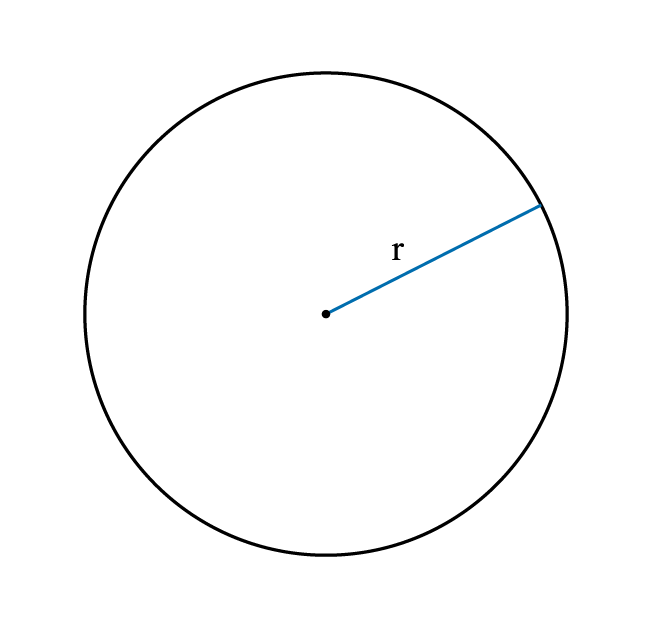
These formulas involve the number \(\pi\) and the length of the radius, \(r\), of the circle, or its diameter, \(d\), where the diameter is twice the radius, that is \(d = 2 r\).
The number \( \pi \) is defined as a ratio
\[ \pi = \frac{C}{d} \]
Where:
- \(C\) is the circumference of a circle
- \(d\) is the diameter of the circle
As all circles are similar, this ratio is the same for any circle.
\( \pi\) is an irrational number, that is, it cannot be expressed as a finite or infinite recurring decimal number. A commonly used approximations for \( \pi\) is \(3.14\).
Circumference of a circle
As \(\pi = \frac{C}{d}\) , the circumference of a circle is given by
\[ C = \pi d = 2\pi r \]
Where:
- \(C\) is the circumference
- \(d\) is the diameter
- \(r\) is the radius
Area of a circle
The area of a circle is given by
\[ \text{Area} = \pi r^2 = \pi \frac{d^2}{4} \]
Where:
- \(C\) is the circumference
- \(d\) is the diameter
- \(r\) is the radius

Note
The formulas for the circumference of a circle are sometimes confused as they both involve \(\pi\) and \(r\). This can be avoided by recalling that \(C\) is a measure of length, so its formula involves a multiple of the length, \(r\), while area must involve square units, so its formula involves a multiple of \(r^2\). |
Worked Example 1
A circle has a radius of \(25\text{ cm}\), what is:
- Its diameter
- Its circumference
- Its area
Diameter:
\(\begin{align} d &= 2r \\ &= 2 \times 25 = 50\text{ cm} \end{align}\).
Circumference:
\(\begin{align} C &= \pi d \\& =\pi \times 50 =157.1 \text{ cm}\end{align}\).
Area:
\(\begin{align} \text{Area} &= \pi r^2 = \pi \times 25^2 = 1963.5\text{ cm}^2\end{align} \)
Worked Example 2
\(80\text{ m}\) of fencing is used to create an enclosed circular region in a field. What is:
- The radius of the circular region
- Its area
The circumference of the circular region is \( 2\pi r =80 \text{ m}\).
Hence the radius of the circular region is
\( r = \frac{80}{2\pi} = 12.73\text{ m} \)
Area:
\( A = \pi r^2 = \pi \times 12.73^2 = 509.3 \text{ m}^2 \)