
Applications to continuous probability
Integration techniques can be used to determine probabilities for any probability that is continuous.
The function that models this probability is called a probability density function.
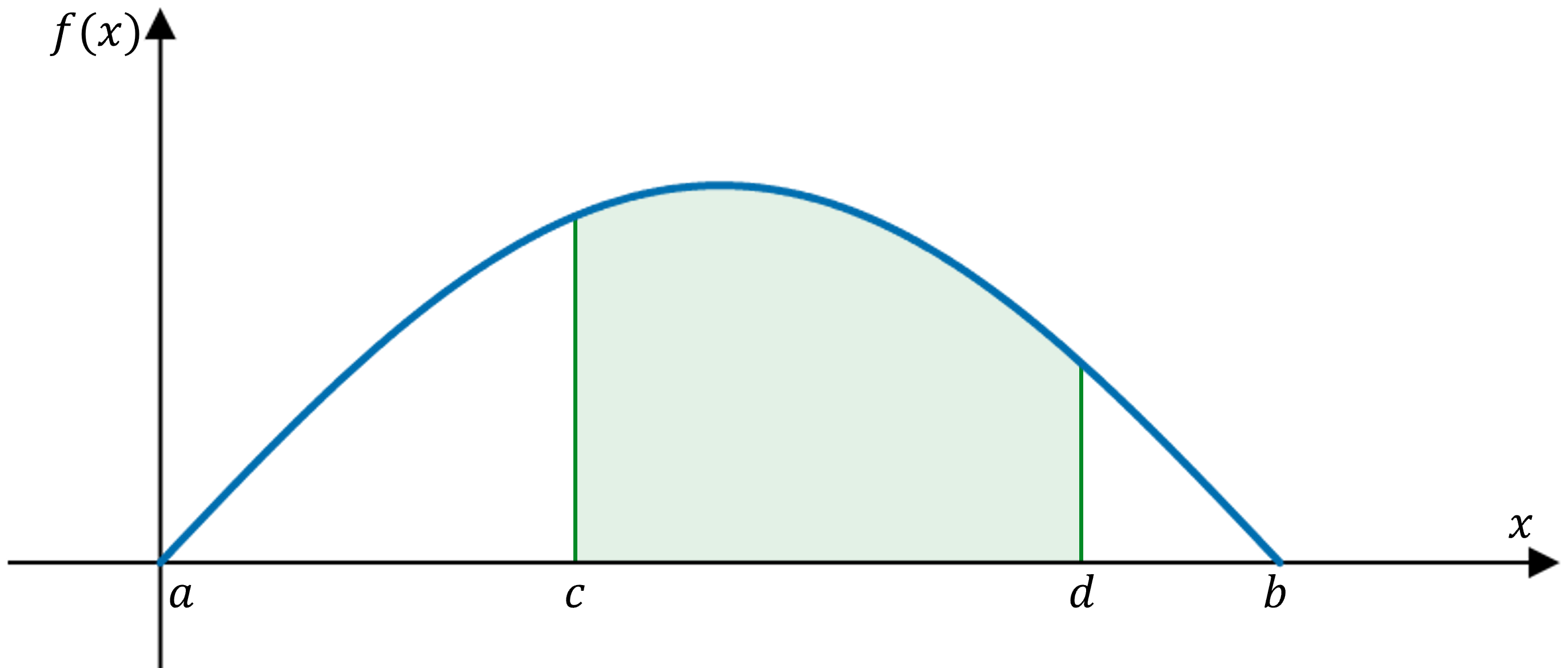
A probability density function \(f\left(x\right)\) is a function with a domain \(x \in [a,b]\) such that:
- All the probabilities are \(0\) or positive: \(f\left(x\right) \geq 0\) for all \(x \in [a,b]\)
- The sum of all probabilities is \(1\): \(\displaystyle\int_{a}^{b}f\left(x\right)dx = 1\)
- The probability of \(Pr \left(c < X < d\right)\) is given by \(\displaystyle\int_{c}^{d}f\left(x\right)dx\)
Worked Example
Consider the probability density function \(f\left(x\right) = \dfrac{1}{2}\sin\left(x\right)\) for \(x \in [0,\pi]\).
Show that \(f\left(x\right)\) is a probability density function, and hence find \(Pr\left(\dfrac{\pi}{6} < x < \dfrac{\pi}{2}\right)\)
First show that \(\displaystyle\int_{0}^{\pi}\frac{1}{2}\sin\left(x\right)dx = 1\)
\[\begin{align}&\int_{0}^{\pi}\frac{1}{2}\sin\left(x\right)dx \\ &=-\frac{1}{2}[\cos\left(x\right)]_{0}^{\pi} \\ &=-\frac{1}{2}\left(\cos\left(\pi\right) - \cos\left(0\right)\right) \\ &= -\frac{1}{2}\left(-1 -1\right) \\ &=1\end{align}\]
Then find the integral to determine the area between \(x = \dfrac{\pi}{6}\) and \(x = \dfrac{\pi}{2}\)
\[\begin{align}&Pr\left(\frac{\pi}{6} < x< \frac{\pi}{2}\right) = \int_{\frac{\pi}{6}}^{\frac{\pi}{2}}\frac{1}{2}\sin\left(x\right)dx \\ &=-\frac{1}{2}[\cos\left(x\right)]_{\frac{\pi}{6}}^{\frac{\pi}{2}} \\ &=-\frac{1}{2}\left(\cos\left(\frac{\pi}{2}\right) - \cos\left(\frac{\pi}{6}\right)\right) \\ &= -\frac{1}{2}\left(0 - \frac{\sqrt{3}}{2}\right) \\ &=\frac{\sqrt{3}}{4}\end{align}\]
 Check your understanding
View
Check your understanding
View

Continuous probability using integration techniques is further expanded on here.