
Bearings and navigation
Applications of trigonometry extend into navigation and GPS through the use of true bearings. True bearings are also known as three-figure bearings as a true bearing requires three figures. True bearings are always measured clockwise from North around to the required direction.
Use this page to revise the following concepts within bearings and navigation:
Finding the bearing
True bearings are always measured clockwise from North around to the required direction. When determining a true bearing:
- Draw a North, South, East, West (NSEW) compass at the point being considered.
- Determine the size of the angle that is being swept from North in a clockwise motion.
A NSEW compass can provide useful reference angles for true bearings.
 Check your understanding
View
Check your understanding
View

Application of bearings and navigation
Navigation requires a direction or bearing and a required distance to be travelled. As a NSEW compass can be assigned to each key point the angle being measured will help form a right-angled triangle and hence the skills of trigonometry can be applied when solving navigation problems.
Worked Example
A student camped out beside a river bank that ran North-South. They walked from point \(A\) on the river bank to point \(B\), on a bearing of \(055^\circ\) for \(12\text{ km}\) as shown.
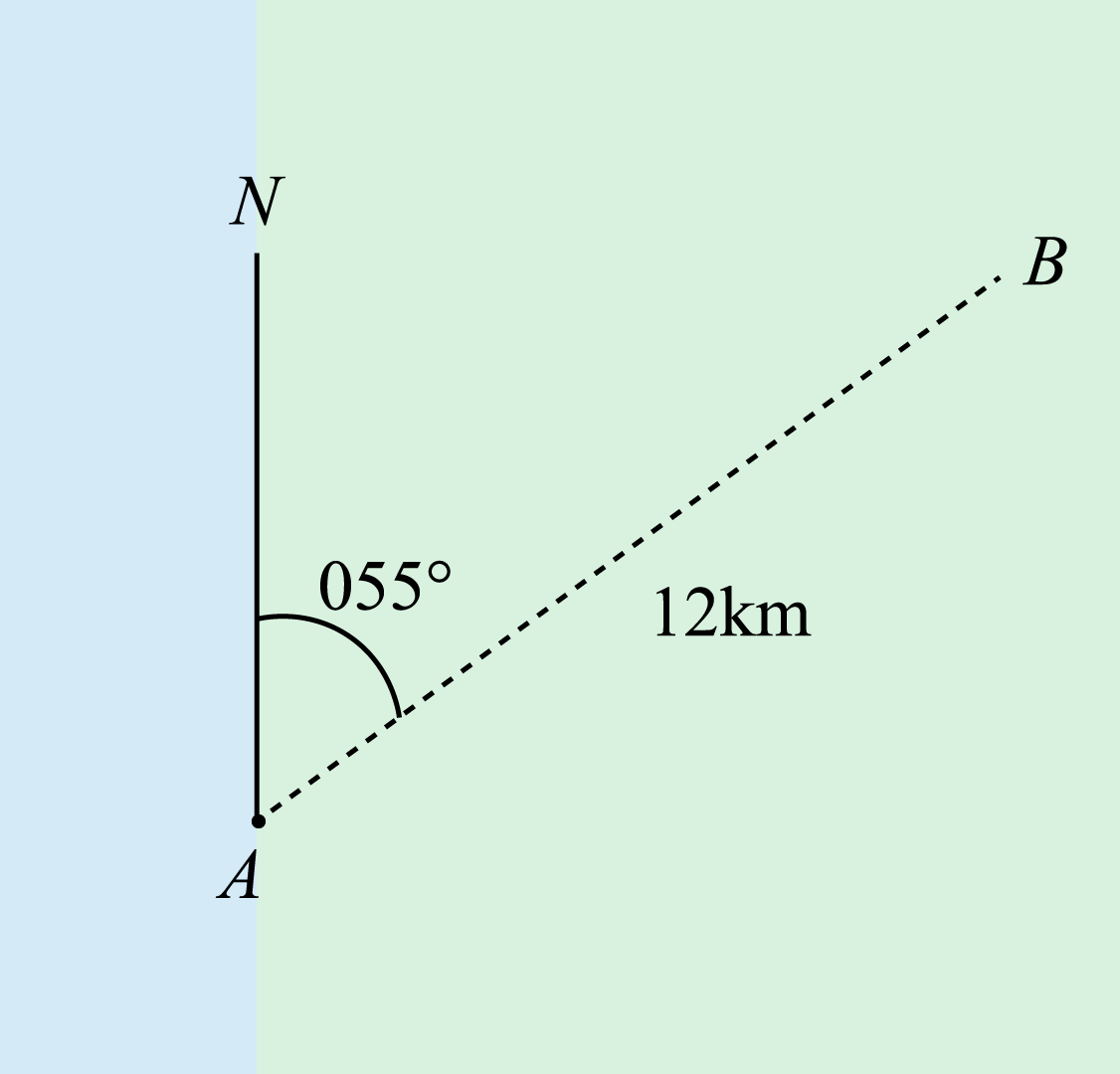
How far east of the river bank, to the nearest \(\text{ km}\), is the student when they arrive at point \(B\)?
1. Form right-angled triangle and label known sides

Use trigonometric ratio to solve for distance \(x\).
\[Hyp\times \sin(\theta)=Opp\]
\[12\times \sin(55)\approx9.8\]
2. To the nearest kilometre, point \(B\) is \(10\text{ km}\) east of the river.