Quadratics
Quadratic functions form the foundation for non-linear modelling. They are the starting point for non-linear polynomials, with a degree of two. They are characterised by their distinctive parabolic shape and key features, such as the turning point, axis of symmetry, and roots. Understanding these features allows us to apply transformation factors to accurately model a wide range of scenarios. Quadratic functions are used in various applications, including modelling projectile motion, solving optimisation problems, and utilising their unique shape in design and architecture.
Use this page to revise the following concepts of quadratic functions:
- Polynomials
- Quadratic Forms
- Expanding Quadratics
- Methods for Solving Quadratic Equations
- Graphing Quadratic Functions
- Transformations of Quadratic Functions
Polynomials
Polynomials are a family of expressions defined by a sum of terms, each consisting of a variable raised to a non-negative integer power, multiplied by a constant coefficient.
This can be expressed mathematically as:
\[P(x) = a_nx^n + a_{n-1}x^{n-1} + \cdots + a_1x +a_0\]
Where:
- \(n\) is the highest degree of the polynomial
- \(a\) is the coefficient of each term
- \(x\) is the variable
The \(n\) value defines what type of polynomial it is.
For example, a polynomial with:
- Degree 0 is a constant, which has the form:
\[P(x) = a_0\] - Degree 1 is linear, which has the form:
\[P(x) = a_1x + a_0\] - Degree 2 is a quadratic, which has the form:
\[P(x) = a_2x^2 + a_1x + a_0\] - Degree 3 is a cubic, which has the form:
\[P(x) = a_3x^3 + a_2x^2 + a_1x + a_0\] - Degree 4 is a quartic, which has the form:
\[P(x) = a_4x^4 + a_3x^3 + a_2x^2 + a_1x + a_0\]
Quadratic functions are polynomial with degree 2, and the focus of this section. Cubic and Quartic functions are covered on the next page.
Check your understanding
View

Quadratic Forms
Quadratic equations can be expressed in several key forms, each representing a different arrangement of the polynomial. The defining characteristic of a quadratic equation is that it is a second-degree polynomial (degree 2), meaning the highest power of \(x\) is squared \((x^2)\). These equations are characterised by the graph of a parabolic curve, which has a distinct vertex (or turning point) along its axis of symmetry.
Check your understanding
View
Expanding Quadratics
Algebraic expansion provides flexibility in altering the form of a quadratic equation, enabling it to be rearranged into a structure that suits specific requirements.
Distributive Property
The distributive property describes how a term is multiplied by multiple terms within brackets.
Each term inside the brackets is multiplied by the term outside of the brackets.
For example:
\[a(x + b) = ax + ab\]
Bracket Expansion
When there are multiple expressions with multiple terms within two sets of brackets, the distributive property must still be adhered to.
For example:
\[\begin{align}(a + b)(x + c) &= a(x + c) + b(x+c) \\ &= ax + ac + bx + bc \\ &= (a + b)x +ac +bc\end{align}\]
FOIL Method
The FOIL method is a quick approach to expanding the product of two binomials. FOIL stands for First, Outer, Inner, and Last, simplifying the multiplication process by breaking it down into manageable steps.
For example:
\[(x + a)(x +b)\]
- First: \(x \times x = x^2\)
- Outer: \(x \times b = bx\)
- Inner: \(a \times x = ax\)
- Last: \(a \times b = ab\)
Therefore:
\[\begin{align}(x + a)(\left(x + b\right) &= x^2 + bx + ax + ab \\ &= x^2+\left(a + b\right)x + ab\end{align}\]
Check your understanding
View
Binomial Expansion
Binomial expansion refers to expanding an expression that is a binomial (an expression with two terms) raised to a power.
For example:
\[(x + a)^2\]
NoteA common misconception for expansion is that each individual term is squared. \[\left(x + a\right)^2 \neq x^2 + a^2\] To illustrate why this is incorrect, consider a simple numerical substitution: \[\left(2 + 3\right)^2 = 5^2 = 25\] \[\begin{align}\left(2 + 3\right)^2 \neq 2^2 + 3^2 &= 4 + 9 \\ &= 13 \neq 25\end{align}\] |
The square applies to the entire binomial, so it must be expanded as:
\[\begin{align}(x + a)^2 &= (x + a)(x + a) \\ &= x^2 + 2ax + a^2\end{align}\]
Check your understanding
View
Algebraic Identities
Manual bracket expansion in every situation can often become time-consuming and cumbersome. Remembering some algebraic identities can speed up this process.
Some key identities include:
Check your understanding
View
Methods for Solving Quadratic Equations
Solving quadratic equations allows us to find the roots, solutions, or \(x\)-intercepts of the function. This can be performed by directly factorising, or by using derived methods such as completing the square or applying the quadratic formula.
Direct Factorisation
This method requires an understanding the product of two binomials identity:
\[(x + a)(x + b) = x^2 + (a + b)x + ab\]
To factorise a quadratic equation, the values \(a\) and \(b\) terms need to be determined. Based on this identity:
- The sum of \(a\) and \(b\) must equal the linear coefficient
- The product of \(a\) and \(b\) must equal the constant term
NoteThis method only applies when the coefficient of the leading term is equal to 1. This becomes more complex when it is not equal to 1. |
Worked Example
For example, to factorise the following:
\[x^2 + 10x +16\]
- Two numbers must sum to \(10\)
- The same two numbers must multiply to give \(16\)
Factors of \(16\) include: \(1, 2, 4, 8, 16\)
The only two numbers that meet these criteria are \(2\) and \(8\)
Therefore:
\[x^2 + 10x + 16 = (x + 2)(x + 8)\]
Pay close attention to the signs within the quadratic expression. For a quadratic to factorise directly into real values, there are four cases to consider (assuming the leading term is always positive). If necessary, factor out a negative sign first.
- A positive constant means that \(a\) and \(b\) have the same sign
- A negative constant means that \(a\) and \(b\) have opposite signs
This is summarised in the following table:
| Linear term | Constant term | Result |
|---|---|---|
| + | + | \((x + a)(x +b)\) |
| - | + | \((x - a)(x - b)\) |
| + | - | \((x + a)(x - b)\text{, where }a > b\) |
| - | - | \((x + a)(x - b)\text{, where }b > a\) |
Worked Example
For example:
\[x^2 - 4x -12\]
Both terms are negative, so the factorised form will be:
\[x^2 - 4x - 12 = (x + a)(x - b)\text{, where } b > a\]
Factors of \(12\) include: \(\pm1, \pm2, \pm3, \pm4, ±6, \pm12\)
Identify two numbers where:
- The sum results in \(-4\).
- The product results in \(-12\).
The correct numbers are \(2\) and \(-6\).
Therefore:
\[x^2 - 4x -12 = (x + 2)(x - 6)\]
Check your understanding
View
Null Factor Law
Once an expression is factorised, the solution of the equation can be found by applying the Null Factor Law. It states that if the product of two numbers equals to zero, then one of either of the numbers must be equal to zero.
If:
\[ab = 0\]
Then:
\(a = 0\) or \(b = 0\)
When a function is factorised, and we solve for the solution to the equation, we let \(f(x) = 0\).
\[f(x) = (x - a)(x - b) = 0\]
Therefore, by applying the null factor law:
\(x - a = 0\) or \(x - b = 0\)
Rearranging the equations:
\(x = a\) or \( x = b\)
Check your understanding
View
Completing The Square
Completing the square is not primarily a direct method for solving a quadratic equation. Instead, it is a technique used to rewrite a quadratic expression as a perfect square, allowing it to be converted into vertex form. However, there are some cases where completing the square can also help to find a solution to the equation.
The method of completing the square comes from geometric interpretation of quadratics.


The method for completing the square involves the following steps.
- Start with quadratic expression in the standard form \(ax^2 + bx + c\). If \(a \neq 1\), divide the entire equation by a to make the coefficient of \(x^2\) equal to 1.
- Determine the value to complete the square. This is half of the coefficient of \(x\) squared: \(\left(\frac{b}{2}\right)^2\).
- Add and subtract this value so that the overall expression remains equivalent to the original. For simplicity, this will be illustrated where \(a = 1\).
\[x^2 + bx + c = x^2 + bx + \left(\frac{b}{2}\right)^2 + c - \left(\frac{b}{2}\right)^2\] - The terms \(x^2 + bx + \left(\frac{b}{2}\right)^2\) form the perfect square: \(\left(x + \frac{b}{2}\right)^2\). The equation then simplifies to the vertex form:
\[x^2 + bx + c = \left(x + \frac{b}{2}\right)^2 + c - \left(\frac{b}{2}\right)^2\]
Worked Example
Find the vertex of the following quadratic:
\[f(x) = x^2 - 4x + 11\]
The coefficient of \(x\) is -4. Therefore, the value required to complete the square is:
\[\left(-\frac{4}{2}\right)^2 = \left(-2\right)^2 = 4\]
Adding and subtracting this value in the equation gives:
\[\begin{align}f(x) &= x^2 - 4x + 4 + 11 -4 \\ &= (x-2)^2 + 11 -4 \\ &= (x-2)^2 + 7\end{align}\]
The vertex of the quadratic is therefore at the point \((2,7)\).
Check your understanding
View
Quadratic Formula
The quadratic formula for the quadratic equation in the form of \(ax^2 + bx + c = 0\) is given by:
\[x = \frac{-b \pm \sqrt{b^2 - 4ac}}{2a}\]
This formula provides a quick method for finding any possible solutions to a quadratic equation, where a simple substitution of the coefficients \(a\),\(b\), and \(c\) will provide the result.
This formula is derived by completing the square for the quadratic equation a \(ax^2 + bx + c = 0\) and isolating \(x\).
Discriminant
There is a particularly important component of the quadratic formula known as the discriminant, denoted by \(\Delta\) (delta). This is the part of the quadratic formula under the square root:
\[\Delta = b^2 - 4ac\]
Since the discriminant is under the square root, it determines the number, and more accurately, the nature of the solutions of a quadratic equation. There are three possible cases for the discriminant:
- \(\Delta > 0\)
There are two real solutions because the square root of a positive number results in a real number. The \(\pm\) in the formula then provides two distinct solutions. - \(\Delta = 0\)
There is one real solution because the square root of 0 is 0. The \(\pm\) component is effectively removed from the equation, leaving a single solution. - \(\Delta < 0\)
There are no real solutions because the square root of a negative number does not result in a real number. However, the equation can be solved in the complex number domain, resulting in two complex solutions.
Worked Example
Use the discriminant to determine the number of solutions for the function \(f(x) = 2x^2 - 20x +42\), and find those solutions if they exist.
Let \(f(x) = 0\):
\[\begin{align}&0 = 2x^2 - 20x +42 \\ &0 = x^2 - 10x +21\end{align}\]
Discriminant:
\[\Delta = (-10)^2 - 4(1)(21) = 100 - 84 = 16\]
Therefore, two real solutions exist.
Use the quadratic formula:
\[\begin{align}x &= \frac{-(-10) \pm \sqrt{16}}{2(1)} \\ &=\frac{10 \pm 4}{2}\end{align}\]
Therefore:
\(x = \dfrac{10 + 4}{2} = 7\) or \(x = \dfrac{10 - 4}{2} = 3\)
Check your understanding
View
Graphing Quadratic Functions
Quadratic functions are represented graphically as a distinct parabolic shape. Key features of the graph of a quadratic function include:
- Shape: A parabola, which may open upwards or downwards depending on the leading coefficient.
- \(x\)- and \(y\) intercepts: The points where the graph crosses the axes.
- Vertex (turning point): The highest or lowest point on the graph, representing a maximum or minimum \(y\)-value.
- End points (if applicable): The boundaries of the graph when the domain is restricted.
Shape
The basic quadratic function \(f(x) = x^2\) is graphed below:

A quadratic function retains its characteristic parabolic shape, regardless of the transformations applied to it. The gradual change in slope, along with the reversal of direction at the vertex, creates either a minimum or maximum point, which is a defining feature of the parabola.
Axial Intercepts
The axial intercepts are the points where the graphs cross the axes. These are also known as the solutions or roots of the equation. Since there are two axes, there are two types of axial intercepts:
- The \(x\)-intercept: the point(s) where the graph crosses the \(x\)-axis
- The \(y\)-intercept: the point where the graph crosses the \(y\)-axis
The \(x\)-axis corresponds to the horizontal line \(y = 0\) and the \(y\)-axis corresponds to the vertical line \(x = 0\). As they correspond to these values, these can be substituted into the function to determine the \(x\)- and \(y\)-intercepts.
The form of the quadratic can be used to determine the \(x\)- and \(y\)-intercepts quickly.
- Factorising to intercept form can be used to quickly identify the x-intercepts:
\[f\left(x\right) = a(x - p)(x - q)\]
\(x\)-intercepts will be at \(\left(p,0\right)\) and \((q,0)\) - Standard form can be used to identify the y-intercept quickly:
\[f\left(x\right) = ax^2 + bx + c\]
\(y\)-intercept will be at \((0,c)\)
Worked Example
Consider the function:
\[f(x) = x^2 - 6x +5\]
- \(y\)-intercept is where \(x = 0\), or from the standard form is at \(\left(0,5\right)\)
- \(x\)-intercepts where \(y = 0\), or if we factorise the equation:
\[f\left(x\right) = x^2 - 6x + 5 = \left(x - 1\right)\left(x - 5\right)\]
Therefore the \(x\)-intercepts are at \((1,0)\) and \((5,0)\)
Vertex (Turning Point)
The vertex is the point where the graph changes direction, also known as the turning point. It represents the maximum or minimum of the quadratic function. The vertex can be identified by rewriting the quadratic function in vertex form:
\[f(x) = ax^2 + bx +c\]
The \(x\)-coordinate of the vertex (and the axis of symmetry) can be calculated as:
\[x = -\frac{b}{2a}\]
This formula is derived by converting the standard form into vertex form while retaining the coefficients from the standard form. Essentially, \(h = -\dfrac{b}{2a}\).
End Points
Endpoints are only present when the function has a restricted domain. In such cases, the endpoints of the domain can be substituted into the function to calculate the corresponding coordinates of the endpoints. This method of finding the endpoints is applicable to other functions.
Worked Example
Consider the function:
\[f: [0,3] \rightarrow, f(x) = x^2 - 4x +4\]
The end points occur at \(x = 0\) and \(x = 3\)
- When\(x = 0\):
\[f\left(0\right) = \left(0\right)^2 - 4\left(0\right) + 4 = 4\] - When \(x = 3\):
\[f\left(3\right) = \left(3\right)^2 - 4\left(3\right) + 4 = 1\]
Therefore, the end points of the function are at the coordinates \((0,4)\) and \((3,1)\).
Check your understanding
View
Transformations of Quadratic Functions
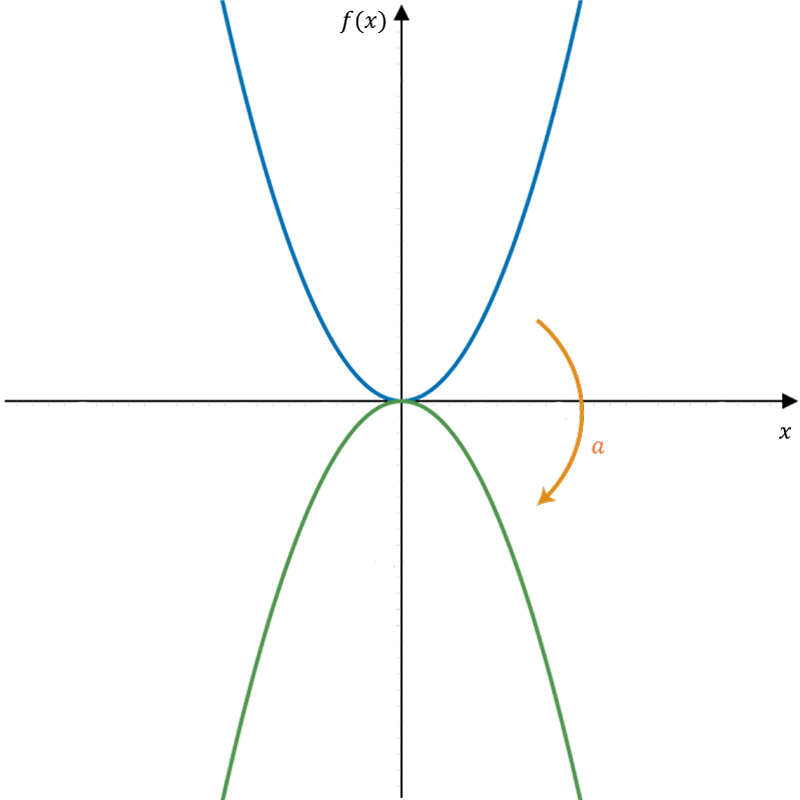
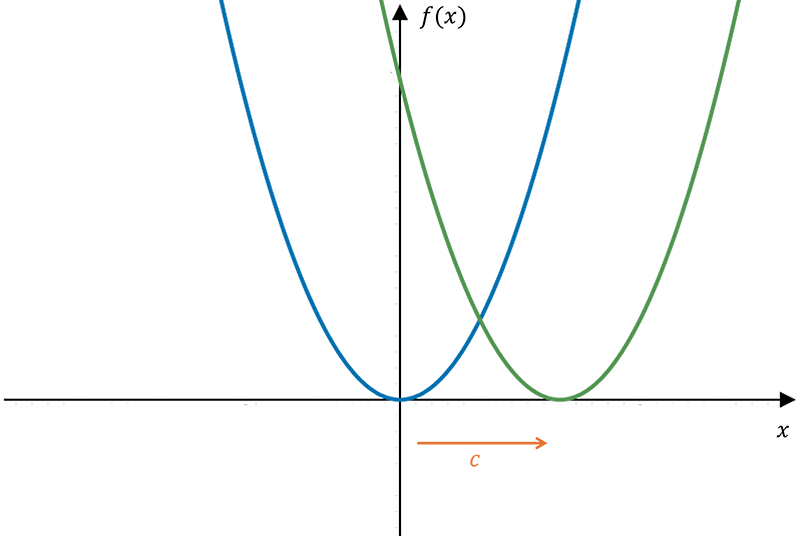
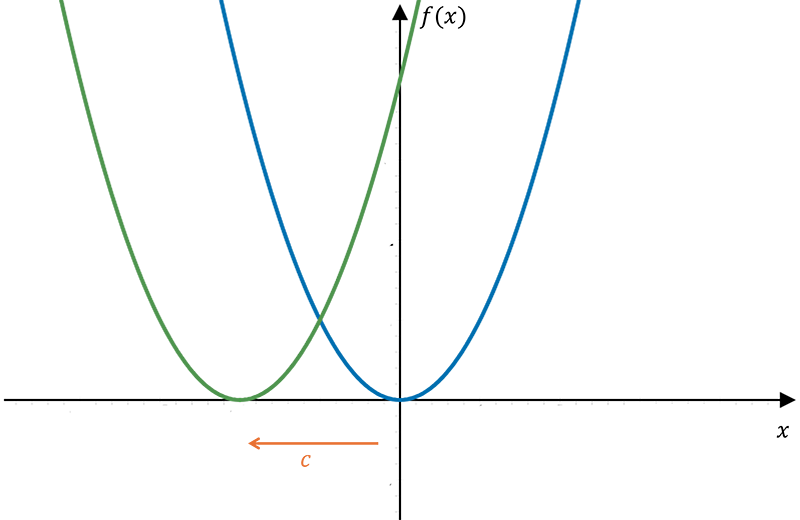
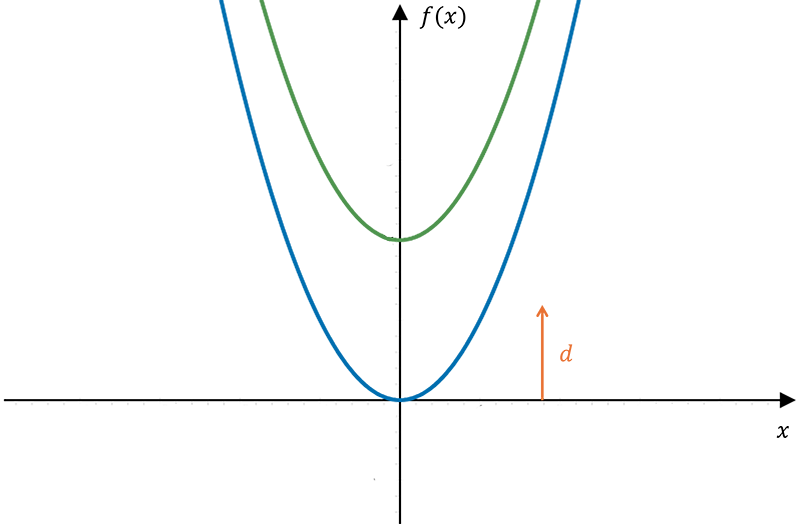
Transformations of quadratic functions can be summarised using a variation of the vertex form:
\[f(x) = a(b(x - c))^2 + d\]
Transformation factors: