
Angles of elevation and depression
Angles of elevation and depression are angles that are given from above or below a horizontal perspective. For example the angle that is made when you look up at something is an angle of elevation. When you look down the angle that is made from your line of sight is called an angle of depression. It is important to note both of these angles are measured from a horizontal perspective.
Use this page to revise the following concepts within Angles of elevation and depression:
- Angles of elevation and depression are alternate interior angles
- Applications of angles of elevation and depression
Angles of elevation and depression are alternate interior angles
Alternate interior angles are pairs of equal angles formed on opposite sides of a transversal, but inside two parallel lines. Angles of elevation and depression are alternate interior angles. That is, they are a pair of equal angles formed on opposite sides of the transverse formed by the line of sight. This can be illustrated as a Z-shaped figure.

From the figure, we can see that a right angle is formed at the intersection of the line of sight and and a perpendicular segment \(C\). This right angle is made up of two complementary angles \(\theta\) and \(\alpha\).
The angles ,\(\theta\), are alternate interior angles and so are equal. Therefore, the angle of elevation is equal to the angle of depression.
 Check your understanding
View
Check your understanding
View

Applications of angles of elevation and depression
Worked Example 1: Using the angle of elevation to find unknown sides
A park ranger measured the top of a tree to be at an angle of \(30^\circ\) when standing \(40\text{ m}\) from the base of the tree. To the nearest metre, what is the height of the tree?
1. Solve using trigonometry: first label triangle with Opp, Hyp, Adj given the location of angle in the right-angled triangle.

2. Identify the appropriate trigonometric ratio
\(\tan(\theta)=\frac{Opp}{Adj}\)
3. Substitute the values and rearrange the ratio to make the unknown side the subject.
\[\begin{align} Adj\times \tan(\theta)&=0pp \\ 40\times \tan(30^{\circ})&\approx23\text{ m} \end{align}\]
Invisible break text
Worked Example 2: Using the angle of depression to find unknown sides
From the top of an \(80\text{ m}\) cliff a spotter notices a shipwreck. The spotter incorrectly measures the angle of depression to be 25°. First find the angle of depression, then find the distance from the base of the cliff to the shipwreck to the nearest metre.
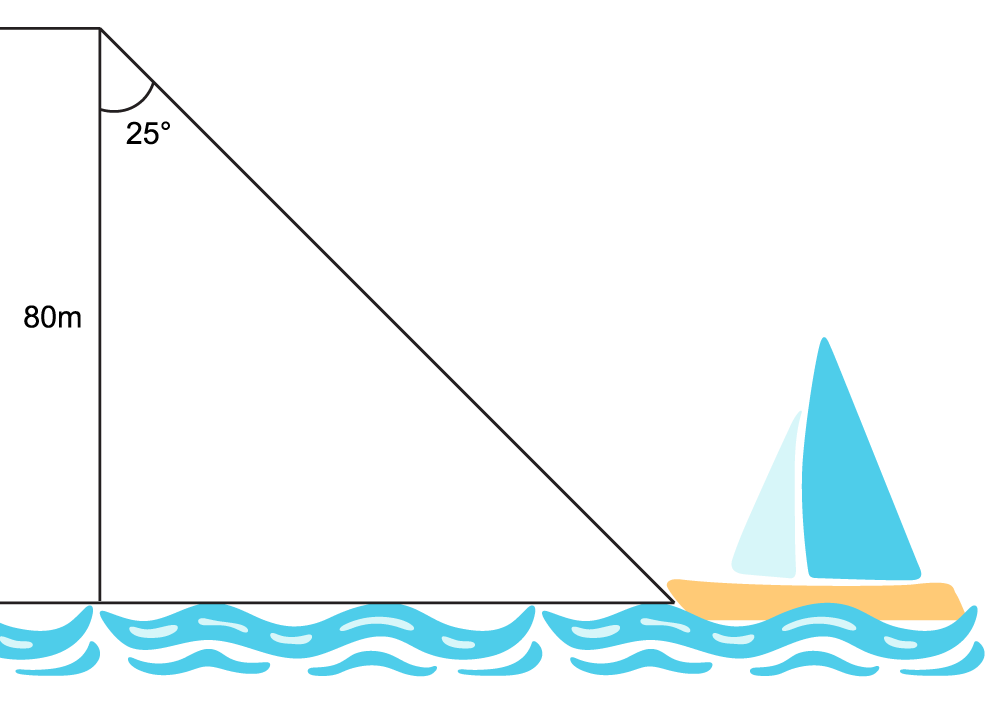
1. Find angle of depression:
Angle of depression is measured off horizontal and is therefore \(65^\circ (90^\circ-25^\circ = 65^\circ). This is also the angle of elevation.

2. Solve using trigonometry; first label triangle with Opp, Hyp, Adj given the location of angle in the right-angled triangle.
3. Identify the trigonometric ratio
\(\tan(\theta)=\frac{Opp}{Adj}\)
Substitute and rearrange ratio to make unknown side the subject. i.e
\[\begin{align} Adj &=\frac{Opp}{\tan(\theta)}\\ x&=\frac{80}{\tan(65^{\circ})}\\ &\approx37\text{ m} \end{align}\]