
Logarithms and orders of magnitude
Logarithms and orders of magnitude are useful concepts for handling numbers that span a very wide range. Logarithms help us understand how numbers grow, simplify complex calculations and can help to display data sets meaningfully in the form of a graph when there is a very wide variation in the measured quantities.
Use this page to revise the following concepts within computation and magnitude:
Orders of magnitude
An order of magnitude describes the approximate scale of a number as a power of \(10\), helping to compare values based on scale or size rather than exact amount, by comparing it to powers of \(1\). For example
\(10\) is one order of magnitude greater than \(1\) (because \(10^1=10\))
\(1,000\) is three orders of magnitude greater than \(1\) (because \(10^3=1000\))
\(0.01\) is two orders of magnitude smaller than \(1\) (because \(10^{-2}=0.01\))
Orders of magnitude are often used when comparing very large or very small values. For example, the mass of the Earth, \(~10^{24} \text{ kg}\) is about \(24\) orders of magnitude larger than \(1\text{ kg}\).
Logarithms
A logarithm is an extension of the idea of orders of magnitude that allows you to precisely compare numbers that may differ by orders of magnitude.
A logarithm tells you what power you need to raise a given base (usually \(10\)) to in order to get a certain number - for example, \( \log _{10} (1000) = 3\) because \(10^3 = 1000\).
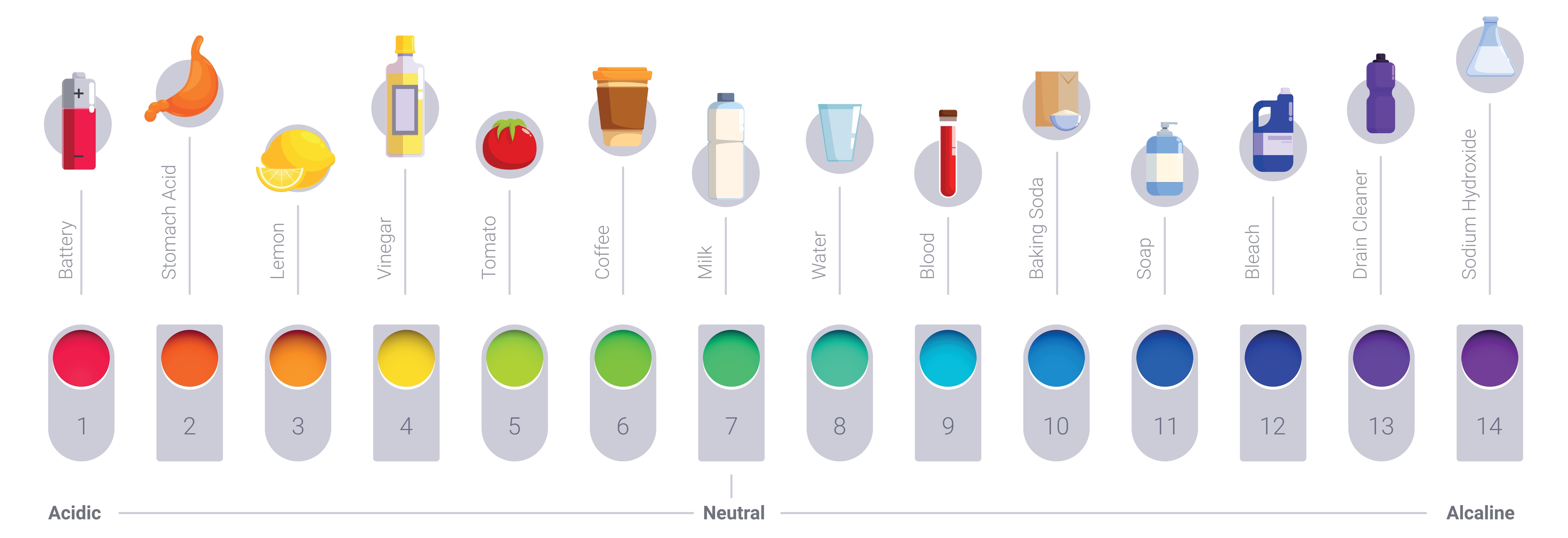
Some common applications that employ logarithmic scales include the Richter scale for measuring earthquake strength, the decibel scale for measuring the loudness of sound, and the pH scale for measuring the strength of acids and bases. These convert very large or small numbers to a scale that is more useful. A change in pH of \(3\) refers to a change of \(3\) orders of magnitude, or \(10^3=1000\). Therefore according to the scale depicted below, stomach acid is \(1000\) times more acidic than coffee.
Logarithms and displaying Data
Logarithms are especially useful in the display of data where quantities may differ by orders of magnitude. If most of the data points are within a fairly narrow range but a few are much larger or smaller, the width of the overall range will tend to obscure the detail within the majority range.
Consider data consisting of annual incomes. It may be that many of the incomes recorded are less than \(\$100,000\) but a few are more than \(\$10,000,000\).
Suppose the following numbers represent costs of items:
| Item | Cost ($) | Visualisation |
|---|---|---|
| A | 10,000 |  |
| B | 60,000 | |
| C | 1,200,000 | |
| D | 20,000 | |
| E | 79,000 | |
| F | 750,000 | |
| G | 2,500,000 | |
| H | 12,000,000 |
Notice that there is quite a difference between the size of the largest and smallest numbers in this set. Any difference between smaller values (A, B, D and E) is visually indistinguishable.
If the base \(10\) logarithm of each number is taken, the following set is obtained:
| Item | Cost ($) | Visualisation |
|---|---|---|
| A | 4 |  |
| B | 4.778 | |
| C | 6.079 | |
| D | 4.301 | |
| E | 4.898 | |
| F | 5.875 | |
| G | 6.398 | |
| H | 7.079 |
These values are much closer together and easier to interpret. This demonstrates why logarithmic scales are so useful.
Worked Example
Consider the following populations of towns and cities in Victoria.
| Town/City | Population |
|---|---|
| Melbourne | 3 707 530 |
| Geelong | 143 921 |
| Ballarat | 85 000 |
| Horsham | 15 292 |
| Churchill | 4 750 |
| Willcannia | 688 |
| Yanac | 84 |
Graph this data on a histogram.
Step 1 - Convert each value as a value \(\log_{10}\) value.
| Town/City | Population | Log(population) |
|---|---|---|
| Melbourne | 3 707 530 | 6.57 |
| Geelong | 143 921 | 5.16 |
| Ballarat | 85 000 | 4.93 |
| Horsham | 15 292 | 4.18 |
| Churchill | 4 750 | 3.68 |
| Willcannia | 688 | 2.84 |
| Yanac | 84 | 1.92 |
Step 2 - Create a histogram.


