
#13 - 7.1-8 The 13th World Festival of Youth and Students in Pyongyang
Published on July 29, 2024
7.1-8 (1989). The 13th World Festival of Youth and Students in Pyongyang.
Since the mid to late nineteenth century global growth in leisure activities, mass sporting events have frequently had both a politically and socially disruptive potential. This inflammatory feature of sporting culture was not lost on British journalist and political commentator George Orwell who once commented that sport was “war minus the shooting.” (Orwell 1945). A well-known example are the 1969 tensions between El Salvador and Honduras which turned an international football (soccer) match into the 100 Hour War (Guerra de futbal).
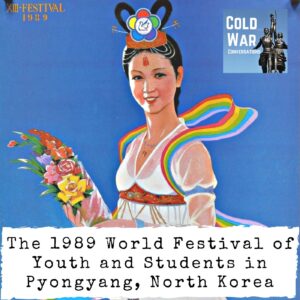 Image source: Cold War Conversations
It is perhaps unusual, however, that a single sporting event could result in the tectonic political, social and cultural shifts that the 1989 13th World Festival of Youth and Students caused for the Democratic People’s Republic of Korea (DPRK or North Korea). The event was originally meant to be a prestige event that showcased the great achievements of the North Korean leadership of Kim Il Sung rivaling the Seoul Olympics held the previous year. In reality, it turned out to be a monumental folly that helped bankrupt the economy, opened the eyes of the population to their poverty and the duplicity of their leadership, initiated significant cultural change and brought very public dissent to the capital Pyongyang.
The origins of the 13th World Festival of Youth and Students lie in the intra-state rivalries of the two Koreas which peaked in the 1980s height of the Cold War (see Armstrong 2013). The 1981 decision of the International Olympic Committee to award the 1988 Olympic Games to Pyongyang’s rival in the south precipitated a significant North Korean campaign to disrupt the games and discredit Seoul. This campaign was fought through a violent military campaign against South Korean civilians and politicians and an extensive soft power campaign to persuade fraternal socialist allies into withdrawing from the 1988 Olympics (Armstrong 2013, 259). When military measures and soft power persuasion failed, Pyongyang opted to create a mass sporting event that it felt would eclipse the success of the 1988 Olympics. It is a measure of how hopelessly out of touch the Pyongyang leadership was that they felt the World Festival of Youth and Students could rival the Olympic Games and bring prestige to the North. First, the Seoul Games were extremely successful, not only because the South Korean authorities had managed to construct the sporting and logistical infrastructure to host a global event in a timely fashion (although this breakneck construction was not without its controversies, see 9.17 Seoul Olympics in this series), but because Seoul 1988 saw the participation of the Soviet Union and the USA in an Olympiad for the first time since 1976.
The World Festival of Youth and Students was an event that was largely ignored outside the Soviet sphere of influence. The festival was founded in the immediate post-Second World War period by the Federation of Democratic Youth (WFDY), a leftist, anti-imperialist movement dedicated to uniting youth from capitalist and socialist countries. However, the US government and its allies largely regarded the group as a Moscow front organization. The Soviet Union had financed many of the previous World Festivals of Youth and Students, and many had been held in countries of the former Eastern Bloc and attended by pro-Moscow organizations or other leftist groups (Lankov 2013, 222). The festival consisted not just of sporting competition but social, political and cultural activities – folk dancing, mass singing or friendship games– many of which appeared to the outside media to be archaic and stiflingly boring in comparison to the excitement of the 1988 Olympics’ heated competition, controversy and superpower rivalry. The world’s media largely ignored Pyongyang’s showcase event as a staged propagandistic attempt by Moscow’s allies to draw support for a Soviet empire in decline. The media attention that the 1989 festival did draw ended up backfiring on the Pyongyang authorities as we see below.
The event that Pyongyang hosted was the most ambitious World Festival of Youth and Students ever. Approximately 22,000 young people from over 170 countries attended. The DPRK authorities transformed Pyongyang’s architectural infrastructure for the occasion constructing the second largest sports stadium in the world (with a seating capacity of 114,000) the Rungrado 1st of May Stadium as well as hotels and monuments all aimed at providing a positive view of the DPRK for assembled delegates and media. All of this construction came at a huge cost for the Pyongyang leadership who spent an estimated US$4 billion on the Festival, an enormous outlay rivaling the amounts Seoul spent on their 1988 Olympics and without the associated boost to the economy that South Korea achieved (See K.Developedia n.d.). Debts associated with investment in the 1989 Festival significantly contributed to the state’s economic collapse of the 1990s (Armstrong 2013, 265).
Worse still for Pyongyang was that the event was a public relations disaster. The 13th World Festival of Youth and Students took place just weeks after the People’s Republic of China’s (PRC) brutal suppression of pro-democracy activists in Tiananmen Square. The PRC was Pyongyang’s closest ally, so state run media had suppressed coverage of the Beijing crackdown fearing contagion. However, foreign delegates to the 13th World Festival of Youth and Students helped leak news of the Tiananmen Square massacre to the general North Korean population. While Festival delegates may have enjoyed the hospitality of the North Koreans, this did not mean that the guests saw it as their prerogative to toe the official political line of their hosts. Far from it, representatives of left-wing Nordic youth organizations used the festival as an opportunity to launch their own protests calling for greater political freedoms in both the PRC and the DPRK. The foreign press recorded these protests. Kim Il Sung allegedly witnessed the dissent and left in disgust (Myrseth 2016).
The DPRK authorities also used the visit of South Korean student activist Im Su-gyŏng as part of a propaganda campaign to demonstrate the support of all Koreans for the Pyongyang leadership. Im was a well-known Hankuk University of Foreign Studies student who had illegally entered the North on the occasion of the Festival. Pyongyang gleefully displayed her presence on state media thinking they would convince the general population of the popularity of their regime. However, DPRK defectors report that ordinary North Koreans paid more attention to Im’s youthful and wealthy appearance, seeing it as evidence of the greater liberties enjoyed by their southern counterparts. North Koreans had previously been taught that the South was considerably poorer and less free than the DPRK. Andrei Lankov claims that this televised coverage of Im was a significant early breach in a tightly controlled state media and caused a great dent in popular perceptions of the Pyongyang leadership (Lankov 2013, 222-225).
The hosting of the World Festival of Youth and Students also brought some interesting cultural changes within North Korea. Sonja Häussler, then a visiting student of the Korean language who was acting as an interpreter at the Festival, reports some official shifts from the regime towards traditional culture (Häussler 2015; 2016). According to Häussler, Arirang, considered by many South Koreans to be perhaps the most iconic of all Korean songs, was revived for the Festival as a public display of inter-Korean unity. Up to that point, foreign visitors to the North recalled never having heard the song (Häussler 2015; 2016). As of 2024, Arirang is ubiquitous in the North, and Koreans on both sides of the divided Peninsula consider the song as evidence of the shared cultural commonality of the two Koreas and their potential for peaceful reunification. Häussler’s account aligns with other scholarly investigations of Pyongyang’s use of culture –traditional, popular and sporting – to achieve its foreign policy objectives (Szalontai 2009, 155).
Despite the unintended consequences of the festival, the 13th World Festival of Youth and Students wasn’t Pyongyang’s last attempt to achieve its foreign policy objectives through mass sport diplomacy. Other efforts to upstage the South came with the “Pyongyang International Sports and Culture Festival for Peace” or as it was unofficially known the “Collision in Korea,” opened by Muhammad Ali and featuring Ali’s former adversary, the Japanese wrestler Antonio Inoki. The wrestling spectacular was promoted by Japanese and US professional wrestling bodies and saw crowds of 160,000 people. It was an attempt to reduce conflict between the DPRK, the US and Japan during a period of North Korean nuclear tensions (Hall 2020). Most famously, in 2002 the DPRK organized its Mass Games of gymnastics to rival South Korea’s co-hosting of the world’s biggest spectator event the World Cup (see 5.31 The Start of the 2002 Japan-South Korea World Cup in this series). The 8th of July 1989 was meant to represent the successful conclusion of a showcase event for Kim Il Sung’s government, but in reality, it became a day to forget for the North Korean government.
-------------------------------------------------..
Andrew David Jackson ©
Please do not reproduce without permission.
References
- Armstrong, Charles K. 2013. Tyranny of the Weak: North Korea and the World, 1950-1992. Ithaca: Cornell University Press.
- Hall, Nick. 2020. “Collision in Korea: Pyongyang’s Historic Socialism and Spandex Spectacular.” N.K. News, April 29. Accessed: April 6, 2021. https://www.nknews.org/2020/04/collision-in-korea-pyongyangs-historic-socialism-and-spandex-spectacular/
- Häussler, Sonja. 2015. “Disco Music and Folklore: Cultural aspects of the 13th World Festival of Youth and Students in Pyongyang.” Paper presented at the 27th Conference of the AKSE (Association of Korean Studies in Europe) Conference. Bochum, July 10-13.
- Häussler, Sonja. 2016. “North Korea and the World Festival of Youth and Students in 1989.” Paper given at “Understanding the Other Korea: North Korea” Workshop, Copenhagen University, April 9.
- Lankov, Andrei. 2013. The Real North Korea: Life and Politics in the Failed Stalinist Utopia. Oxford: Oxford University Press.
- Myrseth, August. 2016. “Beyond Politics of Revenge: Recontextualizing the 13th World Festival of Youth and Students.” MA diss., SOAS, the University of London.
- Orwell, George. 1945. “The Sporting Spirit.” Tribune, 14 December. Reprinted in Orwell Foundation, accessed 12 July 2024, https://www.orwellfoundation.com/the-orwell-foundation/orwell/essays-and-other-works/the-sporting-spirit/
- Szalontai, Balázs. 2009. “Expulsion for a Mistranslated Poem: The Diplomatic Aspects of North Korean Cultural Politics.” In Dynamics of the Cold War in Asia: Ideology, Identity, and Culture, edited by Tuong Vu and Wasana Wongsurawat, 145-164. New York: Palgrave Macmillan.