
Indo-Pacific Future Leaders in AMR Online Student Symposium 2025
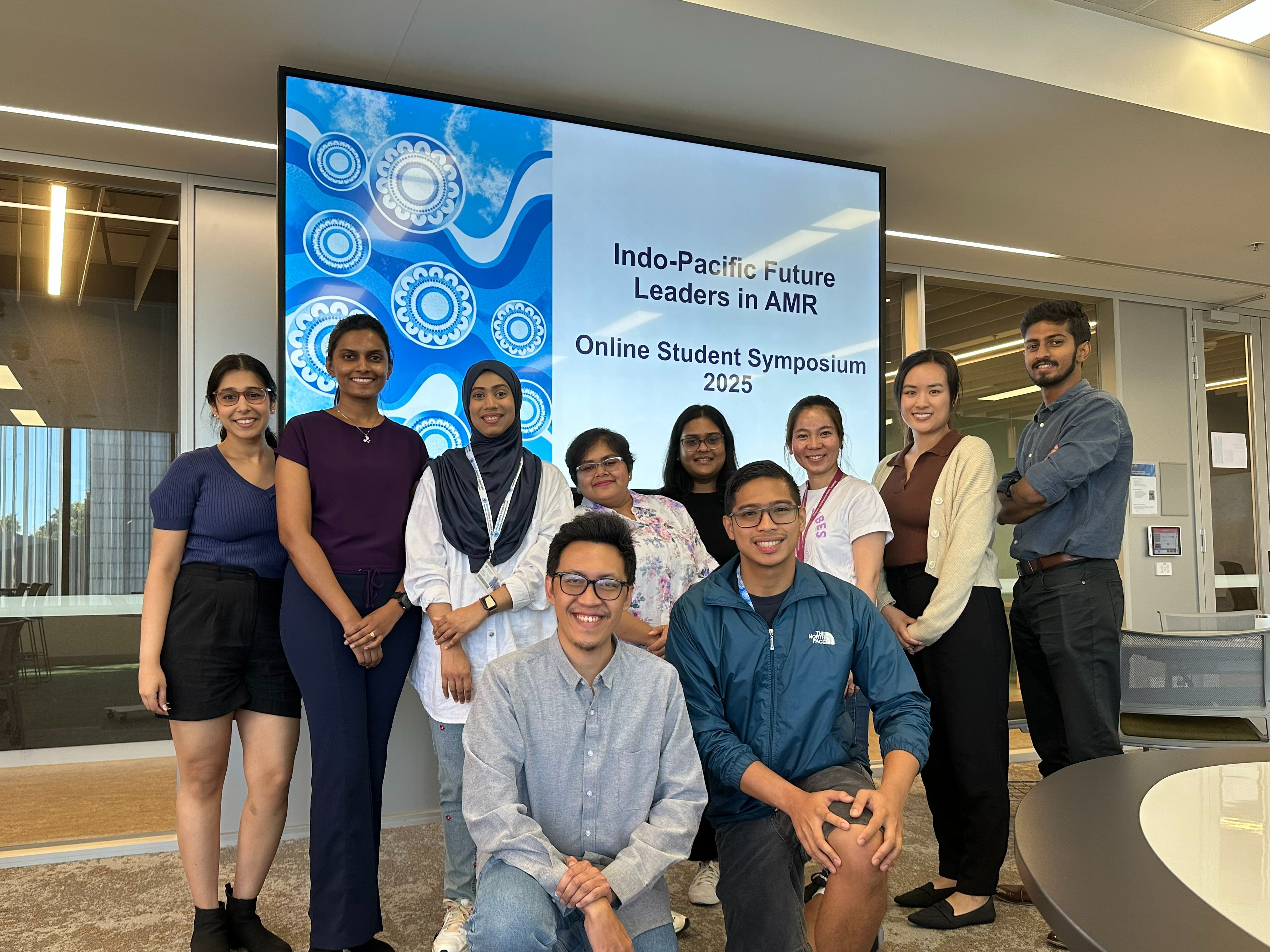
The Inaugural Indo-Pacific Future Leaders in Antimicrobial Resistance (AMR) Student Symposium marked a critical milestone in bringing together researchers from various disciplines and countries together to discuss and disseminate their research. The symposium was hosted by Monash’s Centre to Impact AMR on 25 February 2025. The event was organised by students affiliated with the Centre's Future Leaders in AMR student group. The virtual conference was attended by over 32 student speakers and 70 participants from 8 countries, 17 universities/research institutes and 34 centres for learning and discovery. Keynote speakers included experts in the areas of combating antimicrobial resistance, Professor Mark Blaskovich and Professor Trevor Lithgow.
Keynote Session: Professor Mark Blaskovich, University of Queensland
How do we combat AMR? Global Collaborations for a Global Problem
Chair: Sahampath Hettierachchi
Professor Blaskovich’s talk discussed typical barriers hindering the development of new antibiotics and provided insights into global initiatives for encouraging the discovery of novel molecules with antimicrobial activity and sourcing clinical multi drug resistant isolates to test these novel compounds against. The key message from his talk was that collaboration on a global scale and incentives for development were essential to advancing antimicrobial compound development.
Session 1: Innovative Technologies & Interventions
Chairs: : Dr. Jhih-Hang Jiang & Dr. Galain Williams
Session 1 of the symposium covered innovative technologies and interventions to tackle AMR. Topics varied from the development of modelling to predict antibiotic efficacy to looking at novel antimicrobials produced by populations of bacteria from the gastrointestinal microbiome. Soffi Law Kei Kei from Monash University Malaysia was judged the winner of the session while Jamia Hemphill from the Hudson Institute was awarded the runner-up prize.
Christine Kim - PhD student - New Zealand: Development of hypoxia-activated prodrugs of second-generation analogues of bedaquiline for treatment of latent Tuberculosis
Alice Terrill - PhD student - Australia: Mechanism-based modelling predicts antibiotic effect on Pseudomonas aeruginosa where PK/PD indices cannot
Dominika Fuhs - PhD student - Australia: The effects of different resistance mechanisms on Pseudomonas aeruginosa response to meropenem
Jamia Hemphill - PhD student - Australia: Investigating antimicrobial activity in the human gastrointestinal microbiome (Session Runner-up)
Siobhonne Breen - PhD student - Australia: Ceftolozane/tazobactam plus meropenem against ST235-clone Pseudomonas aeruginosa isolates in hollow-fibre infection model
Tope A. Ibisanmi - PhD student - Australia: Comprehensive resistance factor profiling and data-driven computational drug discovery targeting virulence factor regulators from WGS analysis of Pseudomonas aeruginosa
Soffi Law Kei Kei - PhD student - Malaysia: Exploring phage resistance trade-offs to counteract the evolution of antimicrobial resistance in Escherichia coli (Session Winner)
Session 2: Environmental, Economic & Social Impacts of AMR
Chairs: Dr. Tom Watts and Dr. Gareth Howells
Session 2 focused on the environmental, economic and social impacts of AMR and covered the carriage of antibiotic-resistant bacterial strains in Bangladesh, the roles of mobile genetic elements in Enterococci and the prevalence of antibiotic resistance in Sri Lankan rivers. The winner of this session was Jia Qi Beh from the Peter Doherty Institute.
Muhammad Azreen Bin Mat Husin - PhD student - Malaysia: Determination of Extended Spectrum Beta-lactamase (ESBL) producing Escherichia coli and Klebsiella pneumoniae carriage in Bangladeshi communities working in Klang Valley
Jia Qi Beh - PhD student - Australia: Role of mobile genetic elements in linezolid-resistant Enterococci: a global and Australian perspective (Session Winner)
Meddage A.K.M.M.K - PhD student - Sri Lanka: Prevalence of antibiotic resistance in surface water, groundwater and sediment in the transition zone of the Kelani River Basin, Sri Lanka
This session was kindly sponsored by our industry partner at CSIRO 's Minimising AMR Consortium. Please take time to visit the AMR Action and Insights Knowledge Hub and follow Minimising AMR on LinkedIn”.
Keynote Session: Professor Trevor Lithgow, Monash University
Genomics and Microbiology: Starting to understand how AMR phenotypes arise in our environment
Chair: Sabrina Suhani
Professor Lithgow's talk focused on understanding how AMR phenotypes arose in pathogens while in the environment and understanding how these pathogens developed their resistance. Further points included talking about the evolution of these pathogens and optimizing bacteriophage treatment to combat these pathogens.
Session 3: Regional AMR Challenges & Solutions
Chairs: Dr. Rhys Dunstan and Dr. Tom Stanton
The final extended talks session discussed regional AMR challenges and solutions. The speakers presented on molecular profiling of virulence factors of clinical bacterial isolates, the genomic diversity of antibiotic-resistant gastrointestinal pathogens and the usage of metal-based complexes and coatings to counter antimicrobial resistance. Tanzina Akter and Shyam Kumar Mishra from the University of New South Wales claimed the winner and runner-up prizes respectively.
Tanzina Akter - PhD student - Australia: Phenotypic and molecular insights into antimicrobial resistance differences between exoU and exoS Pseudomonas aeruginosa isolates from Microbial Keratitis (Session Winner)
Munazzah Maqbool - PhD student - Australia: Exploring the genomic diversity of third-generation cephalosporin-resistant Escherichia coli in Australia
Abhinaba Ray - PhD student - Australia: Bacteriocin discovery in Klebsiella isolates from clinical infections
Isa Olamilekan Arinola - PhD student - Australia: Challenging antimicrobial resistance with new bismuth, gallium & Indium based complexes, materials, & coatings
Abiye Tigabu Molla - PhD student - Australia: Molecular profiling of antimicrobial resistance and virulence factors in Pseudomonas aeruginosa isolates from Keratitis patients
Shyam Kumar Mishra - PhD student - Australia: Antimicrobial peptidomimetic against drug-resistant yeasts of medical importance (Session Runner-up)
Mwinyi Shawwaly Omary - Masters student - Tanzania: Combating antimicrobial resistance in Katavi Region: Challenges and strategic solutions
Lightning Talks
Chairs: Dr. Jackie Cheung and Dr. Houdaii Khalil
The lightning talk session consisted of 3-minute talks on tackling AMR through the isolation of an aquatic bacteria that synthesises a metabolite with antimicrobial activity, using the body’s natural immune responses and understanding AMR knowledge and education gaps. The winner of the session was Vedika Bhatt from the University of Malaya and the runner-up was Bahvya Mishra from The Maharaja Sayajirao University of Baroda.
Hoai An (Andy) Nguyen - PhD student - Australia: Prediction of antimicrobial resistance in Pseudomonas aeruginosa using integration of multiple genomic representations and graph neural networks
Muhammad Ridwan Adyatama - PhD student - Indonesia: Successful isolation of anti-MRSA metabolite-producing bacteria from aquacultured and captive scleractinian corals of the Indonesian aquarium trade
Arijit Nandi - PhD student - Australia: Seeing the unseen: Imaging bacterial infections
Shalini Roy - Masters student - India: Using CRISPR/CAS9 system to study co-relation of quorum sensing system and virulence factor in Pseudomonas aeruginosa
Afsaneh Arshadi Edlo - Masters student - Iran: Harnessing the body’s natural defences: Dual-function antibiotics and synthetic biology to combat antimicrobial resistance
Mst Umme Laila Urmi - PhD student - Australia: Construction of antiviral surfaces using peptidomimetics
Rahul Maitra - PhD student - India: Synthesis of tryptanthrin appended dispiropyrrolidine oxindoles and their antibacterial evaluation
Vedika Bhatt - PhD student - Malaysia: Antibiotic resistance knowledge in Malaysia: socio-demographic influences and educational gaps
Deepanshi Saxena - PhD student - India: Pyrvinium pamoate potentiates levofloxacin against levofloxacin-resistant Staphylococcus aureus.
Suleman Irfan - PhD student - Australia: Comparison of susceptibilities of Pseudomonas aeruginosa to antibiotics and bacteriophages
Shakeel Shahzad - PhD student - Australia: Evaluation of patterns of susceptibility of clinical isolates of Acinetobacter spp towards polymyxins and different cationic antimicrobials
Jiawei Shen - PhD student - Australia: Whole genome sequencing-based prediction of antibiotic-resistance of ocular Staphylococcus aureus across six continents
Lakshmi Naga Kavya Menta - PhD student - Malaysia: Phage-based solutions for uropathogenic Escherichia coli infections: investigating resistance mechanisms and therapeutic potential
Bhavya Mishra - PhD student - India: Impact of brlR activation by SagS on antibiotic resistance profiles in biofilm-forming strains of Pseudomonas aeruginosa
Mahi Raj - PhD student - India: Mega plasmids and carbapenem resistance: a deep dive into Klebsiella pneumoniae genomics
The conference concluded with a networking session on Gathertown, a virtual networking platform designed to mimic the organic interactions that occur during in-person networking. Feedback from attendees was exceedingly positive with a significant majority stating that they would recommend the conference to their colleagues and would attend a future symposium organised by the committee. Overall, the symposium brought together emerging leaders in the field of AMR across the Indo-Pacific region to share their research and resulted in high levels of engagement and a valuable opportunity for research students to participate and present their efforts in tackling the AMR crisis.
Acknowledgements
Thank you to the student speakers from all across the Indo-Pacific for coming together to present their research.
Thank you to all the session chairs hailing from various Centre groups for volunteering their time to moderate each session.
Thank you to the keynote speakers, Professor Mark Blaskovich and Professor Trevor Lithgow, for their inspiring AMR talks.
Thank you to Sahampath Hettierachchi for his help in writing up the event summaries for this webpage.
The Centre would like to extend an immense thank you to the student organising committee for their efforts in bringing this fantastic symposium to life.