
International Urban Benchmarking Workshop: Monash University, Indonesia Strengthens Urban Management Capabilities
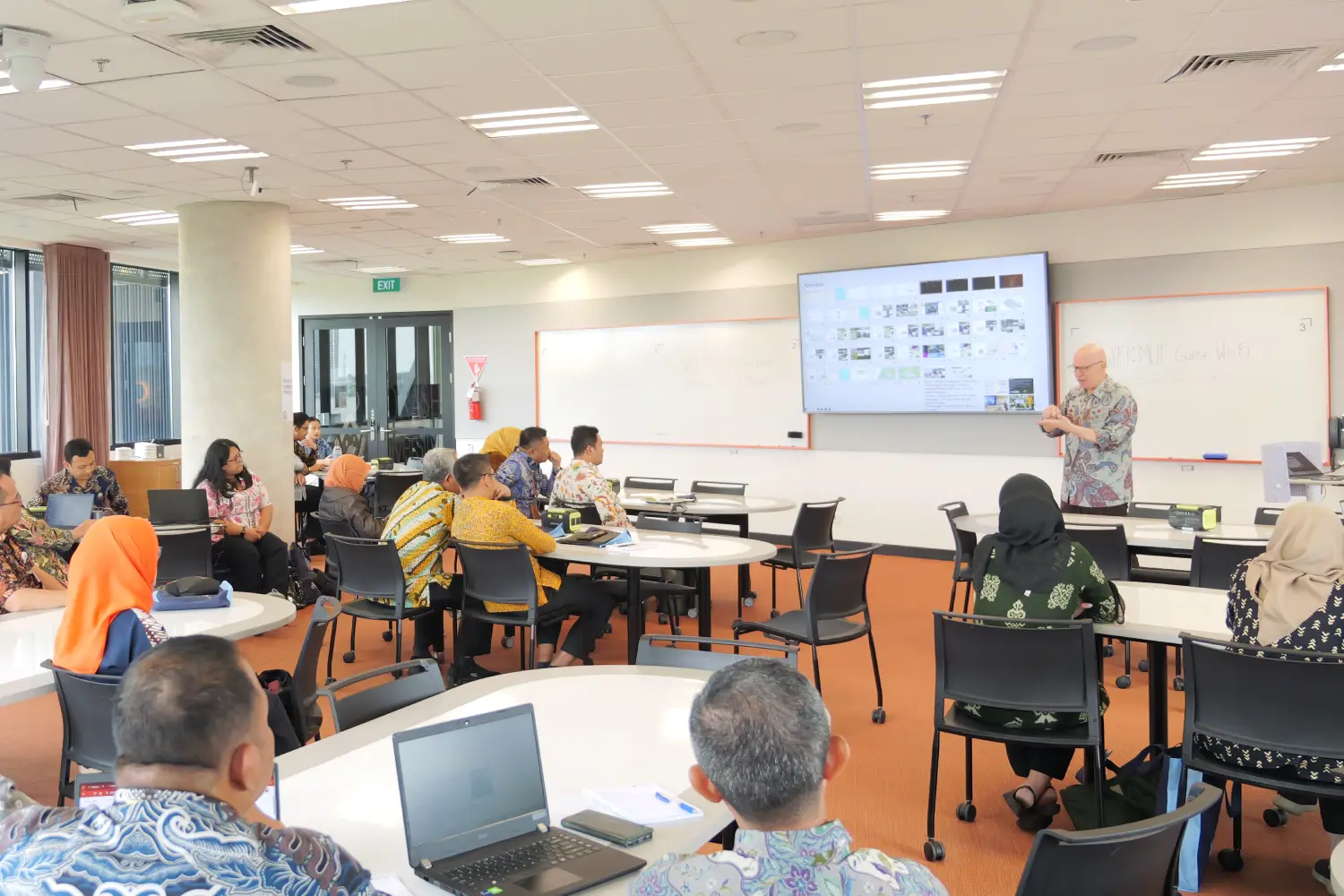
International Urban Benchmarking Workshop led by Professor Stephen Cairns and Assistant Professor Alyas Widita
Monash University, Indonesia has developed a comprehensive capacity-building initiative in partnership with the Ministry of Home Affairs to advance Indonesia's urban management capabilities and city-making practices. The International Urban Benchmarking Workshop represents a landmark collaboration designed to support the implementation of the Rencana Penyelenggaraan Pengelolaan Perkotaan (RP2P) – a flagship cross-sectoral initiative mandated by Peraturan Menteri Dalam Negeri Nomor 24 Tahun 2024.
This strategic partnership addresses Indonesia's urgent need for enhanced urban governance as the nation approaches 59% urbanization and is expected to increase its urban population share to 70% within twenty years, marking the landmark Indonesia Emas 2045 moment. Through international benchmarking, data-driven urban diagnostics, innovative financing mechanisms, and integrated planning approaches, the workshop establishes a foundation for sustainable urban transformation across Indonesian cities and regencies.
The RP2P Framework and Its Strategic Importance
 Deputy Minister of Home Affairs, Dr Bima Arya Sugiarto (centre), attending the opening of the workshop
Regulatory Foundation and National Mandate
The RP2P serves as Indonesia's comprehensive roadmap for delivering high-quality urban services across cities and regencies. Established under Peraturan Menteri Dalam Negeri Nomor 24 Tahun 2024, this framework introduces a systematic approach to urban service provision by integrating phased urban development with key regional planning frameworks.
The regulation specifically addresses persistent urban challenges including fragmented service provision, inadequate policy coordination between sectors, and misaligned infrastructure timing. As emphasized by Deputy Minister of Home Affairs Dr. Bima Arya Sugiarto, RP2P represents an integrated platform that enables in-depth, spatially-embedded understanding of the local contexts and comprehensive implementation by regional governments.
Integration with National Planning Systems
RP2P's innovative approach lies in its integration with existing planning frameworks including the Rencana Pembangunan Jangka Menengah Daerah (RPJMD), Sistem Informasi Pemerintahan Daerah (SIPD), and Rencana Tata Ruang Wilayah (RTRW). This integration ensures that urban services are delivered through structured, comprehensive mechanisms that enhance governance efficiency while promoting sustainable urban transformation.
The framework operates as a consolidation of information regarding urban service provision plans across ministries, agencies, regional apparatus, and legal entities. This consolidated approach facilitates integration between regions, sectors, and government levels according to their respective authorities.
Workshop Structure and Capacity Building Components
The workshop invited 25 government employees from the Ministry of Home Affairs and provinces with top index scores for Regional Innovation and Regional Budget Governance. Participants represented managerial-level personnel with comprehensive oversight capabilities and technical understanding of urban challenges in their respective regions. This strategic selection ensured augmented impact through participants who possessed both decision-making authority and practical implementation capacity.
Through the two-day intensive workshop, participants engaged in collaborative dialogue with faculty, combining theoretical frameworks with grounded, practical applications. Day one focused on developing shared knowledge in International Urban Benchmarking and Regional Governance Integration, while day two emphasized Design Actions as an approach to develop context-specific, strategic urban development. The workshop concluded with co-developed needs and aspirations assessments through dynamic and engaging sharing and exchange sessions, followed by institutional debriefing by the Ministry of Home Affairs. The format ensured comprehensive and sustained coverage while maintaining practical applicability.
Essential Skill Development Areas
The workshop addresses five critical competency areas, aligning with effective RP2P implementation:
- Systems and Design Thinking for Urban Service Planning: Strengthening holistic analysis of urban challenges considering interconnected urban systems.
- Blended and Innovative Funding Mechanisms: Exploring diverse financing strategies including public-private partnerships and value capture mechanisms.
- Cross-Jurisdictional Coordination and Regional Governance: Enhancing collaboration across administrative boundaries for cohesive planning.
- Data Management and Utilization: Building capacity for efficient data collection and processing through government platforms and emerging data sources, leveraging open source support system tools such as ur-scape.
- Evidence-Informed Decision-Making Processes: Strengthening integration of data-driven insights and empirical research into policymaking.
Expert Leadership and Academic Excellence
Distinguished Faculty Profile
The workshop benefits from world-class expertise through Professor Stephen Cairns and Dr. Alyas Widita.
Professor Cairns serves as Professor in Master of Urban Design at Monash University, Indonesia and Titular Professor at ETH Zurich, leading the Agropolitan Territories research group at Future Cities Lab in Singapore. His extensive academic credentials include visiting professorships at Harvard University's Graduate School of Design and National University of Singapore.
Dr. Alyas Widita is an Assistant Professor and Course Coordinator of Master of Urban Design at Monash University, Indonesia. He brings specialised expertise in urban and transportation systems through innovative methodological approaches. His research has been published in leading journals including the Journal of Planning Education and Research, Travel Behaviour and Society, and Regional Science Policy and Practice, and he has consulted internationally with organizations including the World Bank and Korea Transport Institute. His work has secured funding through the Research Grant Bank Indonesia and multiple international collaborations. He holds a Ph.D. in City and Regional Planning from the Georgia Institute of Technology (United States).
Institutional Partnerships and Global Networks
Monash University, Indonesia's position within the global Monash network provides participants access to international best practices and cutting-edge urban planning research. The university's Master of Urban Design program adopts a transdisciplinary framework, forging coalitions with government and industry partners while deploying complementary disciplines to train strategic urban professionals.
National Impact and Urban Development Context
Addressing Indonesia's Urbanization Challenge
With Indonesia approaching 70% urban population by 2045, effective urban management becomes critical for national development. The workshop addresses the reality that Indonesian cities often lack strong identities due to development patterns influenced by political and economic interests rather than knowledge-based planning and urban design principles.
Supporting National Urban Development Initiatives
The workshop complements existing national programs including the National Urban Development Project (NUDP), which operates across 15 pilot cities to enhance integrated urban planning and investment prioritization. NUDP's focus on improving coordination between development plans (RPJMD) and spatial plans (RTRW, RDTR) aligns directly with RP2P implementation objectives.
Building on International Urban Governance Best Practices
The workshop leverages international experience demonstrating that effective metropolitan-level governance structures require support and commitment from all local governments. Drawing from successful models across Europe, North America, East Asia, and emerging frameworks in Latin America, the program provides Indonesian officials with proven approaches to complex urban challenges.
Innovation in Urban Planning Education and Practice
Technology Integration and Data-Driven Approaches
The workshop incorporates contemporary approaches to urban planning including the utilization of platforms like ur-scape for comprehensive urban analysis. This integration of technology enables participants to perform evidence-based analyses, making urban planning more inclusive and capable of addressing complex societal needs.
Sustainable Development and Climate Resilience
The program addresses critical sustainability challenges facing Indonesian cities, including circular economy principles, nature-based solutions, and integrated climate action planning. These approaches align with global best practices for creating inclusive, safe, resilient, and sustainable cities as outlined in SDG 11.
Future Implications and Scalability
Long-term Capacity Building Strategy
The workshop represents the initial session of a four-part annual program spanning September 2025 to September 2026, ultimately reaching 100 regional government employees and officials across Indonesia. This systematic approach ensures comprehensive capacity building across multiple Indonesian regions while maintaining quality and consistency.
Knowledge Transfer and Institutional Development
The program establishes frameworks for ongoing knowledge exchange and institutional strengthening that extend beyond the workshop duration. Through benchmarking toolkits, peer networks, and integration methodologies, participants gain sustainable capabilities for continuous improvement in urban management practices.
Contributing to Indonesia's Urban Future
As Indonesia approaches its Golden Indonesia 2045 vision, the workshop contributes essential capabilities for managing urban transformation effectively. By strengthening urban planning foundations, enhancing cross-jurisdictional coordination, and promoting evidence-based decision-making, the program supports Indonesia's broader development objectives while addressing immediate urban challenges.