What is epidemiology? The modern science of disease tracking, public health, and data analytics
 Epidemiology is the scientific study of the distribution and determinants of health-related states or events in specified populations, and the application of this knowledge to control health problems. Known as the foundational science of public health, epidemiology bridges clinical medicine, statistics, and social dynamics to uncover why diseases occur, how they spread, and how society can prevent them.
While historically associated with infectious outbreaks like cholera or influenza, modern epidemiology evaluates everything from chronic conditions and mental health to road accidents, injuries, and environmental toxicant exposures.
The core mechanics: Key metrics and data concepts
Epidemiologists use several metrics to measure health trends using quantitative, qualitative and/or mix-methods approaches, evaluate and allocate medical resources, healthcare deliverables, and public health investments.
| Metric | Definition | Primary Focus |
|---|---|---|
| Incidence | The number of new cases of a disease that develop in a population over a specified time frame. | Risk assessment and tracking disease transmission speed. |
| Prevalence | The total number of existing cases (both new and old) in a population at a specific point in time | Measuring overall burden on healthcare infrastructure. |
| Morbidity | The state of being diseased or the prevalence of illness within a defined population. | Assessing quality of life and non-fatal disease burden. |
| Mortality | The frequency of occurrence of death in a defined population during a specified interval. | Tracking fatal outcomes and life expectancy trends. |
| DALYs | Disability-Adjusted Life Years; the sum of years of life lost due to premature mortality and years lived with disability. | Quantifying overall global disease burden. |
The epidemiological triad and historical foundations
To understand how diseases enter and spread throughout a population, epidemiologists use structural models alongside historical precedents.
The Host, Agent, Environment Model
Disease transmission rarely happens in isolation. The Epidemiological Triad models disease causation through the interaction of three foundational elements:
- The Agent: The biological, chemical, or physical cause of the disease (e.g., bacteria, viruses, heavy metals, or radiation).
- The Host: The organism (usually human) that harbors the disease, influenced by risk biological factors such as age, genetics, immune status, and lifestyle factors and behaviours.
- The Environment: The external conditions that allow the agent and host to interact, including sanitation, climate, population density, and socio-economic infrastructure.
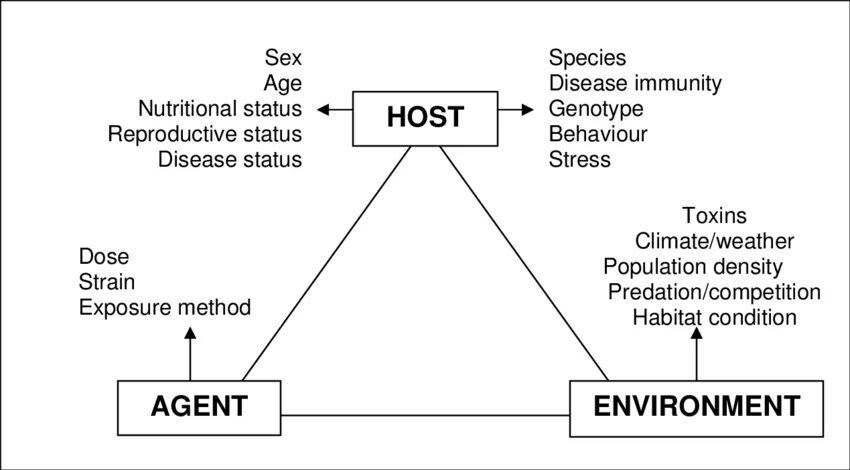 Classical triad representing the interrelationship between host, agent and environment. Image: Fraser and Parmley, 2009 via Researchgate.net
From hippocrates to the broad street pump
The principles of epidemiology evolved across centuries of observation and statistical iteration:
- Hippocrates (400 BCE): The Greek physician was among the first to suggest that environmental factors—such as air, water, and geography—influenced disease distribution rather than supernatural causes.
- Joaquín de Villalba (1802): The Spanish epidemiologist popularized the formal term epidemiología in his historical compilation Epidemiología Española, systematically documenting disease patterns across regions.
- John Snow (1854): Recognized as the father of modern epidemiology, Snow investigated a severe cholera outbreak in London’s Soho district. By mapping cases and interviewing local residents, he traced the source to a contaminated public water pump on Broad Street, disabling it and halting the epidemic years before germ theory was fully established.
Methodological frameworks: How epidemiologists study disease
Epidemiological research is divided into two primary categories: Observational and Experimental studies.
Observational studies
In observational studies, researchers record patterns without intervening or manipulating exposure variables.
- Descriptive epidemiology: Answers the fundamental questions of who is getting sick, what symptoms they exhibit, where the disease is occurring, and when it spreads. This serves as the foundation for hypothesis generation.
- Analytic epidemiology: Focuses on how and why a disease spreads by evaluating potential risk factors, exposure pathways, and cause-and-effect relationships.
Specific study designs
- Case-control studies (Retrospective): Researchers compare a group of individuals who already have a condition ("cases") against a similar group without the condition ("controls"). They look back in time to identify differences in exposure history.
- Cohort studies (Prospective or Retrospective): Researchers track a group of exposed and unexposed individuals over a period to determine who develops the disease, calculating relative risk.
- Randomized sontrolled Trials (RCTs, Experimental): Participants are randomly assigned to receive either an intervention (e.g., a new vaccine or treatment) or a control (e.g., a placebo). This design provides the highest level of empirical evidence.
- Qualitative and ethnographic insights: researchers immerse themselves within the study setting to observe, interact, engage with-, interview and discuss the phenomena of interest
Core public health functions in action
Epidemiologists execute four primary operational functions to safeguard public health:
- Public health surveillance: The continuous, systematic collection, analysis, and interpretation of health data to spot unusual disease clusters early.
- Field investigation : Rapid deployment to trace contact networks, collect environmental samples, and isolate vectors during active outbreaks.
- Policy development: Translating empirical data into actionable public health recommendations, mandatory safety standards, and clinical guidelines.
- Multidisciplinary linkages: Collaborating with biostatisticians, clinicians, computer scientists, and government officials to construct comprehensive response strategies.
Beyond the traditional field: Modern frontiers of epidemiology
While traditional textbooks emphasize infectious outbreaks and government surveys, epidemiology has evolved into a high-tech, multi-sector discipline.
1. The AI revolution and digital epidemiology
Manual questionnaires and paper surveillance systems are increasingly augmented by computational tools. Modern digital epidemiology uses anonymized mobile location data, real-time search engine queries, and machine learning models to "now-cast" disease vectors days or weeks before traditional clinical reporting systems capture them.
Epidemiologists today act as data scientists, writing code in Python and R to analyze vast, unstructured datasets. Natural language processing algorithms scan electronic health records (EHRs) and global news feeds to flag early signs of novel pathogens long before formal hospital reporting triggers an alert.
2. Translating data into hostile political environments
Data alone does not save lives; policy implementation does. However, translating scientific evidence into public policy frequently runs into political pushback, economic pressure, and public skepticism.
During public health crises, epidemiologists must navigate an overwhelming spread of accurate and inaccurate information. Practitioners often find themselves balancing roles as rigorous researchers and public communicators, working to present complex statistical risk models clearly while confronting misinformation campaigns and politicized health mandates.
3. Private sector expansion: Big tech, retail, and global insurance
Epidemiological skill sets are no longer restricted to government agencies like or international and UN-affiliated agencies such as the CDC or WHO. Modern enterprise corporations hire epidemiologists to solve complex risk and behavioral modeling challenges:
- Big tech (e.g., Google, Microsoft, Amazon): Epidemiologists refine consumer health search algorithms, validate wearable biometric monitoring devices, and model population health trends.
- Retail & supply chain (e.g., pharmaceutical industry): Global pharmaceuticals and logistics brands deploy epidemiologists to design medical products, workplace safety systems, assess ergonomic risk factors, and manage workforce health continuity during localized health events.
- National health insurance and/or global insurance & actuarial science: Insurance providers hire epidemiologists to model long-term climate change health impacts, chronic disease projections, and population mortality trends to set accurate underwriting risks.
4. Social epidemiology: Operationalizing health equity
Rather than treating Social Determinants of Health (SDOH) as passive background context, social epidemiology uses statistical methods to audit health systems for structural bias.
Through spatial regression modeling, socioeconomic stratification, and environmental risk mapping, social epidemiologists isolate how factors like income inequality, systemic racism, food access, and housing density directly alter disease susceptibility. Public health leaders use these empirical audits to redirect funding, deploy mobile medical units, and restructure healthcare delivery in historically underserved communities.
Pursue a Master of Public Health at Monash University, Indonesia

Against a backdrop of wicked challenges—including COVID-19 and future pandemics, the rising burden of chronic and non-communicable diseases such as cancer, cardiovascular disease, diabetes, and mental illness, and persistent health inequities underpinned by poverty—public health is becoming increasingly central to Indonesia’s future and the 2025 vision. These challenges are further compounded by rapid technological transformation, the need for sustainable health financing and financial risk protection, climate-related shocks, and growing geopolitical tensions. In this complex and rapidly changing landscape, a strong public health system and workforce are becoming a cornerstone of Indonesia’s health, development, and social resilience.
The demand for skilled epidemiology professionals remains strong as healthcare systems, tech firms, and public infrastructure prioritize data-driven health interventions in Indonesia and globally. Entry-level epidemiologist positions alongside application of public health within Government, private sector, NGOs, academic and think tanks, and UN and humanitarian organizations such as WHO, require a Master of Public Health with a concentration in epidemiology.
Our MPH program provides students through a multidisciplinary curriculum, combining peer-to-peer learning, evidence-based theory, robust methodological application, and contextualised practice, to respond and solve real problems in a variety of workplace settings and health sectors.
The students are supported by experts at the forefront of Indonesian and global public health issues and taught life-long career skills, as they navigate disciplines and issues across outbreaks, prevention, policy, research of infectious and chronic, non-communicable diseases, public health communication, and more.
This article has been reviewed by