Featured publications: Shokouhi AR, Chen Y, Yoh HZ, Brenker J, Alan T, Murayama T, Suu K, Morikawa Y, Voelcker NH, Elnathan R. Engineering efficient CAR‐T cells via electroactive nanoinjection. Advanced Materials. 2023 Nov;35(44):2304122. https://doi.org/10.1002/adma.202304122.
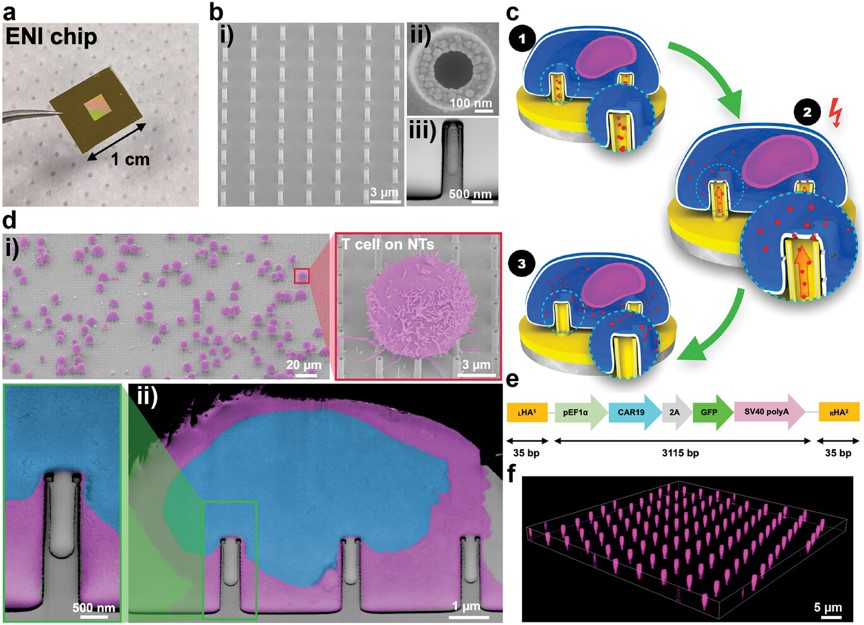
Abstract: Chimeric antigen receptor (CAR)-T cell therapy has emerged as a promising cell-based immunotherapy approach for treating blood disorders and cancers, but genetically engineering CAR-T cells is challenging due to primary T cells’ sensitivity to conventional gene delivery approaches. The current viral-based method can typically involve significant operating costs and biosafety hurdles, while bulk electroporation (BEP) can lead to poor cell viability and functionality. Here, a non-viral electroactive nanoinjection (ENI) platform is developed to efficiently negotiate the plasma membrane of primary human T cells via vertically configured electroactive nanotubes, enabling efficient delivery (68.7%) and expression (43.3%) of CAR genes in the T cells, with minimal cellular perturbation (>90% cell viability). Compared to conventional BEP, the ENI platform achieves an almost threefold higher CAR transfection efficiency, indicated by the significantly higher reporter GFP expression (43.3% compared to 16.3%). By co-culturing with target lymphoma Raji cells, the ENI-transfected CAR-T cells’ ability to effectively suppress lymphoma cell growth (86.9% cytotoxicity) is proved. Taken together, the results demonstrate the platform's remarkable capacity to generate functional and effective anti-lymphoma CAR-T cells. Given the growing potential of cell-based immunotherapies, such a platform holds great promise for ex vivo cell engineering, especially in CAR-T cell therapy.
Publications: Malhotra A, Dehghankelishadi P, Kaur I, Marshall M, Rudd D, Wojnilowicz M, Nowell CJ, Fulcher AJ, Esser L, Tong WY, Cifuentes A. Triple-Negative breast cancer aptamer-targeting porous silicon nanocarrier. ACS Applied Materials & Interfaces. 2025 Jan 13;17(4):5955-69.: 5955-5969.https://doi.org/10.1021/acsami.4c18453.
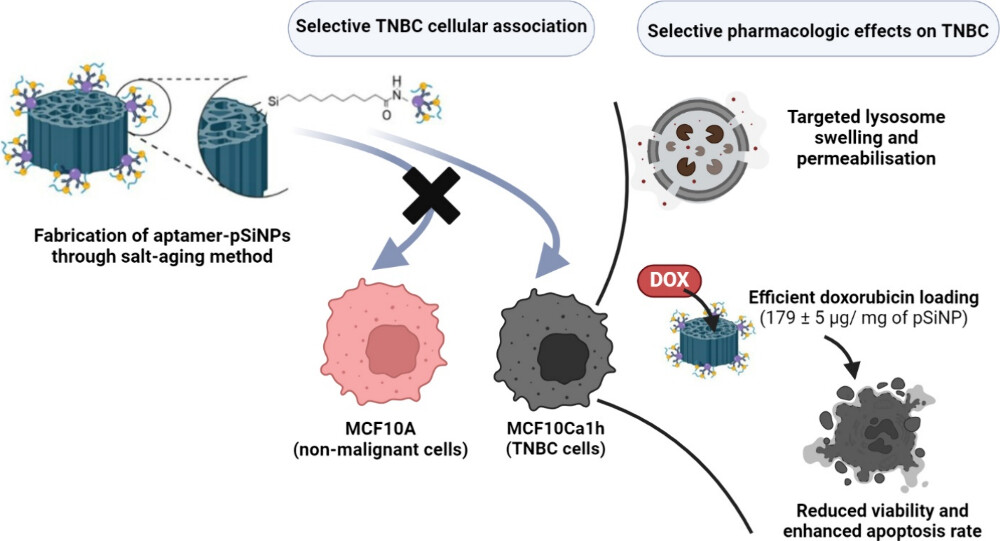
Abstract: Common treatment approaches for triple-negative breast cancer (TNBC) are associated with severe side effects due to the unfavorable biodistribution profile of potent chemotherapeutics. Here, we explored the potential of TNBC-targeting aptamer-decorated porous silicon nanoparticles (pSiNPs) as targeted nanocarriers for TNBC. A “salt-aging” strategy was employed to fabricate a TNBC-targeting aptamer functionalized pSiNP that was highly colloidally stable. Doxorubicin (Dox) was efficiently loaded into nanoparticles (179 ± 5 μg/mg of pSiNP) and experienced pH-dependent release kinetics. Further experiments highlighted that clathrin-mediated endocytosis was the primary route that aptamer-pSiNP conjugates take to enter the endolysosomal compartment of the MCF10Ca1h TNBC cells. A time-interval colocalization study shows the accumulation of an aptamer-decorated pSiNP conjugate in the lysosomes of TNBC cells, unlike for antibody-decorated pSiNPs, leading to particle-induced lysosomal swelling and membrane destabilization. Dox-loaded aptamer-pSiNPs efficiently reduced the viability of the TNBC cells (11.8 ± 1.5%) compared to nontargeted nanoparticles (58.2 ± 8.8%) while the developed system showed a low level of toxicity in healthy cells, both in vitro and in vivo. These findings have laid the foundation for further investigating the potential of aptamer-pSiNP conjugates as a targeted treatment strategy in preclinical TNBC models.