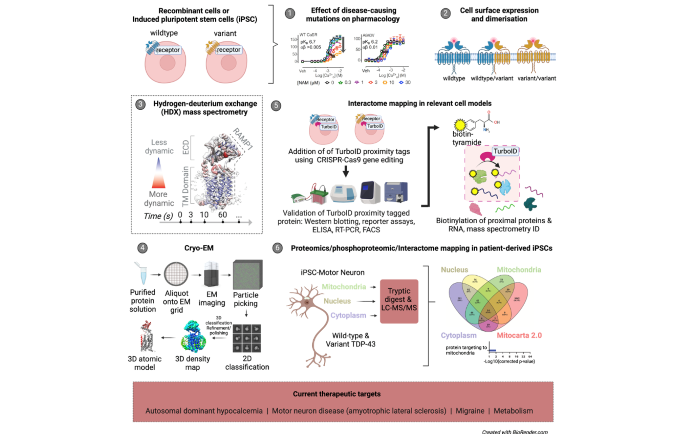
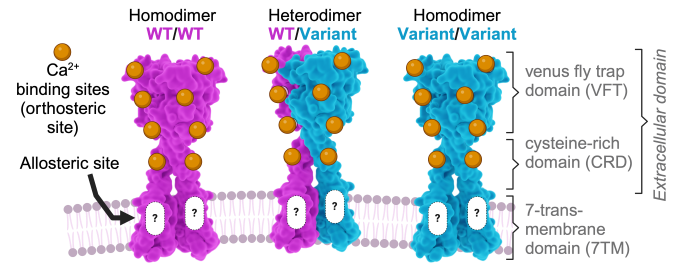
Autosomal Dominant Hypocalcemia Type 1 (ADH1) is a rare genetic disorder that disrupts calcium balance due to mutations in the calcium-sensing receptor (CaSR). These mutations make the receptor overly sensitive to calcium, leading to dangerously low blood calcium levels and complications such as kidney stones and organ calcifications.
Our research focuses on understanding how these mutations affect CaSR’s structure and function, particularly its ability to form dimers—complexes of two receptor proteins. Since current treatments, known as negative allosteric modulators (NAMs), interact differently with various CaSR mutations, our goal is to uncover the mechanisms behind these variations. By studying how CaSR dimers respond to calcium and NAMs, we aim to refine dosing strategies and identify new therapeutic approaches tailored to patients’ genetic profiles.
Through structural biology, pharmacology, and biophysical techniques, we are working to unlock new insights into CaSR function and develop better treatments for ADH1.
Visualising fragment binding at the CaSR using X-ray crystallography. Crystal produced by Gilbert (Yikai) Song, data collected at the Australian Synchrotron.
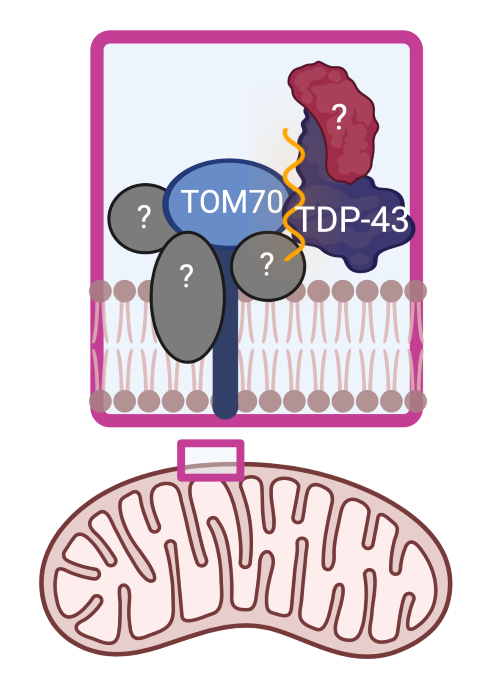
TDP-43 is a crucial protein involved in RNA regulation, but its mislocalisation and accumulation in mitochondria have been linked to neurodegenerative diseases like Amyotrophic Lateral Sclerosis (ALS) and Frontotemporal Lobar Degeneration (FTLD). While TDP-43’s nuclear functions are well studied, its role in mitochondrial dysfunction remains poorly understood.
Our research explores how TDP-43 and its genetic variants are transported to mitochondria, identifying the key interactions and molecular pathways that drive this process and contribute to neuronal damage. By integrating pharmacogenetics, biochemistry, mass spectrometry, and structural biology, we aim to uncover how genetic variations influence TDP-43 mislocalization and its role in ALS and related disorders. Understanding these mechanisms will provide crucial insights into disease variability and patient-specific responses to potential therapies, ultimately guiding the development of targeted treatments for TDP-43 proteinopathies.
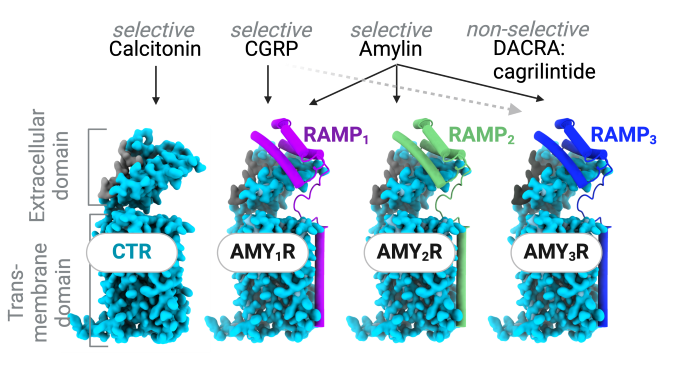
G protein-coupled receptors (GPCRs) are essential for translating external signals—like hormones, neurotransmitters, and peptides—into cellular responses. They regulate everything from metabolism to brain function, making them key drug targets. However, their activity isn't just determined by the signals they receive—accessory proteins like Receptor Activity-Modifying Proteins (RAMPs) fine-tune their function, influencing how they respond to different signals and drugs.
Our research focuses on calcitonin and amylin receptors (CTR/AMYR), which play critical roles in bone health and metabolism. These receptors interact with different RAMP proteins, reshaping their structure and altering their ability to bind peptides and activate specific signaling pathways. Using hydrogen-deuterium exchange mass spectrometry (HDX-MS), cryo-electron microscopy, and molecular pharmacology, we aim to uncover:
By revealing the molecular rules governing GPCR-RAMP interactions, our work will help guide next-generation drug design for metabolic disorders, and beyond.
Our lab is equipped with cutting-edge technologies to investigate protein dynamics, structure, and function with high precision. Key techniques available include:
Biophysical Characterization: We use a range of biophysical techniques, including circular dichroism (CD), differential scanning fluorimetry (DSF), and surface plasmon resonance (SPR), to study protein stability, folding, and binding interactions. These methods provide valuable insights into the physical properties of biomolecules and their behavior in different environments.