Although the development of male genitourinary organs and tissues is controlled hormonally, their physiological function is under the control of the sympathetic nervous system. This autonomic control by the sympathetic and parasympathetic nervous system has a number of consequences in male health. Specifically, overactivity of the sympathetic nervous system is implicated in both benign and cancerous prostate disease, while the parasympathetic nervous system is also implicated in prostate cancer progression. The transport of sperm through the male reproductive tract is also controlled by the sympathetic nervous system making it important in male fertility and a possible target for nonhormonal male contraception.
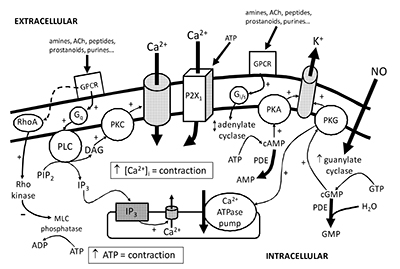
Our research focuses on three interrelated receptor proteins that are the predominant mediators of smooth muscle contractility in male genitourinary tissues: the G protein-coupled α1A-adrenoceptor and M3 muscarinic receptors as well as the P2X1-purinoceptor ligand gated ion channel. Using pharmacological, structural, biochemical, immunohistochemical and genetic approaches, we can study the role played by these receptors in male genitourinary function.
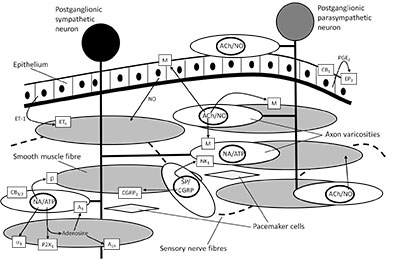
Likely locations on various cell types of membrane bound receptors and extracellular messengers which play a role in the control of prostatic smooth muscle contractility.
ViewClose
Inhibition of vas deferens contraction as a male contraceptive targetView
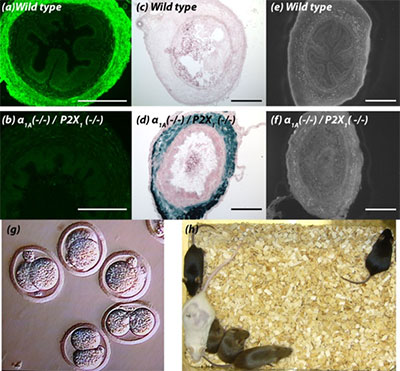
The search for a viable male contraceptive target has been a medical challenge for many years. Most strategies have focused on hormonal or germline strategies to produce dysfunctional sperm that are incapable of fertilization. The problem with such approaches is that they have intolerable side effects such as affecting male sexual activity or causing long term irreversible effects on fertility. In addition, some strategies may transmit detrimental changes to future offspring. This project investigates a male contraceptive target within the autonomic nervous system, which would not affect the long term viability of sperm nor the sexual or general health of males. In addition, due to the nature of the target, the contraceptive has the potential to be orally administered. This project uses genetically modified mice to investigate the viability of this target using behavioural mating studies, isolated tissue experiments, sperm analysis, in vitro fertilization, immunohistochemistry and in vivo cardiovascular physiology experiments.
Vas deferens histochemistry and sperm viability in α1A-adrenoceptor and P2X1-purinoceptor double knockout mice.
What makes the α1A-adrenoceptor gene elicit α1L-adrenoceptor pharmacology?View
The α1A-adrenoceptor is therapeutically exploited because of its prevalence in the lower urinary tract. The pharmacology shown by this lower urinary tract α1A-adrenoceptor is different from that shown by other α1A-adrenceptors, which has led to it being subclassified as an α1L-adrenoceptor. Only in the last few years, was it shown in our laboratory that this pharmacologically distinct α1L-adrenoceptor is a derivative of the α1A-adrenoceptor gene. This project investigates the possible molecular mechanisms by which the α1A-adrenoceptor gene is able to produce two pharmacologically distinct adrenoceptor subtypes. The project utilises cell lines transfected with α1A-adrenoceptors and native tissues which express α1A and α1L-adrenoceptors to investigate possible molecular mechanisms at play. The challenge remains to identify any interacting proteins and show the nature with which they change the pharmacology of the receptor for different ligands.
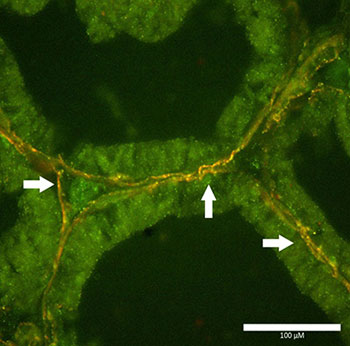
Colocalization of CXCR2 and α-actin within the stroma or the rat prostate gland.
Control of smooth muscle contractility within the prostate glandView
Benign prostatic hyperplasia (BPH) is the major cause of lower urinary tract symptoms in men aged 50 or older. Symptoms are not normally life threatening, but often drastically affect quality of life. Current drugs are only effective in treating mild to moderate symptoms, yet despite this no emerging contenders appear to be on the horizon. This is remarkable given the increasing number of patients with severe symptoms who are required to undergo invasive and unpleasant surgery. This project investigates novel drug targets focusing on drug targets which are able to relax prostatic smooth muscle in a similar way to the α1-adrenoceptor antagonists as this appears to be the most effective mechanism of action for the treatment of urinary symptoms associated with BPH. Recent basic research in our laboratory has revealed a number of novel drug targets such as muscarinic receptor or P2X-purinoceptor antagonists which have the potential to produce more effective and safer drug treatments.