Our research
Innovations in synthetic chemistry have had a profound impact over the past century enabling the discovery and development of life-changing medicines and medical imaging agents. Click chemistry has emerged as a key strategy in synthetic chemistry to overcome the limitations of traditional chemical synthesis (e.g. time consuming, labour intensive) using high energy spring-loaded reactants to forge complex new molecules.
While click chemistry was initially conceived to streamline the drug discovery process, it is now used in almost every corner of chemistry, materials science, and biology, and the significant impact of this approach was recognised in 2022 with the Nobel prize in Chemistry. However, the potential of click chemistry to build diverse, complex molecules with ever increasing economy, efficiency, and precision, remains significantly underexplored.
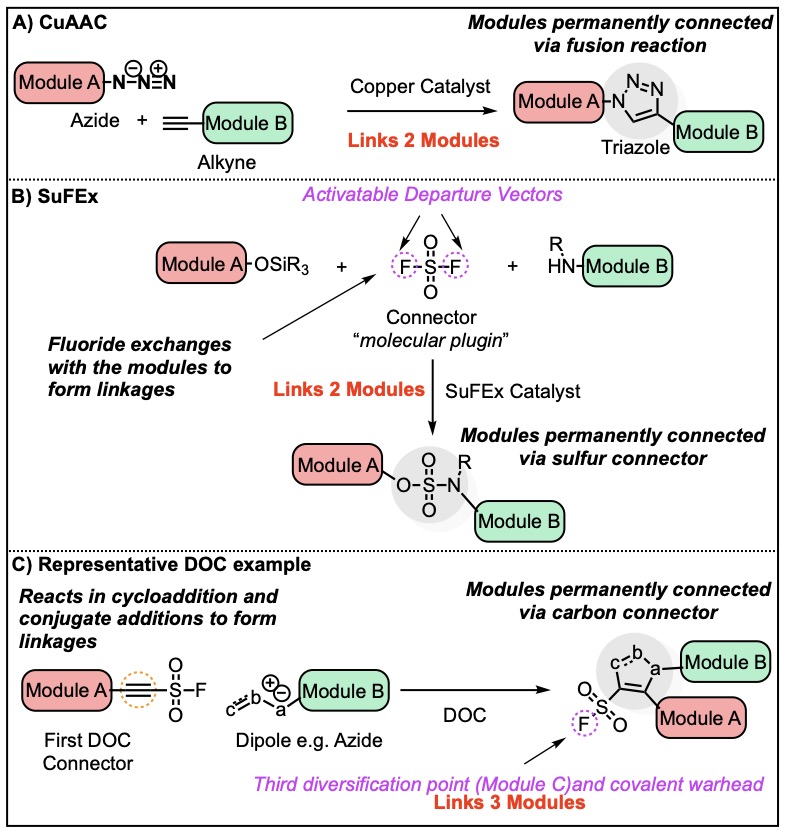
We aim to reinvigorate the wider family of click chemistry reactions using a novel Diversity Oriented Clicking (DOC) approach; a powerful strategy for the modular synthesis of complex molecular frameworks. DOC uses spring-loaded connector molecules (DOC connectors) capable of undergoing a variety of thermodynamically driven click chemistry transformations to access valuable molecules that are difficult or impossible to prepare using existing technologies.
In particular, our projects explore the use of novel DOC connector molecules to access diverse heterocyclic frameworks. These frameworks are highly sought after in medicinal chemistry and can also serve as tool compounds for deciphering biological mechanisms to aid in drug discovery and design.