
Visit deepens research collaboration to combat hospital acquired infections
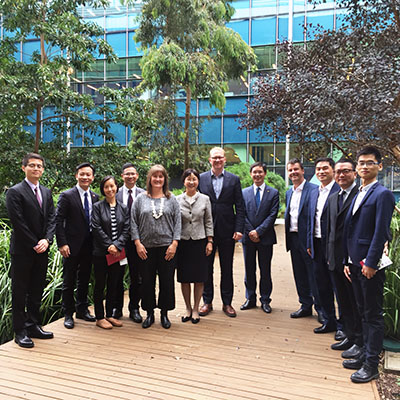
Director of the Monash Biomedicine Discovery Institute, Professor John Carroll,
and the delegation from Wenzhou Medical University
A delegation of representatives from Wenzhou Medical University in China has visited the Monash Biomedicine Discovery Institute, deepening the collaborative relationship between the two research organisations.
The Monash Biomedicine Discovery Institute (Monash BDI) and Wenzhou Medical University (WMU) signed an official Memorandum of Understanding in 2015, with an aim to facilitating researcher and student exchanges.
Since the two research organisations established an official understanding almost two years ago, the collaboration has focused on the field of hospital acquired infections.
Monash BDI researcher’s Professor Trevor Lithgow and Dr Yue Qu have championed the collaboration from the Monash side.
Professor Lithgow said the next steps in the collaboration were to expand the PhD student exchange program in the area of antimicrobial resistance.
“We’re now working with WMU to establish a state-of-the-art microbial genome sequencing laboratory,” Professor Lithgow said.
“We’re excited at the new prospects this collaboration is opening up,” he said.
“WMU has an incredible biobank of antimicrobial-resistant superbugs, isolated from patients over many years. Our collaboration will allow us to study these bacteria together, with an aim to develop new treatments.”
The WMU group included its President Professor Fan Lu, Dean of Postgraduate School Professor Zi-Bing Jin, Deputy Dean of Renji College Professor Zhangping Li, Deputy Director of its 1st Affiliated hospital Professor Pan Jingye, Deputy Director of its 2nd Affiliated Hospital Professor Shen Xian, and International Affairs Office Coordinator Xu Di.
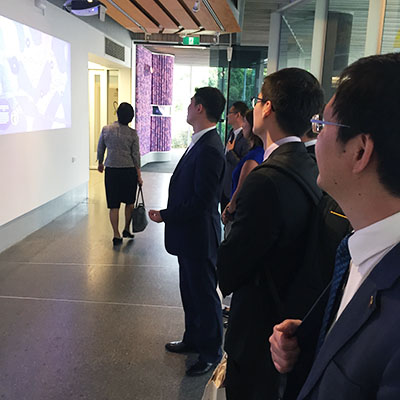 The delegation visited the Monash BDI on Monday February 6, 2017.
Their visit included a tour of the Monash BDI’s newly opened biomedical science exhibition, which showcases how the institute’s research accelerates the ability to prevent, diagnose and treat disease.
The exhibition features a motion-activated historical timeline, touch screens that tell stories of research breakthroughs, biomedical holograms, 3D printed models and animations.