
Monash BDI researcher receives stem cell society leadership role
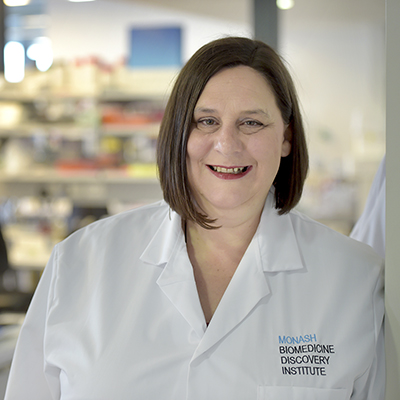
Monash Biomedicine Discovery Institute (BDI) researcher Associate Professor Helen Abud has been elected Vice President of the Australian Society for Stem Cell Research (ASSCR), a role that will see her take over as President in two years.
The appointment recognises Associate Professor Abud as being a leader in stem cell research nationally.
“It’s an honour to receive this kind of appointment,” Associate Professor Abud said.
“It provides a key role for me in interacting with some fantastic stem cell researchers,” she said.
“It’s great to be able to be part of that network and have more of a leadership role in the community.”
“An incredibly important part of my position is fostering the development of up-and-coming stem cell researchers, by promoting opportunities for students and early career researchers to interact with leaders in the field. In particular, I hope to inspire young female researchers to obtain their goals.”
Associate Professor Abud, a long-term member and key figure in the ASSCR, previously chaired its Conference and Awards Subcommittee. She said the ASSCR encourages interaction between stem cell scientists in Australia, connects them with researchers internationally, provides updates on news in the field, offers researchers the opportunity to present their findings to a wider audience, and airs issues.
The organisation has strong ties with the National Stem Cell Foundation of Australia, a philanthropic body supporting stem cell researchers and projects, and with the International Stem Cell Society, whose annual meeting it co-sponsored in Melbourne last year, with nearly 3000 people attending.
Australian stem cell research is regarded as being at the forefront internationally.
“It’s a really exciting time for stem cell research,” Associate Professor Abud said.
“We’re at the bridge of many years of basic research studying how stem cells behave, which is starting to be translated into treatments in the clinic,” she said.
“I think in the future we’re going to have some amazing stem cell therapies but it really requires very dedicated, rigorous research and robust ethical and safety standards.”
One of the leading female researchers at the Monash BDI, Associate Professor Abud has been a laboratory head for 11 years, and is Director of the Monash BDI Organoid Program. She studies stem cell behaviour in the intestine. Overactive stem cells in the intestinal lining can lead to bowel cancer and underactive cells to a loss of intestinal lining. Associate Professor Abud is trying to stop these cells causing tumours and use them to repair damaged tissue.
Information about the ASSCR and details of how to become a member are available on their website.
About the Monash Biomedicine Discovery Institute Committed to making the discoveries that will relieve the future burden of disease, the newly established Monash Biomedicine Discovery Institute at Monash University brings together more than 120 internationally-renowned research teams. Our researchers are supported by world-class technology and infrastructure, and partner with industry, clinicians and researchers internationally to enhance lives through discovery.