
Overcoming tumour barriers for CAR T cell therapy in prostate cancer

A strategic collaboration between Monash Biomedicine Discovery Institute and Peter MacCallum Cancer Centre’s Immunology Program has discovered a novel way in which solid cancers may be made responsive to immunotherapy.
Published recently in Nature Communications, this preclinical research has shown that a type of engineered T cell therapy used successfully for treating some forms of blood cancer can be adapted to treat prostate cancer.
In Chimeric Antigen Receptor (CAR) T cell therapy, a patient’s ‘killer T cells’ are harvested from their blood and re-engineered in the lab to specifically recognise cancer cells. The T cells are infused into the patient where they traffic throughout the body to identify and kill cancer cells that they encounter.
Monash Biomedicine Discovery Institute’s Professor Renea Taylor, co-senior author together with Professor Gail Risbridger, explained that CAR T cells have been extremely effective and are approved for use in patients with blood cancer such as acute lymphocytic leukemia (ALL).
“However, CAR T cell therapy has been far less effective in ‘solid cancers’, because of the hostile environment of solid cancers that prevents the T cells from entering the tumour,” said Professor Taylor.
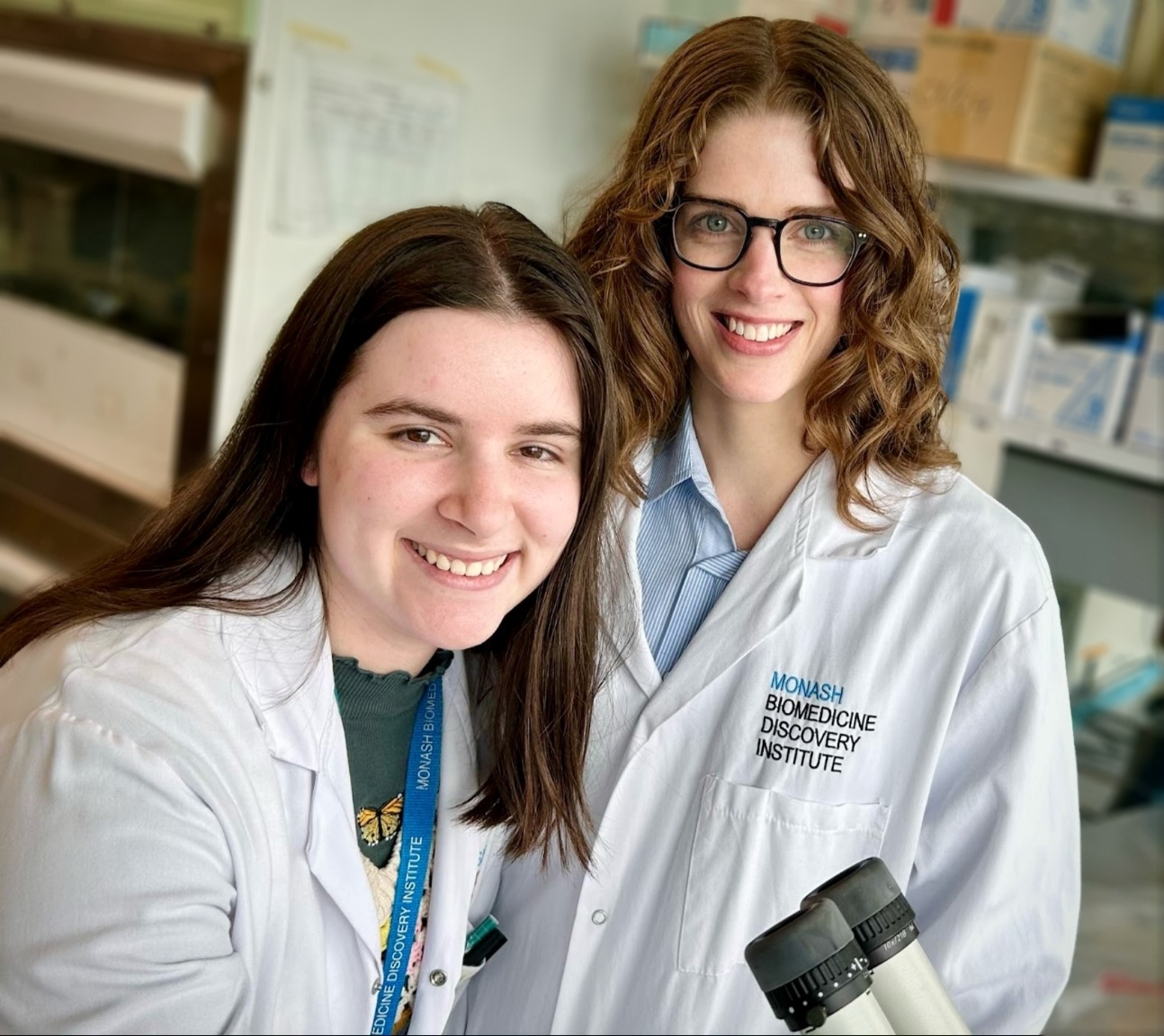
Dr Laura Porter (right) is a postdoctoral fellow in the Prostate Cancer Research group and was the first author of the study. Ms Sophie Harrison (left) is a PhD student who was a co-author on the Nature Communications publication.
In blood cancers, CAR T cell therapies can directly attack cancer cells that are circulating in the blood or being produced in the bone marrow. However, in solid cancers, such as prostate cancer, physical and chemical barriers prevent the CAR T cells penetrating the tumour and killing the cancer cells.
“One of the main reasons for CAR T cell therapy not working so well in solid cancers is the physical barrier created by the structural components of the organ (extracellular matrix and fibroblasts) that make it difficult for T cells to penetrate the cancer. And even if they do, the cells lining the cancer’s own blood vessels can prevent the T cells from entering the tumour.”
Professor Risbridger said, “In this study, we treated prostate cancer tumour cells with a ‘modulating agent’, in this case, chemotherapy, that changed the hostile environment and allowed the CAR T cells to get access to the tumour and kill the cancer cells.”
This is proof of the concept that if you get the ‘modifying’ approaches right, CAR T cells may not only have a broad utility for prostate cancer, but also other solid cancers.
Professor Joe Trapani, Head of Peter Mac’s Cancer Immunology Program said that one of the remarkable things the team found is that giving a small dose of chemotherapy used for some cases of advanced prostate cancer seemed to greatly boost the anti-cancer effects of CAR T cells if they are given a few days later, in many cases leading to the tumour being eradicated.
"Our collaborative team will be continuing to search for more modulating agents that cause such a powerful synergy with CAR T cell immunotherapy and determine why combining the two therapies can be so beneficial. We hope one day to test the best combination therapy in a controlled human clinical trial,” he said.
Read the paper, published in Nature Communications, titled Low-dose carboplatin modifies the tumor microenvironment to augment CAR T cell efficacy in human prostate cancer models
DOI: 10.1038/s41467-023-40852-3
About the Monash Biomedicine Discovery Institute
Committed to making the discoveries that will relieve the future burden of disease, the Monash Biomedicine Discovery Institute (BDI) at Monash University brings together more than 120 internationally-renowned research teams. Spanning seven discovery programs across Cancer, Cardiovascular Disease, Development and Stem Cells, Infection, Immunity, Metabolism, Diabetes and Obesity, and Neuroscience, Monash BDI is one of the largest biomedical research institutes in Australia. Our researchers are supported by world-class technology and infrastructure, and partner with industry, clinicians and researchers internationally to enhance lives through discovery.