
Preventing bowel cancer by reversing ageing in the gut
About 17,000 Australians were diagnosed with bowel cancer last year. With an ageing population, that number will be rising as the risk of developing bowel cancer increases as we age. By age 50, we are at a ten-fold higher risk of developing bowel cancer when compared with earlier in life. Ageing is, therefore, the strongest risk factor for bowel cancer. Strategies to address the increased risk of bowel cancer with age are sorely lacking.
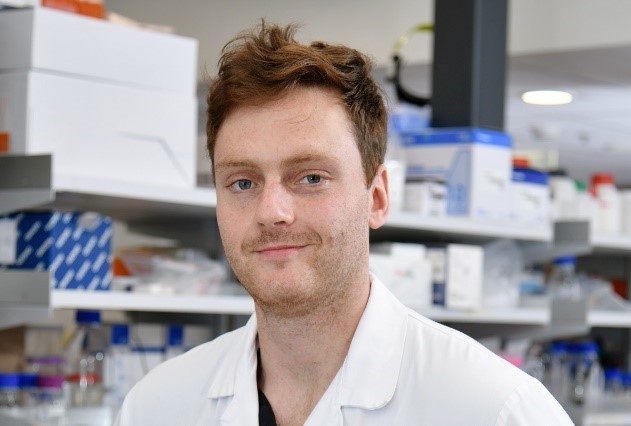
Monash Biomedicine Discovery Institute (BDI) researcher Dr Lochlan Fennell has been awarded $100,000 over 12 months by Cure Cancer to investigate the possibility of restoring the youthfulness of the cells that cause bowel cancer. His research team members are BDI’s Dr Thierry Jarde and Dr Dustin Flanagan, and Professor Vicki Whitehall from Queensland Institute of Medical Research.
Dr Fennell said that until recently, the ageing process — and the risks associated with it — was thought to be irreversible.
“In this research, we will be applying a cutting-edge method known as “cellular reprogramming”, in an attempt to reverse ageing and prevent cancer from taking hold. This method introduces genetic factors that enable aged colon cells - the cells that we know cause bowel cancer - to become more youthful. We think that this will give healthy colon cells the edge they need to “outcompete” cancer initiating cells should they form.
“We will be using innovative “organoid” models to perform this research. These organoid models form 3-dimensional mini-gut structures in a petri-dish and are able to mirror processes that occur in the body, including ageing,” Dr Fennell said.
“By combining these two approaches, we hope to show that by rejuvenating cells we can improve their ability to resist the genetic changes that cause cancer.”
About the Monash Biomedicine Discovery Institute
Committed to making the discoveries that will relieve the future burden of disease, the Monash Biomedicine Discovery Institute (BDI) at Monash University brings together more than 120 internationally-renowned research teams. Spanning seven discovery programs across Cancer, Cardiovascular Disease, Development and Stem Cells, Infection, Immunity, Metabolism, Diabetes and Obesity, and Neuroscience, Monash BDI is one of the largest biomedical research institutes in Australia. Our researchers are supported by world-class technology and infrastructure, and partner with industry, clinicians and researchers internationally to enhance lives through discovery.