
From lab to worksite: how MCAP is accelerating a breakthrough breath test for silicosis
A simple breath test could soon transform how one of Australia’s most devastating occupational lung diseases is detected – and the Monash Institute of Medical Engineering (MIME)’s MedTech Commercialisation Advancement Program (MCAP) has played a critical role in getting it there.
Developed by a multidisciplinary Monash University team, the project aims to create a portable breath test that can identify workers at high risk of silicosis before symptoms appear, enabling earlier intervention, targeted screening and better long-term health outcomes.
Silicosis, caused by inhaling fine silica dust from industries such as mining, tunnelling and cutting engineered stone, is increasingly affecting younger workers. Despite growing awareness, many people are still diagnosed only once the disease is apparent on lunging imaging/radiology.
“At the moment, people are often diagnosed when they’re already quite unwell,” said Project Lead, Dr Paris Papagianis, Postdoctoral Research Fellow in the Respiratory Pharmacology Lab within the Biomedicine Discovery Institute (BDI) at Monash University.
“Our goal is to identify people earlier – while they’re still working, still feeling well – and help manage any symptoms before they are so unwell they can no longer work and before the disease progresses.”
A new pathway for early detection
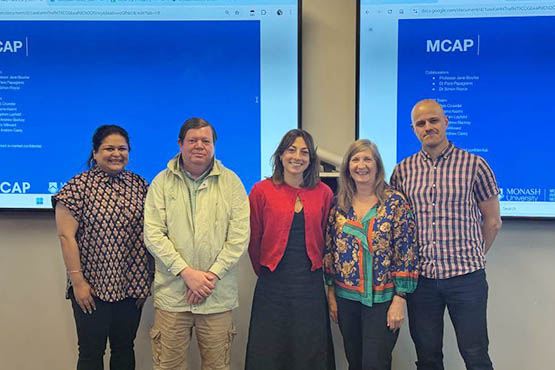
The research team, led by Professor Jane Bourke, and including Dr Paris Papagianis along with senior post-doctoral researcher Dr Simon Royce and recent PhD graduate Dr Claudia Sim, is focused on analysing chemicals in exhaled breath that are unique to people with silicosis.
After completing early clinical pilot studies and collecting breath samples from people with and without the disease, the team is now analysing those samples to identify a panel of target chemicals associated with silicosis.
The long-term vision is a portable, on-site screening tool – similar in ease to an alcohol breath test – that could be used at mine sites and other high-risk workplaces to triage workers into low, medium or high-risk categories.
“We see this as a pre-screening tool,” Dr Papagianis said.
“If someone breathes into the device and is flagged as high risk, they can be prioritised for further testing like X-rays or lung function tests when mobile screening services visit a site.”
How MCAP helped turn an idea into a viable MedTech solution
While the scientific concept was already strong, it was MIME’s MCAP program that helped the team take the crucial next step: thinking beyond the lab and designing a solution that could realistically be adopted, scaled and sustained.
MCAP provides focused, hands-on support to early-stage medical technologies developed by multidisciplinary teams across universities and healthcare settings. Over a 10-week period, the MCAP team worked closely with the researchers, bringing together expertise in commercialisation, design, intellectual property and health economics.
“MCAP was honestly amazing,” Dr Papagianis said.
“We felt incredibly fortunate to have such a dedicated team of experts working directly with us on something we care so deeply about.”
“They brought expertise that we simply don’t have access to as academic researchers – and they did it in a way that was incredibly approachable, supportive and easy to work with.”
Through MCAP, the team gained:
- A clear commercialisation pathway, including early IP landscape analysis and identification of patenting opportunities,
- Health economic modelling to demonstrate potential cost savings for government and screening programs,
- Design expertise that helped visualise what a real-world device could look like and how workers would interact with it, and
- A user-centred approach, keeping workers, clinicians and systems front-of-mind at every stage.
“The process was seamless,” Dr Papagianis said.
“MCAP did the heavy lifting – the research, the market analysis, the IP work – and then brought those insights back to us in a really clear and practical way.”
“It flipped the way we normally do research.
“Instead of starting with a hypothesis, we started with the person. That completely changed how we think about impact.”
Why this matters – for workers, industry and Australia
Silicosis disproportionately affects young, working-age men, often in their 30s, with significant social and economic consequences. Many are supporting families and face the prospect of leaving the workforce entirely once diagnosed.
Early identification could allow workers to:
- Take protective steps sooner,
- Be monitored more closely, and
- Stay in the workforce safely for longer or retrain before their health deteriorates.
At a system level, the implications are just as significant.
“Through MCAP, we were able to model what improved screening could mean economically,” Dr Papagianis said.
“If we can improve detection by even 10 to 30 per cent, that translates to major savings for government and reduced pressure on already stretched screening services.”
What’s next
With analysis of breath samples underway, the team’s next steps involve translating their findings into portable sensors suitable for real-world use and progressing toward field testing at high-risk worksites.
Ultimately, the researchers hope the technology could be adopted as a government-subsidised screening tool, embedded into existing occupational health programs across Australia.
“MCAP didn’t just help us move the project forward,” Dr Papagianis said.
“It changed how we think about research, impact and who we’re doing this for. I’d absolutely recommend it to any team working on patient- or user-facing technologies.”
-
For more on MIME’s MedTech Commercialisation Advancement Program (MCAP) visit:
MedTech Commercialisation Advancement Program - Monash Institute of Medical Engineering
-
GENERAL MEDIA ENQUIRIES
For more Monash media stories, visit our news and events site
Monash Media
E: media@monash.edu
T: +61 (0) 3 9903 4840
About the Monash Biomedicine Discovery Institute at Monash University
Committed to making discoveries that will relieve the future burden of disease, Monash Biomedicine Discovery Institute at Monash University brings together more than 120 internationally renowned research teams. Spanning seven discovery programs across Cancer, Cardiovascular Disease, Development and Stem Cells, Infection, Immunity, Metabolism, Diabetes and Obesity, and Neuroscience, Monash BDI is one of the largest biomedical research institutes in Australia. Our researchers are supported by world-class technology and infrastructure, and partner with industry, clinicians and researchers internationally to enhance lives through discovery.