
Monash BDI researchers secure more than $18M in NHMRC Investigator Grants
Nine researchers from the Monash Biomedicine Discovery Institute (BDI) have secured more than $18 million in funding through the National Health and Medical Research Council's (NHMRC) 2026 Investigator Grant scheme, announced by Federal Minister for Health and Ageing, Mark Butler.
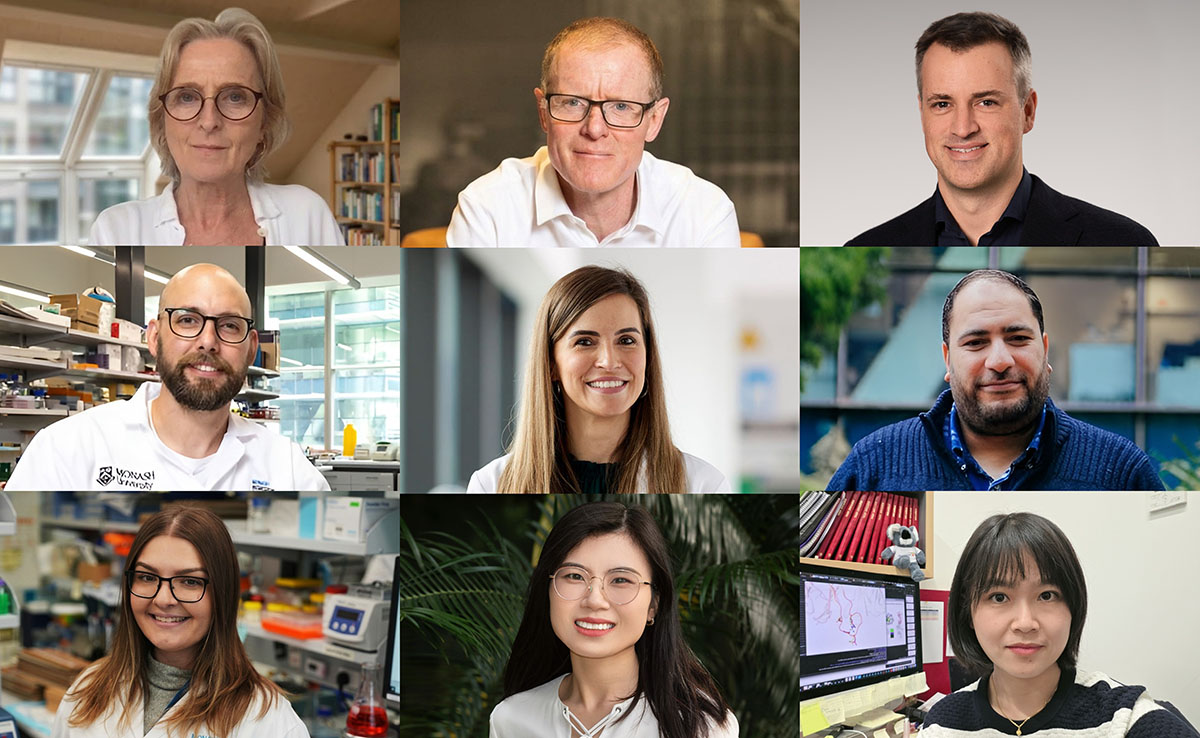
Monash BDI’s NHMRC Investigator Grants 2026 recipients: (Top row L-R) Prof Mary Herbert, Prof Jamie Rossjohn, Prof Andrew Ellisdon, (Middle row) A/Prof Rhys Grinter, Prof Francine Marques, Dr Wael Awad, (Bottom row) Dr Lauren Alesi, Dr Meiling Han, Dr Jia Jia Lim.
Professor Dena Lyras, Interim Director of the Monash BDI, said the funding highlights the strength and diversity of the Institute’s research community.
“These Investigator Grants support some of Australia’s most innovative and ambitious biomedical research programs, and I’m delighted to see nine Monash BDI researchers recognised through this highly competitive scheme,” Professor Lyras said.
“The funded projects span a remarkable breadth of research, from reproductive health and cardiovascular disease to cancer immunotherapy, antimicrobial resistance and AI-enabled drug discovery. Together, they have the potential to deliver important advances in our understanding of disease and contribute to the development of new treatments that improve health outcomes,” she said.
“This funding will enable our researchers to pursue bold ideas and address some of the most significant health challenges facing Australia and the global community. I congratulate all of our Investigator Grant recipients on this achievement and acknowledge the significant effort that goes into developing applications for such a competitive funding scheme.”
The nine Monash BDI projects are among 26 projects awarded more than $49 million in funding to Monash Medicine Nursing and Health Sciences (MNHS) researchers in the latest NHMRC Investigator Grants. Read more on each of the MNHS recipients here.
The nine Monash BDI researchers to receive funding were:
Leadership 3
Professor Mary Herbert, Safeguarding transmission of the maternal genome to improve women's health and reproductive outcomes.
This project investigates why female fertility declines with age, as more Australian women delay childbirth into their late 30s and beyond. The five-year project aims to identify the biological mechanisms driving the loss of egg quantity and quality, which increases the risks of infertility, miscarriage and chromosomal abnormalities. Using mouse models, human eggs and clinical data, the team aims to uncover the molecular drivers of female reproductive ageing. Findings could lead to new treatments and interventions to improve reproductive outcomes for older women and those carrying mitochondrial DNA mutations.
Professor Jamie Rossjohn FAA FRS, A molecular investigation into T cell antigen receptor function and dysfunction in humans
T cells play a key role in the human immune system. However, there are many aspects of T cell mediated immunity we do not understand. This proposal is focused on understanding the molecular mechanisms underpinning how T cell antigen receptor (TCR) recognition events govern cellular immunity in the context of protective, aberrant and anti-tumour immunity. This includes understanding how TCRs recognise peptides, lipids and metabolites presented by the MHC, CD1 and MR1 family of antigen presenting molecules.
Leadership 2
Professor Andrew Ellisdon,Targeting lysosomal cholesterol sensing to combat aberrant cell growth
A newly identified cholesterol sensor, LYCHOS, is emerging as a promising target for treating diseases driven by excessive cell growth, including cancer, diabetes and neurodevelopmental disorders. This project aims to uncover how LYCHOS regulates the key growth pathway mTORC1 and to develop drugs that selectively block its activity. Combining cryo-electron microscopy, AI-assisted ligand screening and drug discovery approaches, the research builds on major advances in understanding LYCHOS structure and function. The expected outcomes include novel therapeutic candidates and new strategies to safely control harmful growth signalling.
Leadership 1
Associate Professor Rhys Grinter, Harnessing AI to develop protein therapeutics targeting Leucine Rich Repeat G-protein Coupled Receptors
Artificial intelligence is being harnessed to develop a new generation of protein-based medicines targeting a family of cell receptors linked to fertility, heart disease, metabolism and cancer. This project will design custom proteins capable of activating or blocking difficult-to-drug receptors known as LGR-GPCRs, using advanced de novo protein design techniques. These engineered binders could lead to novel therapies while also providing new insights into receptor biology. The research is expected to strengthen Australia’s capabilities in AI-driven drug discovery and accelerate the development of treatments for a range of major diseases.
Professor Francine Marques, Harnessing the gut microbiome to transform blood pressure management
High blood pressure affects millions worldwide and remains a leading cause of heart disease and stroke, despite the availability of existing treatments. This research will investigate how the gut microbiome influences blood pressure through communication between the gut and other organs, with the aim of developing new therapies for hypertension. The program will test microbial-based supplements, identify novel drug targets and determine which patients are most likely to benefit from personalised interventions. The findings could transform blood pressure management and open new avenues for precision cardiovascular medicine.
Emerging Leadership 2
Dr Wael Awad, Harnessing Cancer-Activated Invariant T cells for next-generation cancer immunotherapy
A newly discovered cancer-fighting immune cell could pave the way for next-generation immunotherapies that work across a wide range of tumour types. This project focuses on cancer-associated invariant T (CAIT) cells, which recognise cancer-related metabolic signals presented by the molecule MR1. Using structural biology, biochemistry and immunology, this project aims to identify the tumour metabolites that activate these cells and develop novel MR1-based therapies. The findings could reveal universal cancer targets and support the creation of broadly applicable immunotherapies and vaccines for cancer treatment and prevention.
Emerging Leadership 1
Dr Lauren Alesi, Developing a novel strategy to preserve fertility and long-term health after cancer treatment
A promising new approach to protecting women from the long-term effects of cancer treatment is advancing toward clinical development. This project centres on blocking PUMA, a key protein involved in cell death that has been shown to drive chemotherapy-related damage to eggs and reproductive tissues. The research will investigate whether PUMA inhibition can preserve fertility, protect the uterus and reduce damage to other organs affected by cancer therapy. Using human tissue and advanced preclinical models, the study aims to lay the foundation for treatments that safeguard fertility, pregnancy outcomes and overall health in female cancer survivors.
Dr Meiling Han, Reprogramming Bacterial Metabolism: A New Frontier in Overcoming Antibiotic Resistance
Antibiotic-resistant bacteria are a growing global health threat, prompting the search for new ways to restore the effectiveness of existing treatments. This project investigates how Gram-negative bacteria alter their metabolism and cell membranes to survive even last-line antibiotics. Focusing on the role of arginine metabolism in driving resistance, the research will combine advanced metabolic and lipid analysis with human-relevant infection models. The findings are expected to identify new drug targets and support the development of combination therapies that can overcome multidrug-resistant infections and improve patient outcomes.
Dr Jia Jia Lim, Targeting CD1a-restricted T cells for molecular intervention in skin autoimmunity
New insights into how the skin’s immune system responds to altered lipids, with the goal of developing more targeted treatments for inflammatory skin diseases. This project focuses on CD1a, an immune molecule that presents lipid antigens to T cells and can trigger harmful immune responses when skin lipids are altered by factors such as UV exposure or cosmetic products. Using structural biology and immunology, the research will uncover how altered lipids activate pathogenic T cells and explore ways to block these interactions, providing a foundation for improved therapies for psoriasis, eczema and allergic contact dermatitis.
-
GENERAL MEDIA ENQUIRIES
For more Monash media stories, visit our news and events site
Monash Media
E: media@monash.edu
T: +61 (0) 3 9903 4840
About the Monash Biomedicine Discovery Institute at Monash University
Committed to making discoveries that will relieve the future burden of disease, Monash Biomedicine Discovery Institute at Monash University brings together more than 120 internationally renowned research teams. Spanning seven discovery programs across Cancer, Cardiovascular Disease, Development and Stem Cells, Infection, Immunity, Metabolism, Diabetes and Obesity, and Neuroscience, Monash BDI is one of the largest biomedical research institutes in Australia. Our researchers are supported by world-class technology and infrastructure, and partner with industry, clinicians and researchers internationally to enhance lives through discovery.