
Lyceum members book in for a visit with a difference
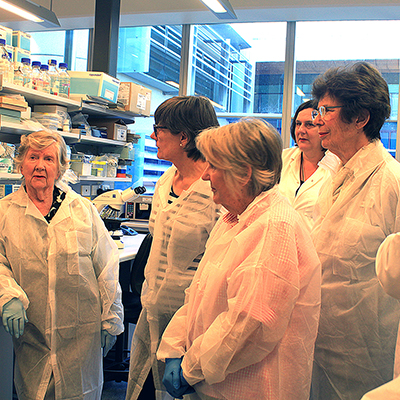
The fascinating story of theHenrietta Lackscell line – the HeLa cells – was the starting point for a tailor-made visit to the Monash Biomedicine Discovery Institute (BDI) early this month by members of the Lyceum Club Book Group.
Nine women from the influential women’s organisation – eight of whom had never been in a laboratory before – were guided around the Monash BDI by two PhD Ambassadors, Meg McFetridge and Tess Malcolm.
The Immortal Life of Henrietta Lacks, chosen in consultation with the book club,is about an “immortal” line derived from cervical cancer cells taken from Henrietta Lacks without her knowledge in 1951. Mrs Lacks died of her cancer that year. The cells have since proved very significant to biomedical research, critical in developing the polio vaccine, cloning and gene mapping among other uses. However, their use has created controversy.
The best-selling book, also a movie, was chosen to engage the women in discussions around the nature of biomedical science and ethics.
Monash BDI Director Professor John Carroll introduced the guests to the Institute, speaking about the role of discovery research and support of women in research. The women then visited two laboratories, Associate Professor Helen Abud’s and Dr Renea Taylor’s labs.
They discussed the book further over high tea at the Monash Club. Aspects of the book were woven throughout the visit, including viewing HeLa cells in the Abud lab and a discussion about the rigorous procedures used to de-identify samples and to protect patients now.
Genevieve Kerr, Organoid Program Manager from the Abud lab said, “These events help to increase public awareness of what actually happens day to day in research institutes.
The participants were excited to see how the research we do in the lab today will hopefully improve the way patients with cancer are treated in the future."
Lyceum Club members comprise of female graduates and other women who have distinguished themselves in art, music, literature, philanthropy or public service and who often have broad and influential networks.
The visit, arranged through a personal connection, created a buzz around the Monash BDI, which is bound to heard beyond the visit.
In thanking the Institute, Mrs Judy Milne-Pott said, “We found the event both highly informative and inspiring as to the wonderful research being undertaken. I am sure the talks have made a strong impression on all of us and it is something we will follow with interest. I know many of us are keen to share with others our newly acquired knowledge of your work and its importance.”
Several follow-up opportunities were created by the event, including discussion about Monash BDI speaker opportunities at the Lyceum Club.
The visit was part of the Monash BDI’s drive to spread the word about the work of the Institute, and the importance of sharing discovery research with new audiences and networks, and in different forums.
“Public engagement is a critical activity for biomedical institutes such as ours, to promote awareness, ensuring that the public understand the importance of discovery research in paradigm-shifting science underpinning the next generation of therapies,” Ms Bianca Chan, Manager, Research and Engagement said.
“Here are nine women – eight who’d never been in a lab before – who became advocates for discovery research and the Institute. It’s about building a groundswell of support for the Institute using both general public events and more bespoke opportunities like this one.”