
Monash BDI researchers speak at Melbourne Knowledge Week
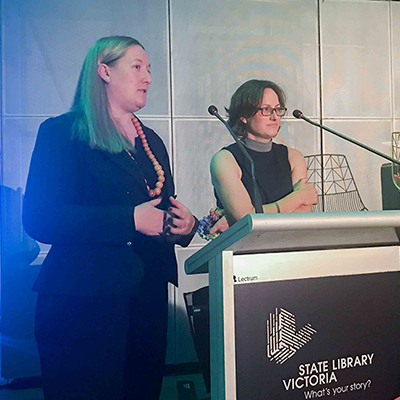
Associate Professors Stephanie Gras and Michelle Dunstone at Melbourne Knowledge Week 2017
Associate Professor Michelle Dunstone and Associate Professor Stephanie Gras are determined to connect with curious minds, and being involved in Melbourne Knowledge Week (MKW) for the second year is a good start! A/Prof Gras, MKW veteran and A/Prof Dunstone, first-timer, both entertained and educated a crowded festival hub at MKW2017.
Experimedia came alive this MKW, with an immersive media lounge – think augmented and virtual realities – an innovation zone, where early adopters and the city’s most exciting coders, hackers and makers showcased tools to change how we work and live. And, midweek, the hub took a dive inwards to find out what keeps us alive. Our two, actual living 'women in science' imparted a memorable saying: where there is structure, there is function.
Fifty or so Melbournians listened to how A/Prof Gras and A/Prof Dunstone are making breakthroughs in immunology and how these breakthroughs translate into life-changing treatments.
A/Prof Gras started at the perfect place, the beginning - aka crystallography- and A/Prof Dunstone looked to the future, cryo-Electron Microscopy and X-ray Free Electron Lasers. But they both agreed – all techniques play a major role in unlocking secrets of the immune system.
A/Prof Gras explained how these discoveries enable us to make better and more efficient vaccinations – yes, that includes your flu shot. And she outlined some recent discoveries made by our CoE around lipid recognition and perhaps a reason why we react and have sensitivities to well-known, and commonly prescribed, medications.
A/Prof Dunstone painted a wonderful story about how these same imaging technologies help us to understand the different ways our immune system kills. She didn’t just paint the story, she blew it up with two different sized balloons. A big balloon represented a human cell and a much smaller balloon, bacteria. A/Prof Dunstone wanted the audience to see the size difference and to understand that all cells, whether big or small, can be popped by pore-forming proteins – one of our killing immune cell. You can find out more about some of these hole punching proteins; including pleurotolysin and perforin.
You know you’ve engaged and educated when the audience ask questions. Broad questions around vaccination and immunosuppression were asked, but there were a couple more intricate questions around protein interactions and how we extrapolate from our crystal structures. A/Prof Gras and A/Prof Dunstone also had a queue of interested rugged up audience members keen to ask questions in private at the wrap of the event.
"We are committed to engaging with the broader public and are eager to encourage them to explore, question and further develop their scientific mindsets. Being involved in MKW gives us a fantastic opportunity to do this, connect with those curious minds." said A/Prof Gras and A/Prof Dunstone.
A/Prof Gras and A/Prof Dunstone are Group Leaders at the Monash Biomedicine Discovery Institute and also Associate Investigators at the Australian Research Council Centre of Excellence in Advanced Molecular Imaging
About the Australian Research Council Centre of Excellence in Advanced Molecular Imaging
The $39 million ARC-funded Imaging CoE develops and uses innovative imaging technologies to visualise the molecular interactions that underpin the immune system. Featuring an internationally renowned team of lead scientists across five major Australian Universities and academic and commercial partners globally, the Centre uses a truly multi scale and programmatic approach to imaging to deliver maximum impact. The Imaging CoE is headquartered at Monash University with four collaborating organisations – La Trobe University, the University of Melbourne, University of New South Wales and the University of Queensland.