
Putting pep into peptide debate
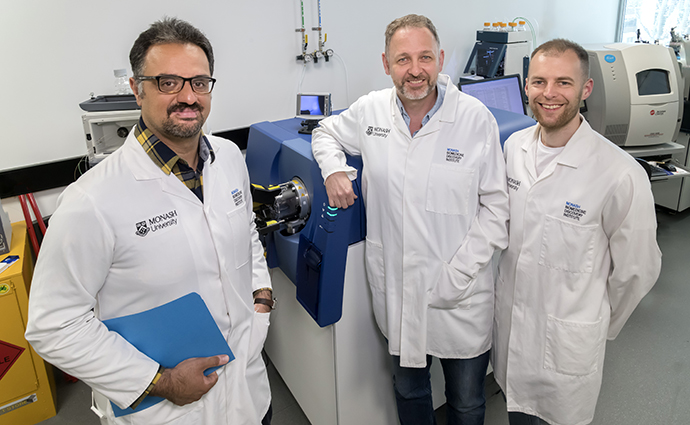
They’ve been dubbed ‘Frankenstein peptides’ and are regarded with scepticism. They may also have untapped potential for new vaccination and immunotherapies. Now Monash Biomedicine Discovery Institute (BDI) researchers have made significant new insights into trans-spliced peptides and their potential disease-fighting properties.
For some years, antigenic peptides recognised by killer T-cells were thought to derive from linear fragments of cellular proteins. Trans-spliced peptides however – first demonstrated experimentally in 2010 – are formed when segments from two different antigens splice and fuse together.
A study published in Science Immunology this month, co-led by Monash BDI’s Professor Tony Purcell and Dr Nathan Croft, found that rather than being a relatively rare occurrence, as previously thought, an abundance of trans-spliced peptides can be found bound to Human Leukocyte Antigen (HLA) molecules on the surface of cells. HLA is a key molecule in the immune response.
“The study is significant in accepting that this new class of peptide antigens exists,” Professor Purcell said.
“I would say this is the first strong evidence that they exist and that they exist in quite high abundance, which is surprising,” he said.
“The more abundant, the more likely they are to be involved in the immune reaction.”
The study is in response to a 2016 study, which controversially showed that up to a third of all peptide antigens found on the surface of different cell types were best explained as spliced peptides. This new study confirms this, showing the unanticipated abundance of trans-spliced peptides.
Using mass spectrometry and data analysis in a novel way, Dr Pouya Faridi and the international team of Monash BDI, Hudson Institute and University of Oxford researchers used de novo sequencing to identify these “mixed and matched” peptide sequences, and then found biological explanations for each particular sequence.
“The significance in accepting this new class of peptide antigen is that it has been totally untapped for the development of vaccination and immunotherapy strategies,” Professor Purcell said.
“Broadening the ‘peptidome’ or the collection of peptides presented on the cell surface diversifies the targets for immunity engendering the host with a better chance of eliminating cancerous or infected cells,” Professor Purcell said.
The results, which highlight the unanticipated diversity of what’s called the ‘immuno-peptidome’, also have important implications for autoimmunity.
The Monash BDI team is furthering this work, looking at anti-tumour immunity and also how the peptides influence infection.
“We’re doing some work on melanoma, where we’ve shown that if you include spliced peptides then you’re able to present a much larger array of tumour-associated antigens,” Professor Purcell said.
The paper is already attracting interest and lively debate online. “More evidence for greater presence of Frankenstein proteins in the immune system,” tweeted one correspondent. The “neoantigen plot thickens”, wrote another. “The work on proteasome splicing . . . really suggests therapeutic potential of splice variants,” was another response.
“Frankenstein was a product of his environment,” Professor Purcell said.
“Some people think he’s a bad guy, others think he’s a good guy. You can have a mechanism that’s protective, which is great, and it may also be to the detriment of the individual in terms of auto-immune disease,” he said.
“When you’ve got science that’s controversial it evolves and certainly this area will keep on evolving rapidly over the next few years until the community comes to a consensus.”
First author on the paper was Dr Pouya Faridi. Dr Julian Vivian and Professor Jamie Rossjohn were also instrumental in determining structures of these peptides bound to HLA molecules.
Read the full paper in Science Immunology titled A subset of HLA-I peptides are not genomically templated: Evidence for cis- and trans-spliced peptide ligands.
About the Monash Biomedicine Discovery Institute
Committed to making the discoveries that will relieve the future burden of disease, the newly established Monash Biomedicine Discovery Institute at Monash University brings together more than 120 internationally-renowned research teams. Our researchers are supported by world-class technology and infrastructure, and partner with industry, clinicians and researchers internationally to enhance lives through discovery.