
Landmark project cements collaboration with leading Japanese brain institute
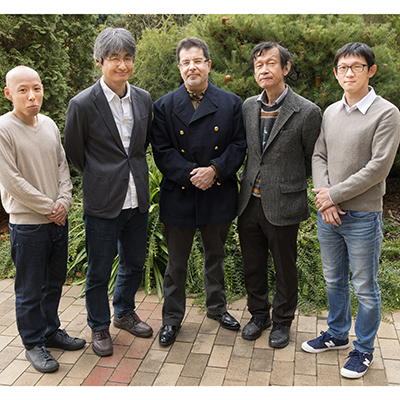
From left to right: Dr Takkaki Kaneko, Dr. Akiya Watakabe, Professor
Marcello Rosa, Professor Tetsuo Yamamori and Dr. Adam Lin
Monash University Biomedicine Discovery Institute (BDI) scientists have successfully embarked on an ambitious project mapping interconnections between brain regions in collaboration with the prestigious RIKEN Brain Science Institute in Japan.
A team of four RIKEN scientists have just completed a two-week visit to Monash, during which time they worked intensively with Monash BDI researchers. The delegation was led by Professor Tetsuo Yamamori.
“The visit was very productive, we analysed a lot of data,” Head of the Monash BDI Neuroscience Program, Professor Marcello Rosa said.
The visit marked the first time the two institutes have worked on a “full-blown” project together, Professor Rosa said. It builds on an ongoing collaboration he began seven years ago working with Professor Partha Mitra, who is based at the Cold Spring Harbor Laboratory in the US, and who now has a joint appointment at the RIKEN.
A Memorandum of Understanding between Monash and the RIKEN was signed last year, with the first Monash PhD students then visiting Japan on an exchange program.
The RIKEN, funded by the Japanese Government, is considered one of the world’s leading neuroscience research bodies.
Professor John Carroll, Director of the Monash BDI said: "It was terrific to host this outstanding team of scientists from the RIKEN Brain Sciences Institute (BSI). Marcello and his team have established an important international partnership with the BSI and I am sure it will go from strength to strength in their efforts to understand the role of neuronal circuits in higher order behaviour."
The current project aims to create an accurate map of the subdivision of the cerebral cortex in an animal model that can be visualised with MRI, pinpointing connections down to the cellular level.
“It’s an ambitious project we’re doing on a scale not attempted before,” Professor Rosa said.
In an innovative move, the data will be published online prior to research papers, allowing scientists and clinicians anywhere in the world to use the information to help accelerate discoveries.
“We’re releasing the entire data set as soon as it becomes processed, and providing analysis tools,” Professor Rosa said.
This approach was used during the Zika virus crisis to disseminate information rapidly and is taking off in laboratories the US.
“The project is bringing a mass of data that did not exist, some of which we are using already.”
Professor Rosa is also the Deputy Director of the Centre of Excellence for Integrative Brain Function (CIBF) and is on the steering committee for the Monash Vision Group.