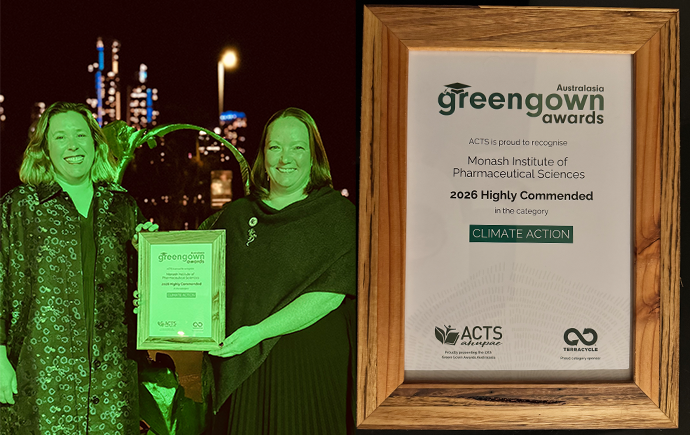
MIPS Climate Health

Our Mission: Addressing the Challenges for Climate Health

Climate change is one of the greatest challenges facing global health. At the Monash Institute of Pharmaceutical Sciences (MIPS), we are confronting the critical paradox that while medicines will be essential to meet emerging climate-induced health challenges, at present, the discovery, development, and manufacture of pharmaceuticals currently contributes significantly to climate change.

Through cross-disciplinary collaboration, we are enhancing the environmental sustainability of our pharmacy and pharmaceutical science activities across research, education and operations. MIPS is embedding sustainability not as a separate initiative, but as a core capability integrated into how we conduct research, educate students and operate our facilities.


MIPS is committed to addressing the Climate Health through:

Increased sustainability of research activities - mitigation of our impact on global warming

Laboratory settings are some of the most resource and energy intensive spaces, but they don’t need to be. MIPS has established a whole-of-institute laboratory sustainability program to transition our research operations toward a low-carbon, closed-loop future.

  • Best-Practice Accreditation

    Currently, >80% laboratories encompassing >325 staff MIPS laboratories have transitioned into a My Green Lab (MGL) Certification framework, the global best-practice standard for laboratory sustainability, putting us on track to reach our stretch goal of certifying 95% of labs at Green level by 2030.

  • Cultural Transformation

    Through our Green Lab Community of Practice, we are turning individual action into institute-wide culture change, embedding sustainability across research, education and operations.

  • Innovative Solutions

    By applying an environmental lens on drug discovery, development and use, we are rethinking traditional research processes to significantly reduce the ecological footprint of the pharmaceutical sector.

Research outcomes that drive adaptation of health systems to a warming world

Research teams across MIPS are not only developing effective treatments for climate-sensitive health and wellbeing risks, they are also seeking to understand how climate change is altering disease patterns and assessing the impacts of drug use and their effects in populations and health economics.

MIPS research teams are addressing the climate-health crisis across four key pillars:
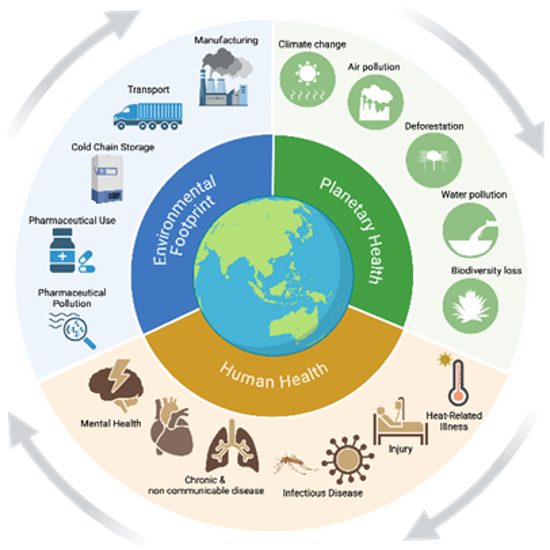
  • Disease Dynamics & Population Health

    Developing treatments for climate-sensitive health risks while researching how shifting climate conditions alter disease patterns and health outcomes.

  • Benign-by-Design Therapeutics

    Designing drug properties from inception to ensure biodegradability and minimise ecological impacts.

  • Medicine Stability

    Evaluating how climate-exacerbated extreme weather and rising temperatures impact pharmaceutical stability and performance.

  • Sustainable Medicine Use

    Assessing the environmental and economic footprints of potentially inappropriate medication use to optimise patient care and reduce waste.

ImageKey areas of focus*:

  • Mental & Psychosocial Health: Climate anxiety, trauma, and PTSD.
  • Cardiovascular Health: Heat-induced cardiovascular stress.
  • Global Health: Malaria, Dengue, Japanese Encephalitis, and West Nile Virus.
  • Zoonotic Outbreaks: COVID-19, Zika, Ebola, H1N1/Swine Flu, MERS, and Rabies.
  • Respiratory Illnesses: Exacerbated asthma and environmental allergies.
  • Healthcare Service Delivery: Extreme weather impacts on aged care and chronic non-communicable disease management for vulnerable populations.

*From National Health and Climate Strategy Consultation Paper (2023); WHO ‘Environment and One Health’ report (2022)

Get Involved

Join our communities of practice

An engaged team of sustainability ambassadors are working to develop communities of practice for the sharing of knowledge (best practice and lessons learned), collaboration, capacity building (enhancement of knowledge and skills), and advocacy.

The team at MIPS will engage stakeholders, coordinate efforts and link in with the activities of the broader Monash community.

  • For Researchers: Apply to join MGL group and/or advisory group
  • For Students: Join our student-focussed sustainability group
  • For Partners: Advisory or collaboration opportunities (University, industry, government and NGO)

Get in contact with us now

My Green Lab

The My Green Lab program is a globally recognised laboratory sustainability initiative that helps research organisations reduce their environmental impact through improved practices in energy use, waste reduction, resource management, and staff engagement.

Impact Laboratories provides independent third-party verification of the certification, ensuring sustainability outcomes are credible, measurable, and aligned with international best practice. Together, the programs support organisations in embedding sustainable laboratory operations, demonstrating environmental leadership, and contributing to broader ESG (Environmental, Social, and Governance) and net-zero goals.

Find out more about My Green Lab

Highlights