
Crashing
Crashing is the final step in optimising project completion time. It involves analysing the critical path and strategically reducing the duration of activities along this path to shorten the overall project timeline.
As activity durations are reduced, the critical path may change, requiring continuous analysis to ensure that efforts remain focused on the new critical path. It is essential to target only activities on the critical path to avoid creating unnecessary float time or inefficiencies elsewhere in the project. Crashing must be managed carefully to balance time savings with potential increases in cost or resource demands.
The critical path method analysis can be used iteratively to shorten project durations by reducing activity times on the critical path and continuously reassessing the critical paths. This process can be simplified into the following steps:
- Identify all possible paths in the project network, listing the sequence of activities and their total time. Determine which path has the longest duration, as this will be the critical path.
- Reduce the durations of activities on the critical path that do not affect the durations of other paths. Continue until another path matches the critical path's duration, creating a new critical path. Record the reductions.
- If multiple critical paths emerge, reduce the durations of activities shared across all critical paths where this will decrease the overall completion time. Record the reductions.
- If no activities are shared across the critical paths, reduce the durations of activities on different critical paths where this will reduce the overall completion time. Record the reductions.
- Repeat until further reductions are not possible or no longer decrease the overall project completion time.
Worked Example
For the activity network provided below, activities D, E and I can each be reduced by up to 3 units at a cost of $1000 per unit. Determine which activities should be reduced to minimise the overall project completion time, along with the new completion time and the total cost of the reductions.
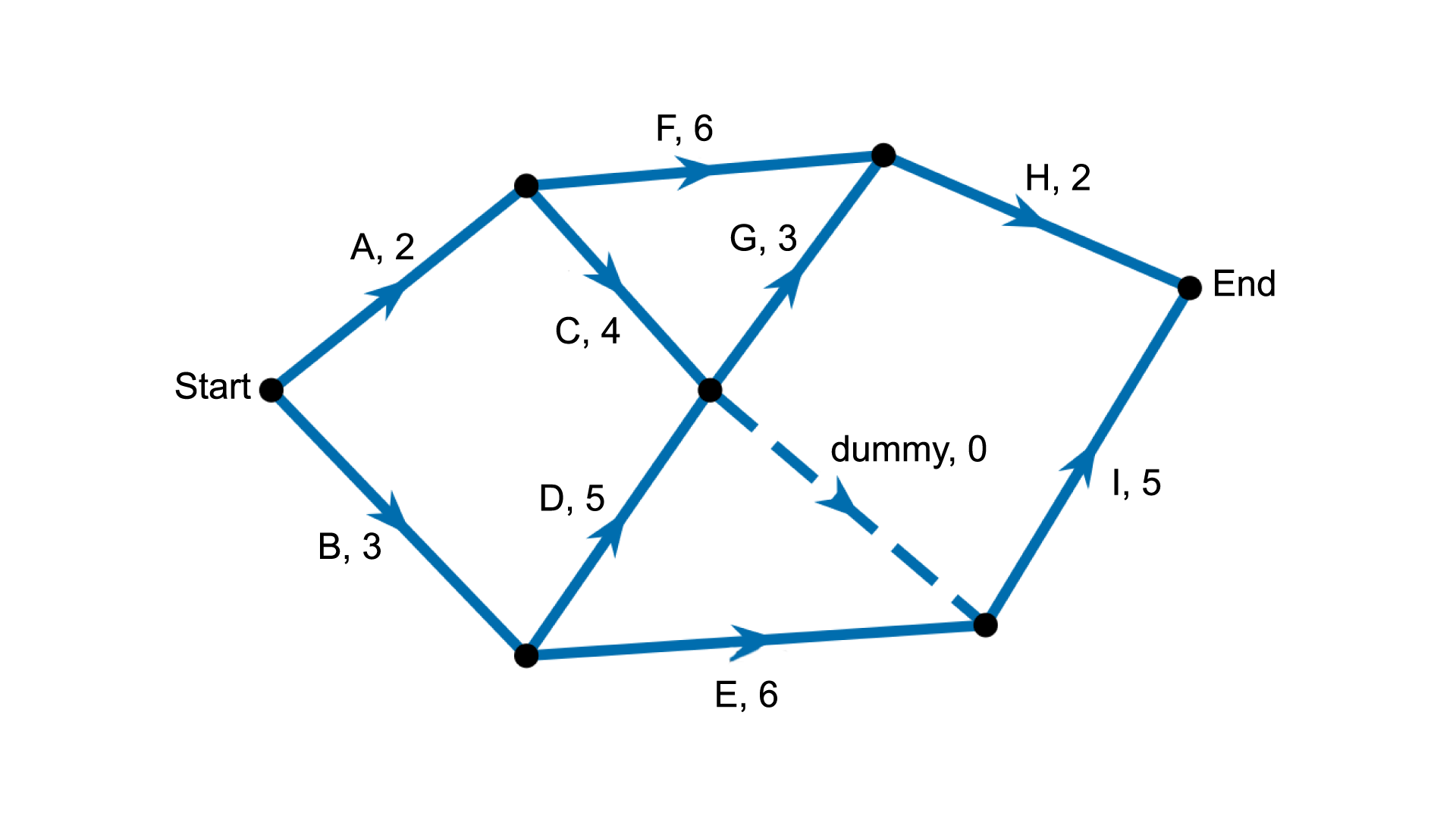 Identify all paths and their completion times
A-F-H: 10
A-C-G-H: 11
A-C-I: 11
B-D-G-H: 13
B-D-I: 13
B-E-I: 14Activities D, E and I can be reduced by 3 units each. E or I are the only ones which will affect the overall completion time as they are on the critical path. E will only affect the critical path, so E will be reduced by 1 unit first as new critical paths will be formed.
A-F-H: 10
A-C-G-H: 11
A-C-I: 11
B-D-G-H: 13B-D-I: 13
B-E-I: 13
Total reductions made:
E: 1
Activities D and I can still be reduced by 3 units each, and E can still be reduced by 2 units. Reducing either D, E or I individually will not reduce the overall completion time, as one of the critical paths will remain, maintaining the completion time of 13 units. Reducing D and E simultaneously by 2 units will reduce all three critical paths.
A-F-H: 10
A-C-G-H: 11
A-C-I: 11
B-D-G-H: 11
B-D-I: 11
B-E-I: 11
Total reductions made:
D: 2
E: 3
Activity I can still be reduced by 3 units and D can still be reduced by 1 unit. Reducing either D or I individually or together will not change the critical path, as A-C-G-H does not contain either activity and will thus remain the critical path despite reductions. Therefore, the total reduction has been achieved.
The total reductions made are 2 units to activity D and 3 units to activity E. This results in a new overall completion time of 11 units and costs a total of $5000.

