
Cellular clean-up: solving the mystery of how cells recycle
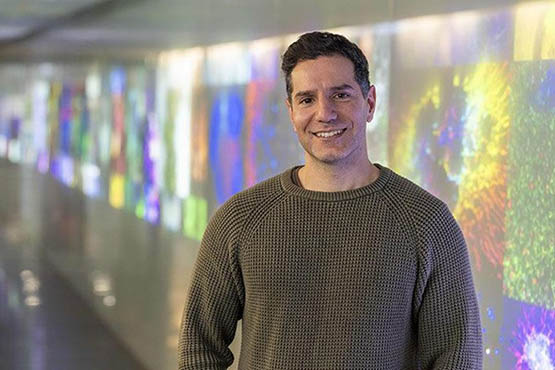
Professor Michael Lazarou, co-corresponding author.
A new discovery from an international collaborative research team has solved the mystery of how cells turn on their recycling process and create ‘garbage bags’ to remove proteins.
The study, published in Science and co-led by Professor Michael Lazarou who holds appointments with Monash University and WEHI, sheds new light on how cells get rid of waste and could help towards finding future cures for neurodegenerative diseases such as Parkinson’s and Alzheimer’s.
At a glance
- The process of how cells recycle waste is crucial to maintaining health, but how it is controlled and turned on has not been understood.
- An international collaboration co-led by WEHI, Monash University’s Biomedicine Discovery Institute (BDI), Max Planck Institute and University of California, Berkeley has now discovered how cells turn on recycling and make cellular ‘garbage bags’.
- It’s hoped this discovery, published in Science, will lead in future to drugs that will help the fight against diseases like Parkinson’s and Alzheimer’s, while also promoting healthy ageing.
Importance of cellular recycling
The process of how cells get rid of waste and recycle useful materials, called autophagy, is critical to health.
In some conditions such as Parkinson’s and Alzheimer’s disease, cell waste accumulates, causing protein build-ups due to the recycling signals not working properly.

The cell recycling process, known as autophagy, is controlled by a complex group of proteins. This 3D image reveals the overall structure of the autophagy promoting complex, showing each of its individual components in different colours. Credit: WEHI.
The new study, co-led by Monash BDI and WEHI’s Professor Michael Lazarou, Professor Gerhard Hummer from the Max Planck Institute and Professor James H. Hurley from University of California, Berkeley, has unravelled one of the key cellular processes that govern autophagy.
The research team found how this process is controlled by a complex group of proteins that add a molecular signal to a cell membrane.
This signal is a critical step in switching on the autophagy process, allowing for the formation of cellular ‘garbage bags’ so that the damaged materials within cells can be recycled.
“We know that cellular recycling is absolutely fundamental to our overall health but we’ve struggled to understand precisely how this complex process is regulated – and how we can fix it when it breaks,” said Professor Lazarou.
“In our team’s new study, we discovered surprising ways those cellular ‘garbage bags’ are created and how this group of proteins is regulated. Crucially, we found the switch that kick starts the process.
“Now we know how this recycling process is switched on, we hope that knowledge will in future lead to new treatments that can turn on that process to promote healthy ageing and target diseases like Parkinson’s and beyond.”
Caption: This video shows how a rotational mechanism in the autophagy promoting complex switches it on, so that it can drive the formation of cellular ‘garbage bags’. By identifying the switch that kickstarts the cell recycling process, researchers hope to work towards new treatments that can turn on autophagy to promote healthy ageing and target diseases like Parkinson’s and beyond.
An international collaboration
The research is part of an international research grant through the Aligning Science Across Parkinson’s collaborative network, which fosters collaboration to better understand the underlying causes of Parkinson’s disease. Their aims of scale, transparency and open access data sharing are designed to accelerate the pace of discovery and find a cure for Parkinson’s.
The WEHI Parkinson’s Disease Research Centre is also a member of ASAP’s Global Parkinson’s Genetic Program, a collaboration working to unlock the genetic architecture of Parkinson’s disease.
Read the full paper published in Science, titled Structural pathway for PI3-kinase regulation by VPS15 in autophagy DOI: 10.1126/science.adl3787
MEDIA ENQUIRIES
Cheryl Critchley, Monash University
Media and Communications Manager (medical)
E: cheryl.critchley@monash.edu
M: +61 (0) 477 571 442
GENERAL MEDIA ENQUIRIES
For more Monash media stories, visit our news and events site
Monash Media
E: media@monash.edu
T: +61 (0) 3 9903 4840
About the Monash Biomedicine Discovery Institute at Monash University
Committed to making discoveries that will relieve the future burden of disease, Monash Biomedicine Discovery Institute at Monash University brings together more than 120 internationally renowned research teams. Spanning seven discovery programs across Cancer, Cardiovascular Disease, Development and Stem Cells, Infection, Immunity, Metabolism, Diabetes and Obesity, and Neuroscience, Monash BDI is one of the largest biomedical research institutes in Australia. Our researchers are supported by world-class technology and infrastructure, and partner with industry, clinicians and researchers internationally to enhance lives through discovery.
About WEHI (Walter and Eliza Hall Institute of Medical Research)
WEHI is where the world’s brightest minds collaborate and innovate to make life-changing scientific discoveries that help people live healthier for longer. Our medical researchers have been serving the community for more than 100 years, making transformative discoveries in cancers, infectious and immune diseases, developmental disorders, and healthy ageing. WEHI brings together diverse and creative people with different experience and expertise to solve some of the world’s most complex health problems. With partners across science, health, government, industry, and philanthropy, we are committed to long-term discovery, collaboration, and translation. At WEHI, we are brighter together.
Find out more at www.wehi.edu.au