
Fungal infections explode immune cells and shape-shift to defeat immunity
Scientists from Monash University have discovered how the world’s deadliest fungi explode immune cells and shape-shift to defeat the immune system, providing new avenues for treatments and drug discovery.
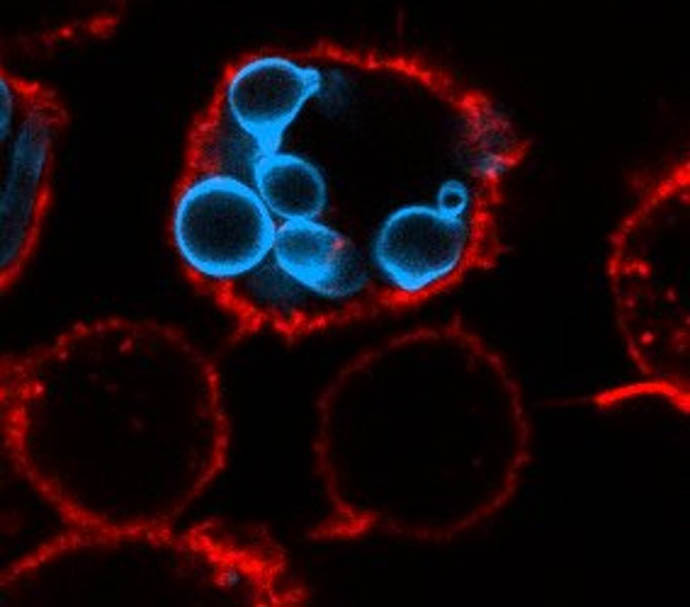
Caught in the act: macrophages (red), the immune system's first responders, engulf invading Candida yeast cells (blue). This microscopic battle is at the heart of research into new ways to fight fungal disease. Image captured by Françios Olivier".
Candida auris and Candida albicans are microscopic fungi that cause life-threatening human infections, killing almost a million people globally every year.
The World Health Organization lists both species among the top four most concerning fungal pathogens in existence, and while relatively uncommon in Australia, growing outbreaks in Europe and the United States have been responsible for forcing restriction and even closure of Intensive Care Units.
New Monash University research, published in Nature Communications and Nature Microbiology, opens the door for future therapeutic strategies by identifying the nutrients the fungi and immune cells use to battle each other.
The Nature Communications study identified a critical, naturally occurring amino acid called alanine that reverses the process these fungi use to defeat the immune system.
When an immune cell ‘swallows’ a fungal microbe to destroy it, the fungus fights back from the inside, triggering the host protein Ninjurin (NINJ1) to form large pores, causing the immune cell to explode and release the fungal cells to spread the infection.
By supplying a higher dosage of alanine, researchers successfully blocked the protein, preventing the immune cells from bursting, thereby containing the fungal cells.
First author Dr Harshini Weerasinghe, Research Fellow at the Monash Biomedicine Discovery Institute (BDI), said keeping the pathogen securely trapped in a cellular bottleneck would ensure it could be contained and targeted more effectively.
“This gives us an option to treat the patient by strengthening their immune system, potentially in conjunction with antifungals that can eradicate it,” Dr Weerasinghe said.
“Fungi are remarkably similar to humans at the cell biology level, so often the drugs that harm the fungi also harm the patient. This is a real problem for finding new effective treatments.
“Finding a new way to contain the infection, literally inside the immune cells, would be a game-changer.”
The Nature Microbiology study discovered the shape-shifting ability of the mysterious Candida auris, which can adapt itself to stick to tissues and remain invisible to immune cells in different parts of the body.
When it consumes glucose (a sugar that is abundant in the bloodstream) it stays in a small and round shape that immune cells do not recognise as a threat. When Candida auris find different sugars that are normally present on skin it becomes long and sticky, allowing it to attach and persist under these conditions.
First author Irma Tedja, PhD Candidate at the Monash BDI said this understanding is critical to finding treatment options.
“Because it is so new, little was known about how this fungi thrives on human skin and evades detection,” Tedja said.
“Our discovery shows Candida auris acts as a clever environmental sensor, monitoring the types of sugars available in tissues and changing its cell shape and properties to stick to skin while evading immune systems in conditions found in the bloodstream.
“Understanding this nutritional trigger opens the door to finding ways in which we could prevent the fungus from hiding or anchoring to the body.”
Professor Traude Beilharz, co-senior author on the Nature Microbiology publication and a Lab Head at Monash BDI, said the findings revealed an unexpected level of sophistication in how fungal pathogens survive within the body.
“We've shown that Candida auris can sense the nutrients available in different parts of the body and fundamentally change its behaviour in response. The more we understand how these pathogens read and respond to their environment, the better positioned we are to disrupt those processes and develop new ways to prevent and treat fungal disease.”
Fungi deploy an extraordinary gene regulatory repertoire to meet the diversity of their environments. Professors Traven and Beilharz share nearly two decades of productive collaboration decoding how different yeasts use transcriptional and post-transcriptional control mechanisms to adapt to their environment. Professor Beilharz says that thanks to rapidly advancing transcriptomic technologies this decoding can now be done in unprecedented detail.
Senior author on both papers, Professor Ana Traven from the Monash BDI, said drastic environmental and economic shifts in recent years have made the work of the world’s few fungal experts all the more important.
"Fungi cause deadly infections and are being supported by changing climate conditions,” Professor Traven said.
“We have few traditional antifungals to control these infections, and pharmaceutical companies have largely pulled out of developing new antibiotics and antifungal therapies because it isn't economically beneficial.
“So, we need to think laterally. In addition to finding new ways to poison the fungus, we are also looking at how we could nutritionally manipulate the patient's body to give their immune system the energy and tools to fight back."
Read the research paper in Nature Communications: https://doi.org/10.1038/s41467-026-74195-6
This research is a collaboration between Monash University, the Walter and Eliza Hall Institute of Medical Research, the Hudson Institute of Medical Research, The University of Queensland, the Australian National University and The Hans Knöll Institute (Germany).
Read the research paper in Nature Microbiology: https://doi.org/10.1038/s41564-026-02454-9
This research is a collaboration between Monash University and Purdue University (United States). It benefited from cross-disciplinary and international collaborations with Associate Professor Shankar Thangamani at Purdue University.
MEDIA ENQUIRIES
Toni Brient
Media and Communications Manager
P: +61 423 964 191
E: toni.brient@monash.edu
GENERAL MEDIA ENQUIRIES
Monash Media
P: +61 3 9903 4840
E: media@monash.edu
For more Monash media stories, visit our news and events site
About the Monash Biomedicine Discovery Institute at Monash University
Committed to making discoveries that will relieve the future burden of disease, Monash Biomedicine Discovery Institute at Monash University brings together more than 120 internationally renowned research teams. Spanning seven discovery programs across Cancer, Cardiovascular Disease, Development and Stem Cells, Infection, Immunity, Metabolism, Diabetes and Obesity, and Neuroscience, Monash BDI is one of the largest biomedical research institutes in Australia. Our researchers are supported by world-class technology and infrastructure, and partner with industry, clinicians and researchers internationally to enhance lives through discovery.