
How the canny tick could help prevent disease like MS and cancer

When the immune system detects a harmful or foreign agent it triggers an inflammatory response: small proteins called chemokines direct immune cells to the site of the injury or infection, resulting in the invader being inactivated.
More commonly known as a parasite, ticks are able to attach and draw blood off us, or our pets, without triggering an immune reaction, because they produce proteins called evasins, which attach to these chemokines preventing them from warning the immune system that it is under attack. These chemokines can also “turn bad” overstimulating the immune system resulting in diseases like rheumatoid arthritis (RA), multiple sclerosis (MS), cancer and inflammatory bowel disease.
Now, a team from the Monash University Biomedicine Discovery Institute has identified a tick-derived evasin that can bind to two major classes of chemokines, a discovery that is important for the development of therapeutics targeting inflammatory and autoimmune diseases. Until now, scientists had identified only evasins that selectively block chemokines within a single class.
The study, published in the journal, Structure, by lead authors Professor Martin Stone and Dr Ram Bhusal, is important because a broad acting evasin, such as they have discovered, is a potential therapy for autoimmune and inflammatory diseases, and cancer.
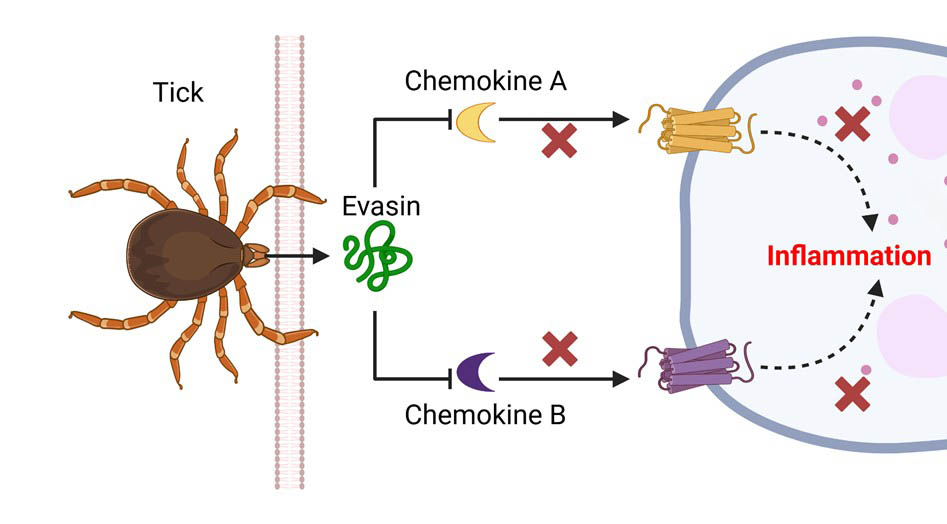
Researchers have identified a tick-derived evasin that can bind to two major classes of chemokines.
According to co-first authors Mr Kunwar and Dr Devkota, it was previously believed that ticks suppress the immune system by secreting a cocktail of different evasins, each targeting a specific class of chemokines.
“However, in this study, we have identified a naturally occurring evasin that can inhibit both major classes of chemokines,” Mr Kunwar said. “This is a novel finding and represents a significant advance in the field.”
Dr Devkota added: “The discovery opens up new opportunities to develop therapies that target chemokines driving inflammatory diseases such as RA and MS. While treatments are available, there remains a significant need for therapies that more effectively prevent disease progression.”
Read the full paper published in Structure, titled Discovery of an evolutionarily distinct evasin with dual CC and CXC chemokine inhibitory activity
DOI: 10.1016/j.str.2026.02.001
MEDIA ENQUIRIES
Tania Ewing
Media and Communications Contractor
Monash University
E: taniaewing@taniaewing.com
M: +61 (0) 408 378 422
GENERAL MEDIA ENQUIRIES
For more Monash media stories, visit our news and events site
Monash Media
E: media@monash.edu
T: +61 (0) 3 9903 4840
About the Monash Biomedicine Discovery Institute at Monash University
Committed to making discoveries that will relieve the future burden of disease, Monash Biomedicine Discovery Institute at Monash University brings together more than 120 internationally renowned research teams. Spanning seven discovery programs across Cancer, Cardiovascular Disease, Development and Stem Cells, Infection, Immunity, Metabolism, Diabetes and Obesity, and Neuroscience, Monash BDI is one of the largest biomedical research institutes in Australia. Our researchers are supported by world-class technology and infrastructure, and partner with industry, clinicians and researchers internationally to enhance lives through discovery.