
Scientists discover novel immune ‘traffic controller’ hijacked by virus
Researchers from Monash University and the Lions Eye Institute have discovered a tissue protein that acts as a central ‘traffic controller’ for immune cells and can be hijacked by a virus to weaken immune responses. The discovery could drive new treatments for autoimmune conditions.
In a major scientific breakthrough, researchers from Monash University and the Lions Eye Institute have discovered a tissue protein that acts as a central ‘traffic controller’ for immune cells and can be hijacked by a virus to weaken immune responses. The discovery could drive new treatments for autoimmune conditions.
Published today in Nature, the study discovered a key mechanism that controls how immune cells coordinate their responses, and how a common virus can sabotage it.
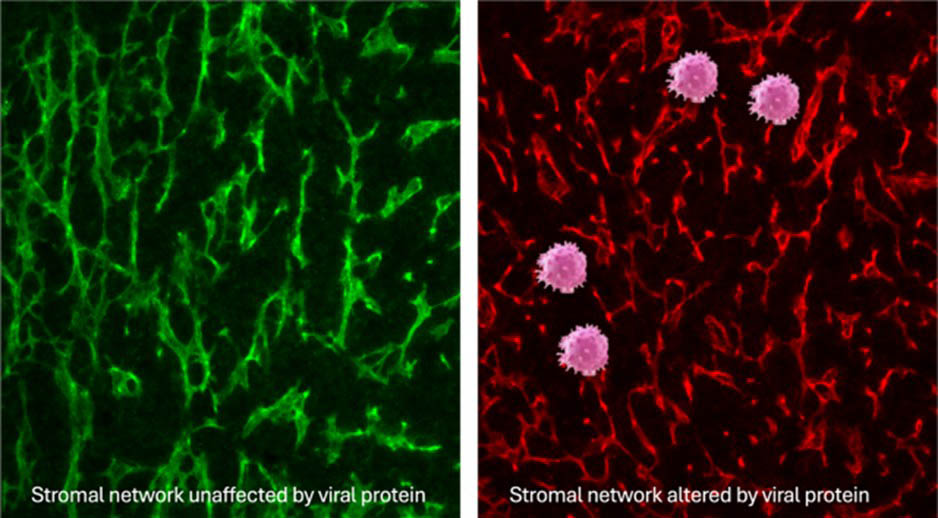
The research reveals that a molecule called CD44 centrally controls the network of support cells that guide immune system function.
Within this network of support cells, stromal cells help immune cells move efficiently and exchange the information needed to fight infections, respond to vaccines, and maintain overall health.
In a landmark finding, the research team discovered that cytomegalovirus (CMV) can hijack this system by producing a protein that blocks CD44 function on stromal cells, derailing immune cell traffic at its source and weakening the body’s antiviral response.

First author Dr Xavier Sng, and co-lead authors Prof Mariapia Degli-Esposti and Dr Chris Andoniou.
Lead researcher Professor Mariapia Degli-Esposti, Head of Experimental and Viral Immunology at the Monash Biomedicine Discovery Institute (BDI) and Head of Experimental Immunology at the Lions Eye Institute (LEI), said the findings fundamentally change how scientists understand the signals that shape immune function.
“Think of the immune system like a busy city with millions of cells patrolling to keep us safe,” she said.
“CD44 acts as the central traffic controller; it keeps immune cells moving and coordinates their interactions at the right place and time.”
“Our study identifies CD44 as a master regulator of immune cell movement and communication and shows that viruses can undermine immunity not only by attacking immune cells directly, but also by targeting the essential tissue infrastructure they rely on.”
“This is a completely new way for a virus to target an immune response,” Professor Degli-Esposti said.
This work redefines how immune responses are initiated and regulated by identifying stromal CD44 as a previously unrecognised checkpoint.
What this means for future breakthroughs in health and disease
Co-lead researcher Dr Chris Andoniou, a Senior Research Fellow at Monash BDI and the LEI, said the findings have wide-ranging implications for human health.
“Because CD44 plays such a central role in regulating immune activity, drugs inspired by the viral protein identified in this study could be developed to precisely dampen harmful inflammation,” he said.
“By learning from the virus, we may be able to design therapeutic molecules that safely reduce excessive immune activation, which could ultimately help manage and treat autoimmune conditions. We are still in the early stages, but this is an exciting development.”
Collaborative science drives innovation
First author Dr Xavier Sng, Research Fellow at BDI, conducted innovative experimental work that revealed how stromal CD44 functions within the immune network. Complementary studies by Dr Valentina Voigt at LEI demonstrated that the CMV protein binding CD44 impairs antiviral T cell responses.
The work was made possible by strong interdisciplinary collaboration across teams at BDI, including key contributions from Professors Anne Fletcher and Jamie Rossjohn’s laboratories. By combining deep expertise in immune cell biology, the researchers linked molecular mechanisms to immune system function, highlighting the power of collaborative science to drive innovation.
This research was supported by funding from the Australian Research Council and the National Health and Medical Research Council.
Read the paper “Fibroblastic reticular cells direct the initiation of T cell responses via CD44“ at Nature: https://doi.org/10.1038/s41586-025-09988-8
MEDIA ENQUIRIES
Toni Brient, Monash University
Media and Communications Manager (medical)
E: toni.brient@monash.edu
M: +61 (0) 423 964 191
GENERAL MEDIA ENQUIRIES
For more Monash media stories, visit our news and events site
Monash Media
E: media@monash.edu
T: +61 (0) 3 9903 4840
About the Monash Biomedicine Discovery Institute at Monash University
Committed to making discoveries that will relieve the future burden of disease, Monash Biomedicine Discovery Institute at Monash University brings together more than 120 internationally renowned research teams. Spanning seven discovery programs across Cancer, Cardiovascular Disease, Development and Stem Cells, Infection, Immunity, Metabolism, Diabetes and Obesity, and Neuroscience, Monash BDI is one of the largest biomedical research institutes in Australia. Our researchers are supported by world-class technology and infrastructure, and partner with industry, clinicians and researchers internationally to enhance lives through discovery.
About the Lions Eye Institute
For more than 40 years, the Lions Eye Institute has been at the forefront of global vision research and innovation, transforming the lives of patients through pioneering treatments. The Institute’s dedicated team of experts provides safe, effective and world-class eye care across Western Australia. To date, the Lions Eye Institute has delivered more than one million consultations, supporting its mission to achieve better vision for all.