
Leveraging Environmental History for a Sustainable Future: Key Insights from the Environmental History Workshop Co-Organized by IFAR Monash University, Indonesia

Environmental History Workshop Co-Organized by IFAR Monash University, Indonesia
For centuries, the Sulawesi Strait was home to the Pataroni, or flying fish, which would glide over fishing boats in vast numbers. However, those days are long gone. The flying fish are now scarce. Fishermen need to venture as far as Fak Fak to catch them.
"The decline started in 2002, not due to overfishing of the flying fish, but of their eggs," explains Ian Adrian, an undergraduate history student at Universitas Hasanuddin who is researching environmental history of flying fish egg overexploitation for his undergrad thesis.
"Japan’s demand for flying fish eggs, a popular sushi topping, led to a shift in Takalar’s fishing industry. Fishermen abandoned catching fish in favor of harvesting the more lucrative eggs," Ian added.
Ian was one of ten young historians invited to a four-day environmental history workshop in Puncak, Bogor, 6-9 August 2024. The workshop was a collaborative effort by Sejarawan Lintas Batas (SINTAS), the Directorate Pembinaan Tenaga dan Lembaga Kebudayaan at the Ministry of Education and Culture, and Monash University, Indonesia’s Institute of Advanced Research, aimed to mainstream environmental history in Indonesia.
The event was also supported by the Nurturing Young Talent program at the Regional Science Association International (RSAI), based in Portugal.
The Urgent Need for Environmental History
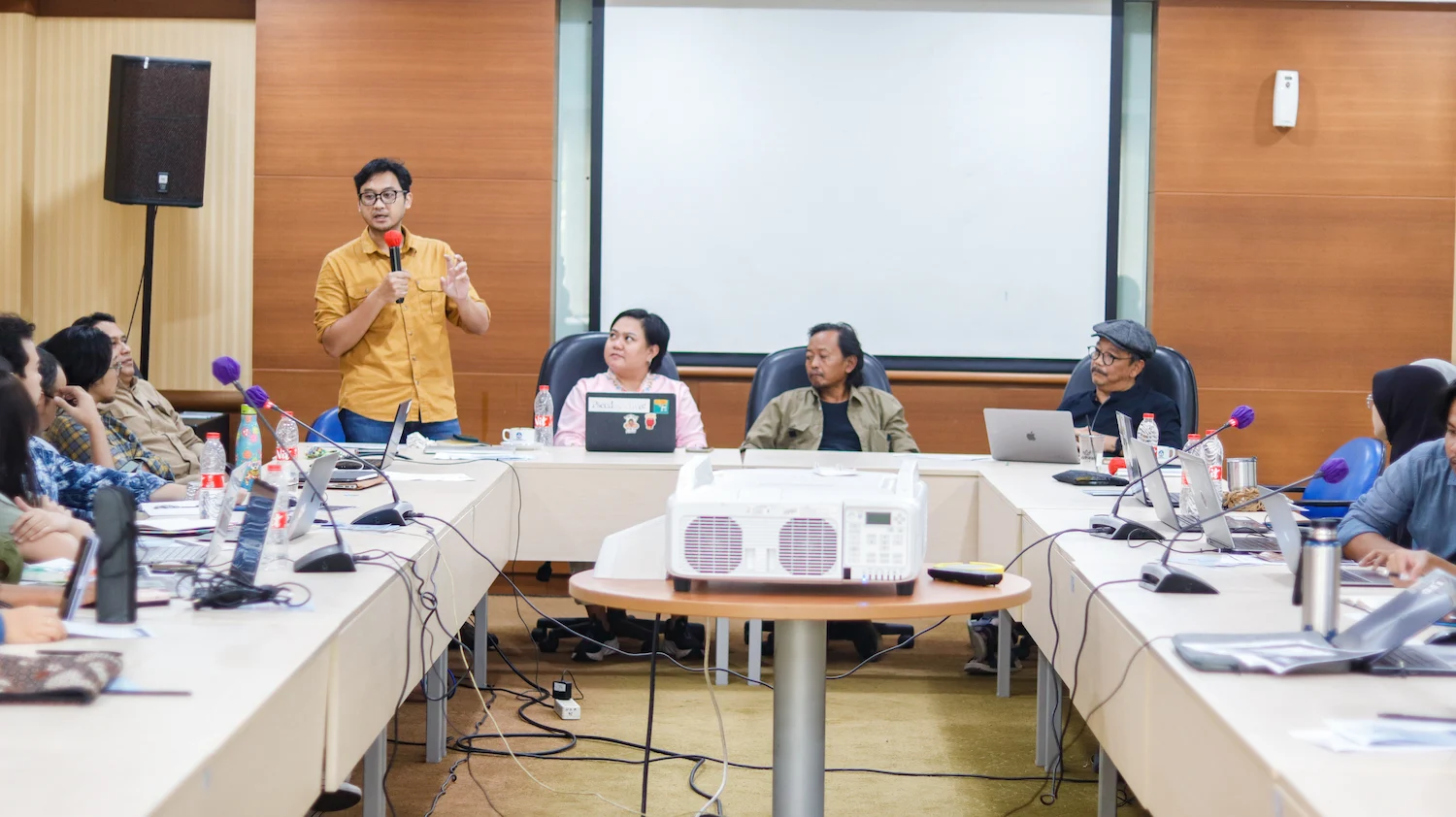 Luthfi Adam presenting his research in the roundtable session
Luthfi Adam, a research fellow at the Institute for Advanced Research at Monash University, Indonesia, introduced students to historiography and methodology of environmental history. Environmental history examines the interactions between humans and the natural environment over time, focusing on how nature influences societies and vice versa. Luthfi emphasized that in the face of climate change, pollution, deforestation, and biodiversity loss, developing environmental history in Indonesia is critical.
During the workshop, participants explored how history can help us understand the roots of our environmental crises by examining the evolving relationship between humans and nature. Like Ian, other participants analyzed how these relationships have changed in the modern world. For instance, Khopipah Fauziah, from Universitas Negeri Semarang, used the case of Javan rhinoceros conservation in Ujung Kulon to argue that land use changes into agricultural farms, crops plantations, and cities in the nineteenth century led to the animal being viewed as a pest, thus becoming a target for game hunting.
Similarly, Rendy Aditya, from Universitas Jambi, conducted research on wild boar (babi hutan) hunting in Jambi, revealing that the expansion of the palm oil industry contributed to the decline in the Sumatran tiger population. This decline led to a surge in wild boar numbers, which are now considered pests, driving an increase in hunting activities targeting these animals.
The history projects presented at the workshop were not about elites or grand narratives but focused on "history from below" and "non-human agency." The participants creatively explore how we can understand Indonesia’s struggle with environmental problems by foregrounding stories of animals, plants, forests, and marginalized communities. For example, Reni Nurhidayati from Universitas Airlangga historicized plants collections and the dynamics of conservation agenda at Purwodadi Botanic Garden. Meanwhile, Safinatun Hikmah from Universitas Negeri Semarang discussed the impact of tin mining on poverty and ecological decline in Belitung Island.
Other participants explored how local ecological knowledge has been marginalized by industrial and developmental practices. Ridlo Awlia who studies in the master of history at Universitas Indonesia shared the story of disappearing Dayak botanical knowledge as their Dayak gardens were transformed into palm oil estates. Alissa Wiranova, a master's student in anthropology at Universitas Padjadjaran, examined how social formations in Indonesia were shaped not only by state power but also by colonial plantations established by private companies.
History for the Future
In this workshop, mentors encouraged participants to connect current environmental crises with their historical roots. They emphasized that history is not just about the past; it is a vital tool for analyzing contemporary issues and making informed decisions for the future by understanding the lessons and experiences of the past.
Concerns about the current and future ecological impact of Indonesia’s developmentalist expansion in Kalimantan were a significant focus for many participants. Krisnaldi, a master's student at Universitas Padjadjaran, discussed how Kalimantan became a war zone between Banjar forces and the Dutch colonial army in the mid-nineteenth century. Zahra Aulia, an undergraduate at the same university, investigated how the Dutch used cartography as an imperial tool to map Kalimantan’s natural resources. Rydho Bagus Pratama, a master student at Universitas Gadjah Mada examined how poorly regulated forest exploitation in South Kalimantan has led to ecological disasters like landslides and floods.
History, as a method for anticipating the future, provokes critical learning from past human failures. In his lecture session at the workshop, Restu Gunawan, a historian, who is also the Director of Pembinaan Tenaga dan Lembaga Kebudayaan at the Ministry of Education and Culture, discussed the successes and failures of flood management engineering through canal systems in colonial and postcolonial Jakarta.
Mainstreaming Environmental History
The workshop participants—comprising six undergraduate and four master’s students—benefited from four training and mentorship sessions led by Luthfi Adam, an environmental historian at Monash University, Indonesia; Andi Achdian, a historian at Universitas Nasional; Gani Jaelani, a historian specializing in the history of medicine at Universitas Padjadjaran; and Muzayin Nazaruddin, an environmental humanities scholar at Tartu University.
In a roundtable session, participants explored the concept of non-human agency with Fathi Rayyani, an ethnobotanist at BRIN, and examined gender perspectives in social science research with Sari Damar Ratri, a research fellow at the Institute for Advanced Research (IFAR) Monash University, Indonesia.
Additionally, students attended two public lectures on environmental history by Faizah Zakaria, from the National University of Singapore and Restu Gunawan from the Directorate PTLK, Ministry of Education, as well as a lecture on oral history methodology by Amurwani Lestariningsih, a historian specializing in oral history.
This workshop is about writing history with the future in mind. It not only provided valuable insights into Indonesia’s environmental history but also equipped participants with the tools to critically engage with contemporary and future environmental challenges.
The workshop's primary goal is to nurture talent in environmental historical writing. To support this, the Ministry of Education will provide research grants for five selected participants to conduct their environmental history research and writing. The organizers hope that within the next few years, participants will publish environmental history books that inspire readers to make more informed and thoughtful decisions for a better future.
About the Author:
Luthfi Adam is a historian and research fellow at the Institute for Advanced Research at Monash University, Indonesia. He is also an active member of Sejarawan Lintas Batas (SINTAS).