
Monash Public Policy and Management Students’ Pilot Field Studies in Urban Policy and Governance Concluded Successfully
Monash University, Indonesia’s Master of Public Policy and Management program (MPPM) recently conducted its pilot unit, Field Studies in Urban Policy and Governance. The Field Studies used Jakarta as a case study in which 21 students from Monash University, Indonesia and 3 students from Monash University Australia engaged with diverse stakeholders directly at multiple field sites for 5 days from 1 to 5 July 2024.
Students’ engagement with stakeholders was aimed at understanding better the issues and best practices of governing urban mobility, hygiene, and connectivity. Students apply their understanding to the unit’s assessments which include daily end-of-day reflection on the bus, policy concept note, group presentation, and final individual learning reflection.
The following tabs show the students’ journey:
1 July 2024 - Introductions
Students attended introductory seminars on Monash BSD Campus. Associate Professor Ika Idris delivered a seminar on Jakarta’s urban policies from the period of Governor Ali Sadikin in the 1960s to the present. Assistant Professor Sabina Puspita’s seminar discussed the collective governance framework to explain the distinction between urban policy and governance from other types of policy and governance.
The Field Studies unit also facilitated transdisciplinary exchanges by inviting Monash University, Indonesia’s urban politics research fellow lecturers and Urban Design lecturers to share their expertise to the students. Associate Professor Eka Permanasari discussed the historical development of Jakarta as a city, Assistant Professor Alyas Widita explained the problems and progress of Jakarta’s transportation system, and Dr. Wara Urwasi presented a portion from her recent dissertation on Jakarta’s informal settlements. Students showed their enthusiasm by posing many questions during the Q&A session.
2 July 2024 - Urban Mobility
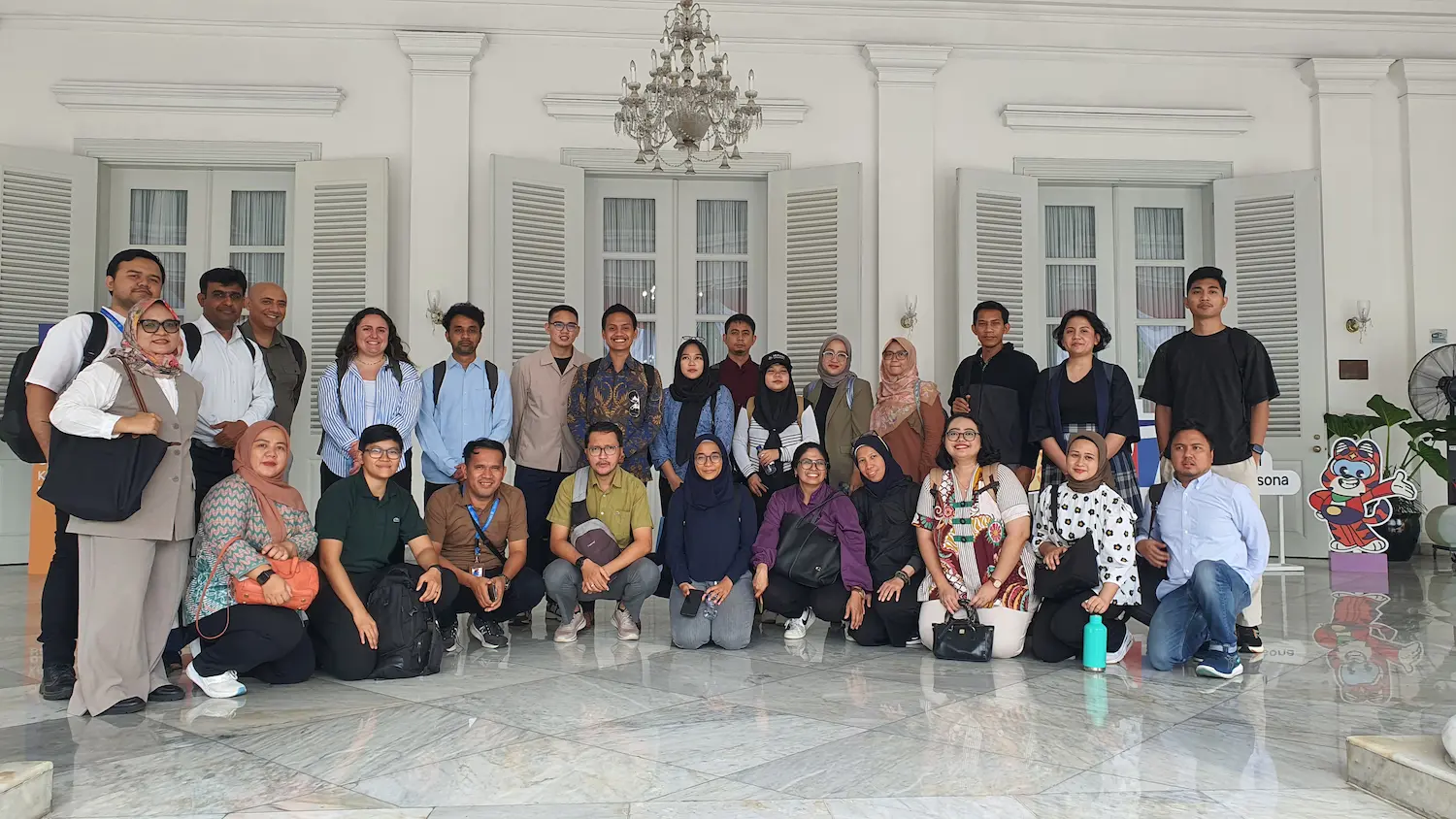 Monash University, Indonesia and Australia students visits Jakarta Government’s office and the City Hall (Balai Kota)
Students visited Jakarta Government’s office and the City Hall (Balai Kota). Then, students observed the office of Jakarta’s Integrated Transport Modes Hub (PT. MITJ). Finally, students rode the MRT to M Bloc Space, for an evening discussion on Jakarta’s Urban Innovation.
At Balai Kota, Abdul Ghofar (Coordinator for Food and Economic Affairs) and his colleagues at the city government’s Bureau for Economic Affairs, Bureau for Human Resource, and Bureau for Regional Planning and Development, welcomed the students with a presentation on the city government’s efforts to transform Jakarta into becoming a Global City. Many references to cities such as New York and London were made to describe the city government’s vision of a global city. Students learned of the city government civil servants’ labor, challenges, and creativity in working toward approximating the vision.
At PT. MITJ, Fuad Fachroeddin (Director) welcomed the students with a brief introduction on the history and mission of PT. MITJ’s establishment. Roykhan Bawazier (Project Development Specialist) then gave a comprehensive presentation on PT. MITJ’s previous, ongoing, and future projects as well as the governance supporting the projects. Students learned of the creative and participatory nature of the works to improve Jakarta’s innovation for better and connected transportation services and the infrastructure to support them.
At M Bloc Space (formerly an abandoned money-printing factory), students discussed Jakarta’s Urban Innovation with Raihana Hutami, a Researcher for the civil society organisation Rame-Rame Jakarta; and Bram Hertasning, Deputy Director for Urban Transport Policy of the Ministry of Transportation’s Center of Traffic and Urban Transport Policy. The lively, interactive discussion enabled students to learn more about the informal economy and its actors in Jakarta’s urban spaces from the perspectives of the national government and local civil society organisation.
3 July 2024 - Urban Hygiene
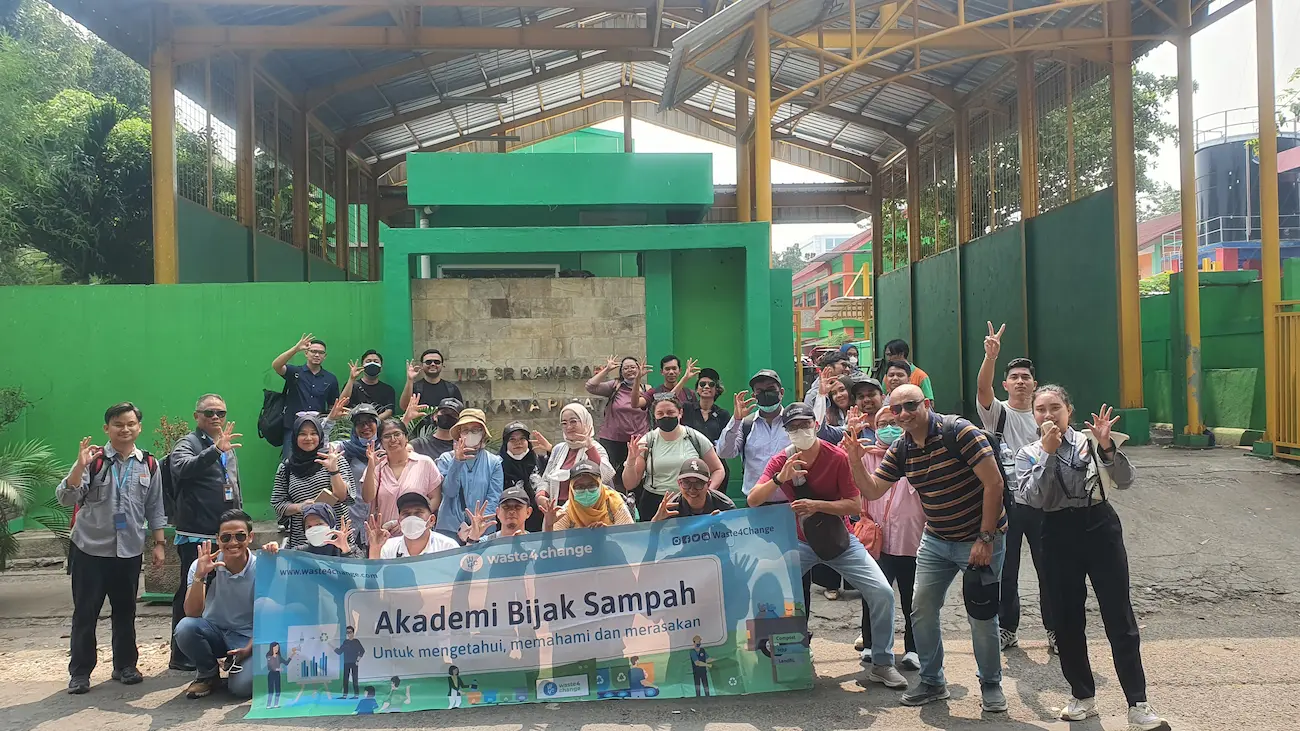
Monash University, Indonesia and Australia students visit Rawasari Recycle Management Station
Students visited the Rawasari Recycle Management Station at Central Jakarta. Prior to observing the recycling processes at the station, non-profit organisation Waste4Change gave a brief introductory presentation on waste management policies and systems to students. One of the highlights from the students’ visit to the station was observing the cultivation of the black soldier fly larvae for reducing organic waste.
From Central Jakarta, students went to the Kamal Water Pump Station at North Jakarta to examine, among other issues, how the city of Jakarta has been protected from flood. Jakarta City Government’s Water Resource Department welcomed the students. The students also went to observe the neighbourhoods surrounding parts of the giant sea wall project, just a few minutes walk away from the water pump station. Students were intrigued by the level of these dense neighbourhoods which sat very much lower than the sea level beyond the walls.
4 July 2024 - Urban Connectivity
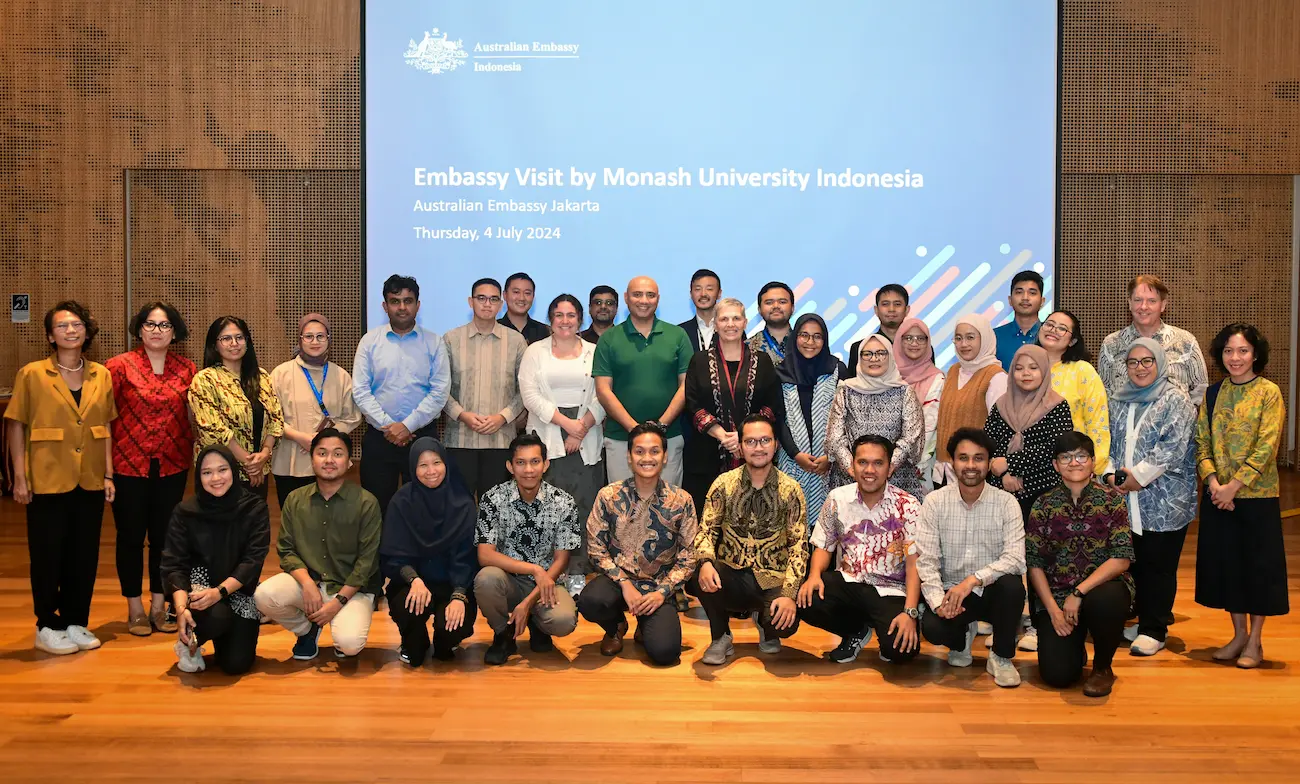
Monash University, Indonesia and Australia students visit Australian Embassy
Students first visited the Australian Embassy in Jakarta. Then, students stopped by the Maritime Museum (Museum Bahari) to work on their group presentation before visiting Kampung Akuarium at North Jakarta. Finally, students went to the Kampung Akuarium housing area and met with the community there.
The Australian ambassador, H.E. Penny Williams, welcomed the students after her team from the Indonesia Australia Partnership for Infrastructure (KIAT) project delivered an insightful presentation and discussion. Students learned of the major bilateral efforts made between Australia and Indonesia to enhance not only Indonesian people’s connectivity but also application of the Gender Equality, Disability and Social Inclusion framework (GEDSI) in infrastructure projects such as the Bus Rapid Transit (BRT) plans in Jakarta and Bali.
Topaz Juanda and his community members of the Kampung Akuarium housing area gave a very warm welcome to students. Topaz led a discussion with students on the history of Kampung Akuarium and his community’s resilience enduring past eviction and COVID-19. From the visit, students learned of the Community Action Plan (CAP) framework and its practice by Kampung Akuarium residents.
5 July 2024 - Solutions for Urban Sustainability
Finally, students get to showcase their learning outcomes by delivering their group presentations to a panel of experts at Monash BSD Campus. The experts were professionals such as Bima Santosa (Senior Economist at Paramadina Public Policy Institute), Roykhan Bawazier (Project Development Specialist at PT. MITJ), and Donatus Edna (Transit-Oriented-Development Concept and Planning Manager at PT. MITJ); as well as academics such as Professor Stephen Cairns and Assistant Professor Alyas Widita from the Master of Urban Design program at Monash University, Indonesia.
The 24 students were divided into 6 groups. Their presentations’ topics go as follow:
- "Urban Mobility in Jakarta: Bus Rapid Transit (BRT) Case,"
- "Community Participation in the Use of Public Transport in Jakarta,"
- "Mitigating Water Supply Challenges in Jakarta: A Comprehensive Action Plan,"
- "Enhancing Jakarta’s Urban Hygiene through Street Food’s Governance,"
- "Jakarta as a Global City: Commitment to Obtaining and Maintaining Global Agenda in GHG Reduction," and
- "Urban Connectivity: Lesson Learned from Citayam Fashion Week."
Concluding the session, several Monash University, Indonesia’s academics from the Master of Urban Design and Master of Sustainability progras debriefed students about ways to move forward for achieving urban sustainability. Assistant Professor Eka Permanasari discussed the implications of Indonesia’s ongoing Capital City of Nusantara (Ibu Kota Nusantara, IKN) on Jakarta’s urban governance. Then, Professor Stephen Cairns demonstrated the usefulness of open data on analysing urban governance. Finally, Professor Alex Lechner elaborated the concept and cases of nature-based solutions for students to think more about the biodiversity of cities such as Jakarta.
Prior to the Field Studies on 30 June 2024, students experienced cultural immersion sessions by visiting Bank Indonesia’s History Museum and Fatahillah Museum at Jakarta’s Old Town district (Kota Tua). Students also visited the Grand Istiqlal, Southeast Asia’s largest mosque, and Jakarta’s Cathedral that sits across Istiqlal, to sense the heterogeneity of Jakarta’s urban population.
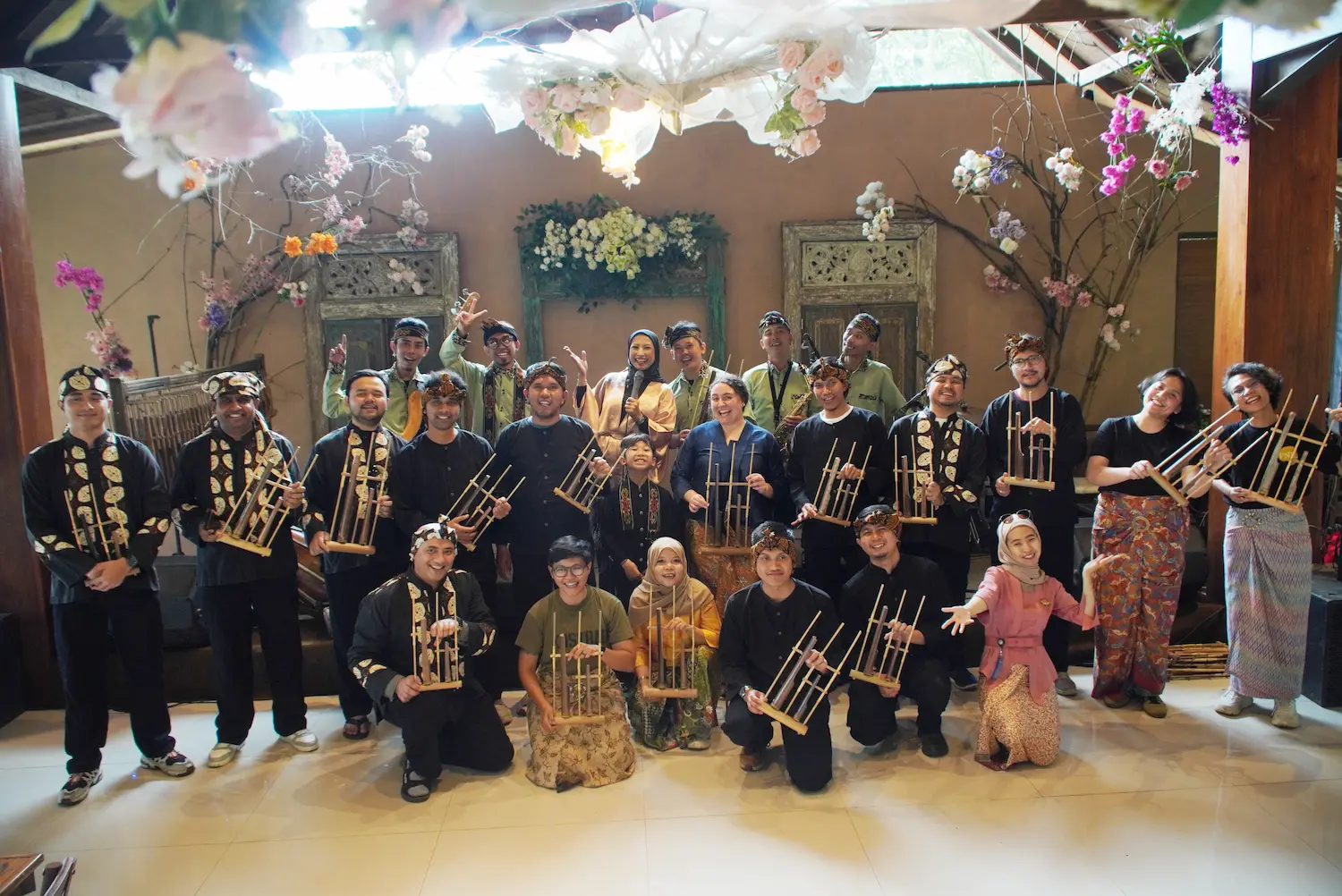
Monash University, Indonesia and Australia students play angklung
The Fields Studies was concluded by a trip to Bandung from 6 to 7 July 2024, in which students experienced another round of cultural immersion sessions at Jakarta’s neighbouring city and Melbourne’s sister city. Students visited the Rengganis Crater, played angklung at Sapu Lidi cultural gallery, and toured around Bandung city’s central district with the bandros (Bandung Tour on Bus). From the Bandung trip, students sense the challenges and opportunities of connecting the two neighbouring cities together (Jakarta and Bandung) and of optimising the sister cities relationship (Melbourne and Bandung).