
Transforming Elderly Healthcare: A Sustainable Approach for the Future
As we strolled around the Royal Botanic Gardens of Melbourne during the Australia Leadership Program (ALP) 2024 by Monash University, Indonesia, we stumbled upon a solitary bench adorned with a silver-plated plaque commemorating a family’s beloved grandparent. This simple yet touching gesture served as a poignant reminder of the importance of caring for our elders as they age. It sparked a reflection on the inevitable passage of time and the need to ensure the well-being of our aging population for a sustainable future. With the theme “Echoes of Tomorrow; Leading with impact for a sustainable society,” ALP 2024 prompted us to delve deeper into the pressing global challenge of elderly healthcare sustainability in alignment with Monash Impact 2030 Global Strategy.
According to the latest United Nations report on World Population Ageing 2020, the global elderly population is projected to double by 2050, exceeding 1.5 billion individuals, with one in six people worldwide aged 65 or older. This demographic shift is more pronounced in developed nations like Japan, Spain, and Hong Kong, as well as in ASEAN countries such as Thailand and Singapore, where aging populations are leading to rising healthcare costs.
The challenges posed by aging populations are multifaceted, encompassing health issues, inequality, discrimination, and policy barriers. Addressing these challenges requires innovative solutions and transformative approaches developed in collaboration with communities locally and globally. Sustainable elderly healthcare has emerged as a critical global concern, necessitating a re-evaluation of our approach to elder care to ensure alignment with the principles of Monash Impact 2030 Global Strategy, emphasizing innovation and collaboration to build thriving communities.
These challenges include cultural sensitivities, policy barriers, and caregiver shortages, impacting the well-being of older individuals worldwide. Innovative solutions such as human-centered design thinking, digital health innovation, and community-centered governance frameworks offer pathways to develop resilient geriatric care models that meet immediate needs while ensuring long-term sustainability and fostering thriving communities. This leads us to ponder: How can we promote healthy aging and create community-focused elder care systems that respect the diversity of ASEAN cultures? Through collaboration and innovation, we aim to address these questions and pave the way for a future where aging is associated with dignity and fulfilment for all.
1. Human-Centered Design for Personalized Elder Care Needs and Care Plan
Human-centered design (HCD) offers an innovative approach to addressing elder care needs, emphasizing collaboration and empathy. Teams like those at The Oregon Health & Science University (OHSU) utilize HCD to brainstorm ideas, rapidly prototype solutions, and refine them to address healthcare challenges, such as digital accessibility. This methodology fosters innovation by leveraging diverse perspectives, breaking down organizational barriers, and enhancing solution quality. OHSU’s Office of Digital Health, established in 2019, has embraced HCD to drive innovation in digital healthcare, ensuring solutions meet the unique needs of all users. This approach facilitates meaningful engagement with stakeholders, contributing to the advancement of digital health initiatives. Figure below are the example of OHSU’s project approach of HCD process.
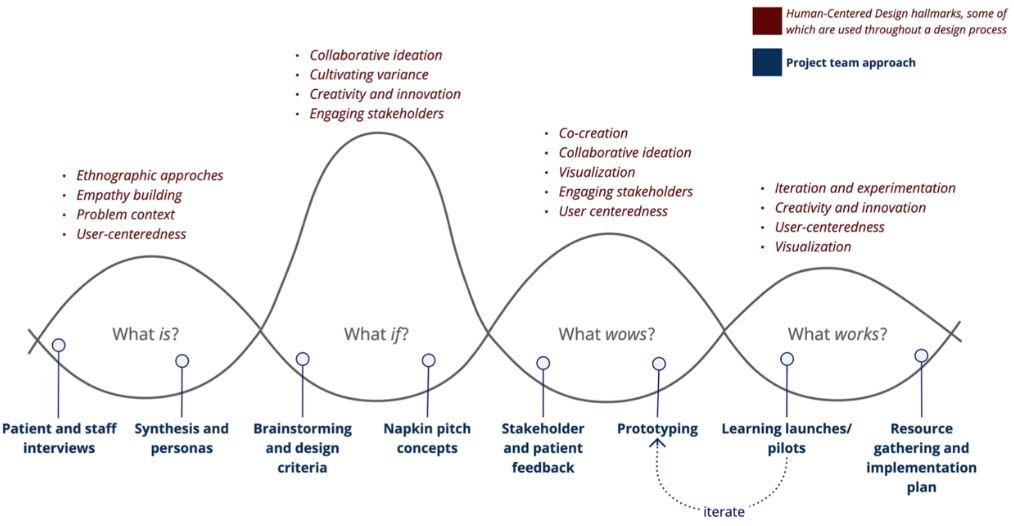
Figure: Four stages of human-centered design process. Adapted from: Liedtka J, King A & Bennett K. "Solving Problems with Design Thinking." Columbia University Press; 2013.
Additionally, adopting centralized systems like Australia's ‘My Aged Care’ portal can bridge the gap in elder care by giving essential information and services related to elder care, streamlining access for both seniors and their caregivers while also facilitating personalized care plans based on individual needs. This initiative aligns with Monash Impact 2030’s goal of building enduring partnerships with industry and government organizations to develop solutions for community betterment.
2. Leveraging Digital Health Technology to Enhance Healthcare Assessment
Incorporating Artificial Intelligence (AI) into elder healthcare presents a promising avenue for enhancing efficiency and precision. AI-driven algorithms can rapidly analyze extensive datasets, facilitating care decisions and ensuring fair resource allocation, aligning with Monash Impact 2030’s goal of leveraging innovation for global challenges. Ethical guidelines from the World Health Organization (WHO) underscore the importance of autonomy, safety, transparency, accountability, equity, and sustainability in AI healthcare applications. AI offers diverse benefits, from reducing human error to providing continuous patient support, exemplified by IBM Watson Assistant AI healthcare chatbots. Despite these advantages, there’s a gap in awareness and utilization of digital tools for geriatric assessment among healthcare workers, necessitating further integration of AI solutions. A cross-sectional study conducted by Department of Internal Medicine, Faculty of Medicine University of Indonesia in Jakarta, revealed healthcare workers’ recognition of ICT’s importance in managing geriatric patients, signaling potential for digital comprehensive geriatric assessment (CGA) to enhance patient care, though implementation challenges persist where a significant portion of subjects had never applied CGA apps to their geriatric patient.
3. Community-Centred Social Governance Framework within Geriatric Care Model Best Practices
Technology alone cannot effectively address the complexities of elder care. A community-centered social governance framework is crucial, ensuring policies align with ASEAN cultural nuances. Active community involvement and policy reform promote inclusivity and fairness in geriatric care delivery, empowering communities to tailor healthcare systems to their needs. This reflects Monash Impact 2030’s emphasis on collaboration with diverse communities to tackle global challenges.
Singapore’s healthcare transformation, driven by demographic shifts, focuses on preventive measures and community-based care under the “Three Beyond” approach. Initiatives include increased funding for preventive measures, action plans for successful aging, and the adoption of value-based healthcare in acute hospitals. Similarly, Australia’s aging population prompts innovative policies like subsidized community-based aged care services, researcher collaboration for National Centre for Healthy Ageing infrastructure facilities and Community Paramedicine (CPN), expanding paramedic roles beyond emergency response to preventive and rehabilitative services. These initiatives reflect a departure from traditional healthcare models, emphasizing professional achievement-based role allocation. Through community engagement and policy innovation, elder care can evolve to meet diverse needs, ensuring a sustainable and inclusive healthcare future.
Lastly, we hope that our recommendations to enhancing elderly healthcare aligns with Monash Impact 2030’s goal of building thriving communities. By addressing aging population challenges through innovation and collaboration, we’re not just improving seniors’ lives but also ensuring a sustainable future. Monash University’s dedication to community enrichment drives us towards a world where aging is dignified and joyful. Together, we navigate the complexities of elder care, envisioning a future filled with vitality. Through collaboration and innovation, we shape a healthcare system that meets today’s needs and paves the way for an inclusive future where everyone can thrive, regardless of age.
Author:
Nadya Azzahra
Master of Public Health Student at Monash University, Indonesia