
Successful Transit-Oriented Development (TOD) Hinges Beyond Concentrating Population Density Around Transit Nodes, Study Shows
Transit-Oriented Development (TOD) is a widely recognized urban planning and design concept that aims to augment transit accessibility and reduce reliance on private vehicles by concentrating development around transit nodes. Originally emerging in the United States, TOD has gained global attention as a strategy for promoting sustainable urban growth, including in the rapidly urbanizing Jakarta metro.
Dr. Alyas Widita, an academic at Monash University, Indonesia specializing in urban analytics and transportation, noted, “Interest in TOD among stakeholders in the Jakarta metro area is definitely palpable, and for good reason. If Indonesia is to fully reap the benefits of urbanization, it is essential to anchor urban development around increased transit usage, and TOD provides a powerful framework for achieving that."
"To maximize TOD's intended benefit in promoting increased transit usage, it is imperative to understand how TOD drives this shift," he emphasized. "However, our understanding of the extent to which different TOD elements influence ridership, and to what extent, remains limited."
In a recently published article in the Public Transport journal, co-authored with academics from Universitas Gadjah Mada, Dr. Widita and his co-authors developed statistical models to tease out the TOD elements most closely linked to ridership at the station level.
"We adopted the 3Ds – Density, Diversity, Design – framework to construct and quantify TOD indicators, such as population density, employment density, land use entropy/mix, and street network connectivity, among other measures," he explained.
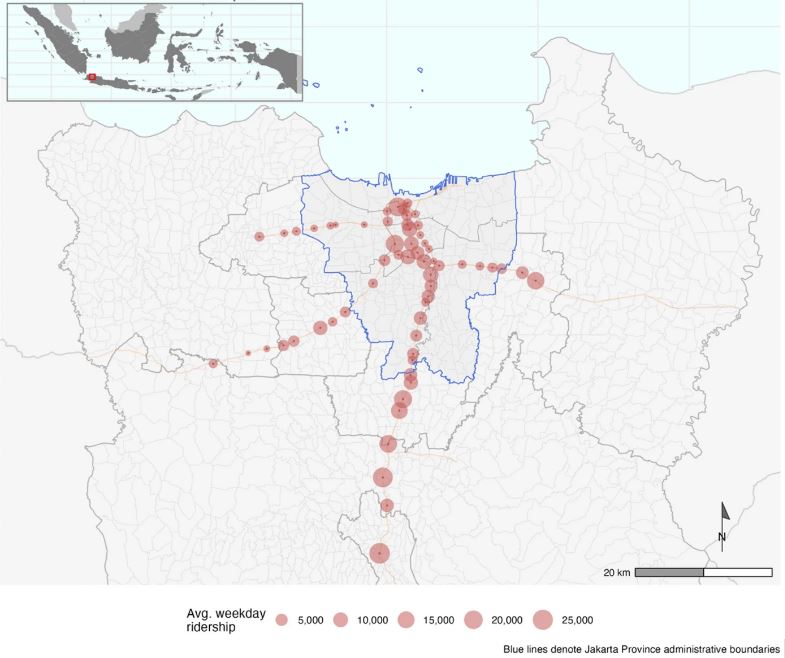 Source: Widita, Ikaputra, Widyastuti (2024)
Our Findings Reveal Some Novel Insights
Contrary to the widely held belief that concentrating population density around stations is the most effective TOD strategy, our findings reveal that employment density and land use mix are actually the most influential TOD elements driving ridership.
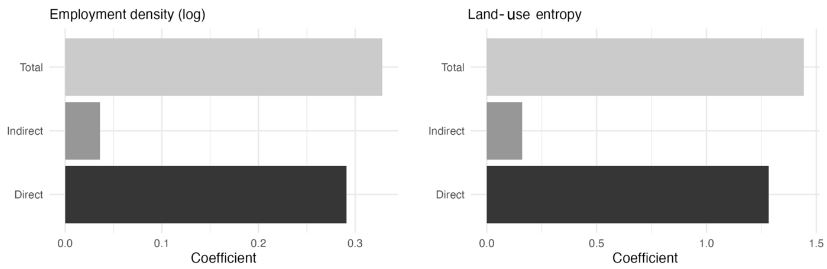
Source: Widita, Ikaputra, Widyastuti (2024)
Providing a practical perspective, the study estimates that adding 1,000 employment opportunities within a TOD station area could lead to approximately 300 additional weekday riders.
"Modifying land use and designing places to accommodate more employment opportunities around transit nodes is a strategy that urban designers, planners, transit agencies and other TOD stakeholders may consider," noted Dr. Widita.
Dr. Widita and his co-authors emphasized the adaptability of their framework and its potential application across other Indonesian cities exploring TOD. "Emerging urban analytics can equip cities and stakeholders with the insights needed for informed TOD planning, paving the way for more sustainable cities and thriving communities," he added.
Read the full paper published in the Public Transport journal, TOD-related features and station-level ridership: insights from the Jakarta Metropolitan Area, Indonesia.