
Our work

The urgency to address climate change has never been greater, and politicians hold a pivotal position in communicating impactful, evidence-based narratives to a diverse population.
The primary objective of this book titled "Navigating Climate Change Issues in the 2024 Election: A Communication Guide for Politicians" is to assist politicians in securing a higher percentage of votes during the upcoming 2024 election by providing climate change narrative with up-to-date scientific information and effectively countering any disinformation pertaining to climate change.
The phenomenon of climate change exerts a substantial influence on political conduct, while the occurrence of misunderstanding might wield the power to affect public perception and subsequently impact future policy decisions.
The book provides an overview of current scientific research on climate change, such as the increasing sea levels in Indonesia and earth's global temperature in June-August 2023 is the hottest summer in the last 174 years.
The book also underscores the significance of engaging in collaborative efforts with stakeholders, including the media, when advocating for climate change matters. Additionally, the paper examines the most effective methods for effectively communicating climate change concerns to a diverse electorate
(ranging from voters with strong religious beliefs to housewives), as well as presenting case studies of political campaigns that have achieved success in this regard.
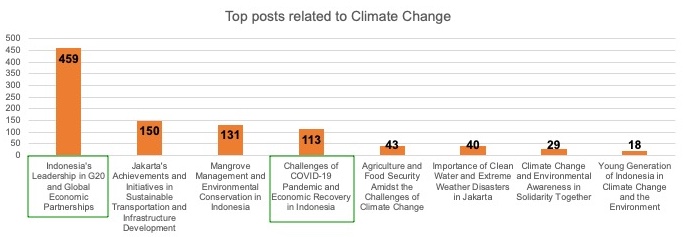
This study analyses climate change discussions on Indonesian politicians' Facebook posts using text mining to identify their focus and agendas. The study examines 157 politicians' Facebook posts from the past three years, including ministers, members of the House of Representatives, governors, and leaders of political parties. Using 40 predetermined keywords relevant to climate change issues in Indonesia, we collected and analysed 983 climate change-related posts using CrowdTangle, a social monitoring platform owned by Meta.
The study uncovers eight dominant topics that exist across groups of politicians. The dominant topics include economic partnership, transportation, environment, economic recovery, food security, clean water, environmental awareness, and the young generation. However, the main agenda on climate change was elite agendas such as the G20, COP26, and Net Zero Emission initiatives. Most politicians talked about government programs, global events, and partnerships, while the grassroots voters may not understand that things that happen in their daily lives are in fact the impact of climate change.
Analysing the Visions of Presidential Candidates for Indonesia:
A Comprehensive Examination
In light of the Indonesian election outcomes, MCCCRH Indonesia Node has reexamined the vision and mission of the presidential contenders, with particular emphasis on their perspectives concerning climate change and environmental matters.
Climate Direct aims to equip journalists with the tools and resources to effectively communicate climate science and solutions. In countries like Indonesia and Malaysia where climate impacts such as floods are severe, journalists can play a key role in increasing climate literacy and action through science-informed, accessible reporting.
The Resource Bank offers culturally relevant, accessible materials to enhance the quality of climate storytelling across Malaysia, Indonesia and around the world.

This resource bank was developed as part of the following project: Building capacity through co-production in Indonesia and Malaysia to address the climate change communication gap between scientific and lay audiences through journalists. The project is supported by the Asia-Pacific Network for Global Change Research (APN-GCR). Funder ID: https://doi.org/10.30852/p.25886.