Urban-Rural Mosaic
Urban-Rural Mosaic
Across Indonesia and Southeast Asia — and in our home province, Banten — rapid urbanisation is redrawing the relationship between cities, towns, villages, and the natural environments around them. Areas near major metropolitan centres often expect to share in their prosperity, but many instead sit in their shadow, facing economic polarisation, uneven healthcare access, environmental strain, and planning systems that struggle to keep pace. Urban-Rural Mosaic exists to understand these dynamics and design actionable, place-sensitive models for more balanced, resilient urbanisation.
Urban-Rural Mosaic is a research hub within Monash University's Urban Transformation Network (UTN).
Mission
To design credible, actionable models for sustainable urban-rural growth across Indonesia and Southeast Asia — grounded in Banten, and built to travel beyond it — empowering communities and inspiring the world.
Context: Proximity without prosperity
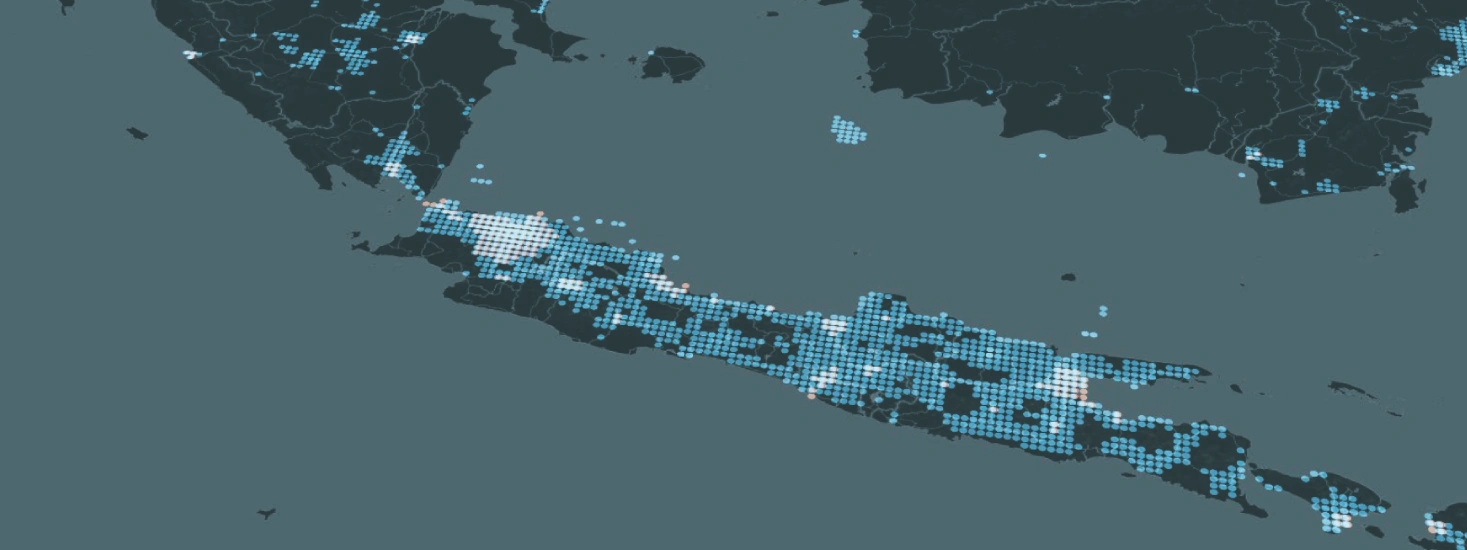
Our local case study is Banten, a rapidly urbanising province in Java neighbouring Jakarta. Despite its strategic location, Banten remains largely in Jakarta's economic shadow — its wealthiest areas generate over 30 times the GDP per capita of its poorest, driving sharp disparities in health, education, and opportunity. Similar patterns of proximity without prosperity recur across Southeast Asia.
Challenges: Urban growth pressures
- Habitat — sprawl and environmental strain, from deforestation to seismic risk.
- Health — unequal access to care and a rising communicable and non-communicable disease burden.
- Prosperity — some areas thrive while others lack jobs, services, and resources.
- Cultural heritage — accelerated urbanisation endangers sites and living traditions such as Banten's Baduy culture.
- Planning capacity — cross-sector integration and modern tools are needed to keep pace with growth.
Approach: A mosaic of interconnections
Our approach is place-sensitive and system-wise. We start with the particularities of Banten's own territory, then look beyond individual sites and sectors to the connections between them — treating cities, towns, regions, and ecologies as interdependent, rather than focusing solely on cities. Five principles guide the hub: a compact polycentric network of cities, towns, and villages; healthy and resilient environments; mixed-use economies; nature-based solutions; and smart, secure governance.
Underpinning this is our Data Commons — the best available data on Banten, hosted by Monash Indonesia, connecting local government, developers, and NGOs with international partners.
The Model: From Banten to the world
Many regions near major cities across Southeast Asia face challenges like Banten's. Drawing on comparative research and the Data Commons, Urban-Rural Mosaic aims to inform sustainable urbanisation policy wherever proximity to a metropolitan centre has not translated into shared prosperity.
Research actions
A suite of fixed-term projects feeding into 20-year goals, each complementing the next — indicative for now, and evolving as the hub grows.
- Healthy homes — Piloting walkable districts in Banten built around healthy housing, green space, and integrated health services, to combat NCDs and lift wellbeing.
- Mixed-use neighbourhoods — Testing compact, decentralised neighbourhoods in Banten that combine housing with micro-enterprise, digital manufacturing, and local food and energy production.
- Networked townships — Linking Banten's towns through a polycentric, 15-minute-town transit network focused on electric and active mobility.
- Circular food regions — Connecting Banten's farms, smallholdings, and coastal waters through agropolitan and minapolitan strategies for food security and ecological resilience.
- ZIP innovation corridor — Reactivating the disused Rangkasbitung–Labuan rail line in West Banten — a government-designated Proyek Strategis Nasional (PSN) — as a heritage-led corridor for renewable energy, eco-cultural tourism, and resilient regional growth.
Hub members
- Professor Stephen Cairns — Urbanisation & Cities; Agro-Mina-Politan
- Professor Taufiq Asyhari — Data Science & AI; Remote Sensing
- Associate Professor Amitangshu Acharya — Sustainability; Water & Society
- Associate Professor Ade Tinamei — Urbanisation & Cities
- Assistant Professor Gabriela Fernando — Public Health; Social Equity
- Assistant Professor Aichiro Suryo Prabowo — Public Policy; Finance & Budgets
- Assistant Professor Sabina Puspita — Public Policy; Gender Politics
- Assistant Professor Perdana Roswaldy — Sustainability; Forestry & Land Use
- Assistant Professor Alyas Widita — Urbanisation & Cities; Transport & Mobility (Convenor)
- Haidar El Haq — Research Associate
Invitation to collaborate
Urban-Rural Mosaic is a model for sustainable, actionable growth across Indonesia and Southeast Asia, grounded in Banten. We invite stakeholders to join us. For enquiries, contact alyas.widita@monash.edu.